

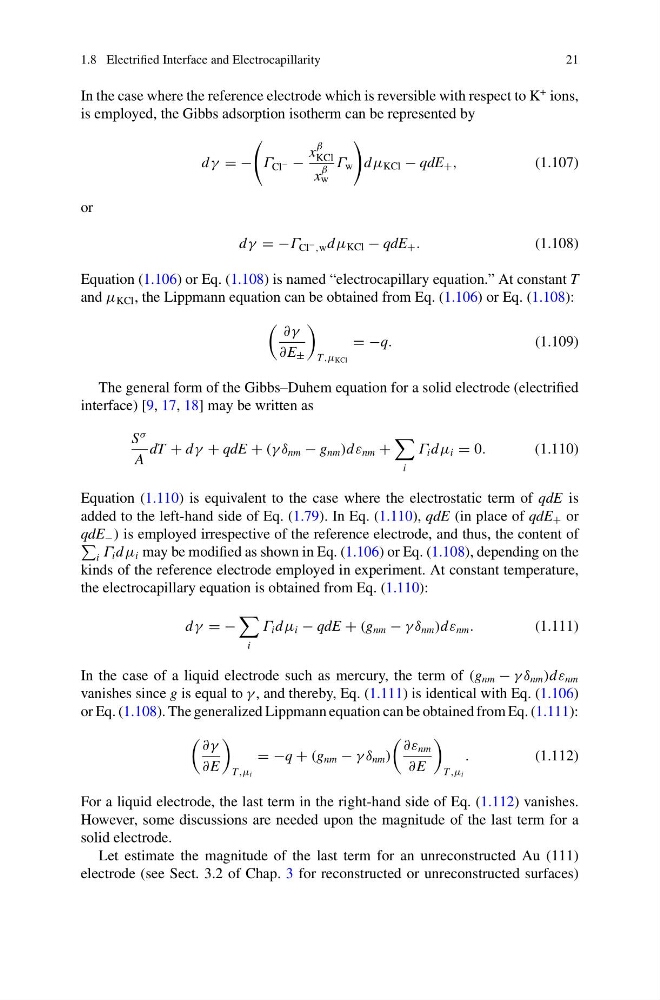
1.8 Electrified Interface and Electrocapillarity
21
In the case where the reference electrode which is reversible with respect to K
+ ions,
is employed, the Gibbs adsorption isotherm can be represented by
d γ = −
Γ Cl
− −
x
β
KCl
x
β
w
Γ w
d μ KCl − qdE + ,
(1.107)
or
d γ = −Γ Cl
− ,w d μ KCl − qdE + .
(1.108)
Equation (1.106) or Eq. (1.108) is named “electrocapillary equation.” At constant T
and μ KCl , the Lippmann equation can be obtained from Eq. (1.106) or Eq. (1.108):
∂γ
∂E ±
T ,μ KCl
= −q.
(1.109)
The general form of the Gibbs–Duhem equation for a solid electrode (electrified
interface) [9, 17, 18] may be written as
S
σ
A
dT + d γ + qdE + (γ δ nm − g nm )d ε nm +
i
Γ i d μ i = 0.
(1.110)
Equation (1.110) is equivalent to the case where the electrostatic term of qdE is
added to the left-hand side of Eq. (1.79). In Eq. (1.110), qdE (in place of qdE + or
qdE − ) is employed irrespective of the reference electrode, and thus, the content of
i Γ i d μ i may be modified as shown in Eq. (1.106) or Eq. (1.108), depending on the
kinds of the reference electrode employed in experiment. At constant temperature,
the electrocapillary equation is obtained from Eq. (1.110):
d γ = −
i
Γ i d μ i − qdE + (g nm − γ δ nm )d ε nm .
(1.111)
In the case of a liquid electrode such as mercury, the term of (g nm − γ δ nm )d ε nm
vanishes since g is equal to γ , and thereby, Eq. (1.111) is identical with Eq. (1.106)
or Eq. (1.108). The generalized Lippmann equation can be obtained from Eq. (1.111):
∂γ
∂E
T ,μ i
= −q + (g nm − γ δ nm )
∂ε nm
∂E
T ,μ i
.
(1.112)
For a liquid electrode, the last term in the right-hand side of Eq. (1.112) vanishes.
However, some discussions are needed upon the magnitude of the last term for a
solid electrode.
Let estimate the magnitude of the last term for an unreconstructed Au (111)
electrode (see Sect. 3.2 of Chap. 3 for reconstructed or unreconstructed surfaces)
21
In the case where the reference electrode which is reversible with respect to K
+ ions,
is employed, the Gibbs adsorption isotherm can be represented by
d γ = −
Γ Cl
− −
x
β
KCl
x
β
w
Γ w
d μ KCl − qdE + ,
(1.107)
or
d γ = −Γ Cl
− ,w d μ KCl − qdE + .
(1.108)
Equation (1.106) or Eq. (1.108) is named “electrocapillary equation.” At constant T
and μ KCl , the Lippmann equation can be obtained from Eq. (1.106) or Eq. (1.108):
∂γ
∂E ±
T ,μ KCl
= −q.
(1.109)
The general form of the Gibbs–Duhem equation for a solid electrode (electrified
interface) [9, 17, 18] may be written as
S
σ
A
dT + d γ + qdE + (γ δ nm − g nm )d ε nm +
i
Γ i d μ i = 0.
(1.110)
Equation (1.110) is equivalent to the case where the electrostatic term of qdE is
added to the left-hand side of Eq. (1.79). In Eq. (1.110), qdE (in place of qdE + or
qdE − ) is employed irrespective of the reference electrode, and thus, the content of
i Γ i d μ i may be modified as shown in Eq. (1.106) or Eq. (1.108), depending on the
kinds of the reference electrode employed in experiment. At constant temperature,
the electrocapillary equation is obtained from Eq. (1.110):
d γ = −
i
Γ i d μ i − qdE + (g nm − γ δ nm )d ε nm .
(1.111)
In the case of a liquid electrode such as mercury, the term of (g nm − γ δ nm )d ε nm
vanishes since g is equal to γ , and thereby, Eq. (1.111) is identical with Eq. (1.106)
or Eq. (1.108). The generalized Lippmann equation can be obtained from Eq. (1.111):
∂γ
∂E
T ,μ i
= −q + (g nm − γ δ nm )
∂ε nm
∂E
T ,μ i
.
(1.112)
For a liquid electrode, the last term in the right-hand side of Eq. (1.112) vanishes.
However, some discussions are needed upon the magnitude of the last term for a
solid electrode.
Let estimate the magnitude of the last term for an unreconstructed Au (111)
electrode (see Sect. 3.2 of Chap. 3 for reconstructed or unreconstructed surfaces)