

7.3 Nano-Mechanical Properties of Solid Surfaces Obtained by Nano- …
201
Contact profile
Contact profile
Pile-up
Pile-up
Sink-in
Sink-in
(a)
(b)
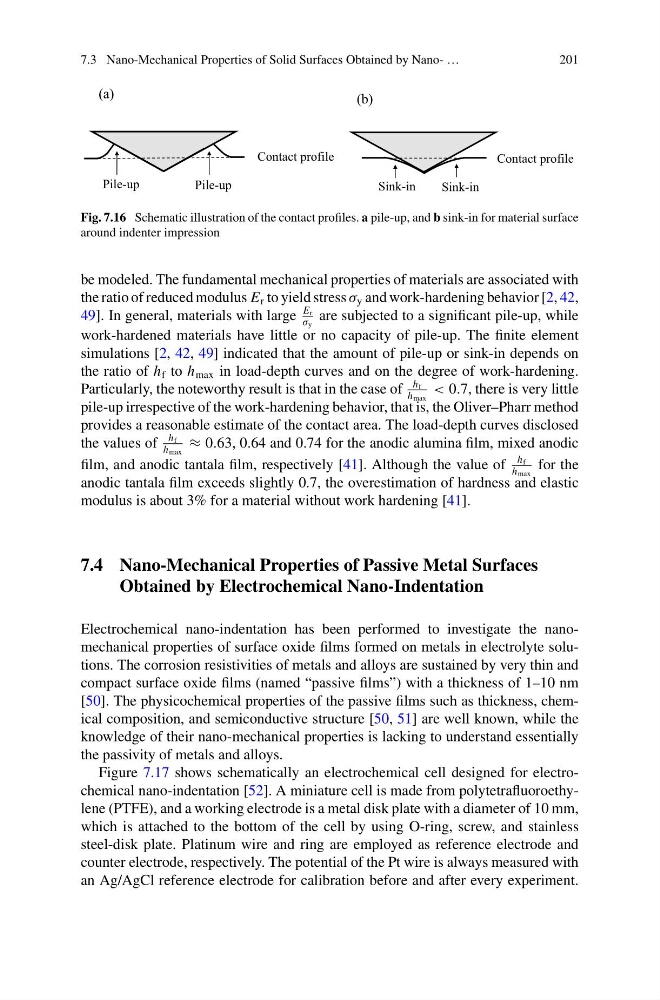
Fig. 7.16 Schematic illustration of the contact profiles. a pile-up, and b sink-in for material surface
around indenter impression
be modeled. The fundamental mechanical properties of materials are associated with
the ratio of reduced modulus E r to yield stress σ y and work-hardening behavior [2, 42,
49]. In general, materials with large
E r
σ y
are subjected to a significant pile-up, while
work-hardened materials have little or no capacity of pile-up. The finite element
simulations [2, 42, 49] indicated that the amount of pile-up or sink-in depends on
the ratio of h f to h max in load-depth curves and on the degree of work-hardening.
Particularly, the noteworthy result is that in the case of
h f
h max
< 0.7, there is very little
pile-up irrespective of the work-hardening behavior, that is, the Oliver–Pharr method
provides a reasonable estimate of the contact area. The load-depth curves disclosed
the values of
h f
h max
≈ 0.63, 0.64 and 0.74 for the anodic alumina film, mixed anodic
film, and anodic tantala film, respectively [41]. Although the value of
h f
h max
for the
anodic tantala film exceeds slightly 0.7, the overestimation of hardness and elastic
modulus is about 3% for a material without work hardening [41].
7.4 Nano-Mechanical Properties of Passive Metal Surfaces
Obtained by Electrochemical Nano-Indentation
Electrochemical nano-indentation has been performed to investigate the nanomechanical properties of surface oxide films formed on metals in electrolyte solutions. The corrosion resistivities of metals and alloys are sustained by very thin and
compact surface oxide films (named “passive films”) with a thickness of 1–10 nm
[50]. The physicochemical properties of the passive films such as thickness, chemical composition, and semiconductive structure [50, 51] are well known, while the
knowledge of their nano-mechanical properties is lacking to understand essentially
the passivity of metals and alloys.
Figure 7.17 shows schematically an electrochemical cell designed for electrochemical nano-indentation [52]. A miniature cell is made from polytetrafluoroethylene (PTFE), and a working electrode is a metal disk plate with a diameter of 10 mm,
which is attached to the bottom of the cell by using O-ring, screw, and stainless
steel-disk plate. Platinum wire and ring are employed as reference electrode and
counter electrode, respectively. The potential of the Pt wire is always measured with
an Ag/AgCl reference electrode for calibration before and after every experiment.
201
Contact profile
Contact profile
Pile-up
Pile-up
Sink-in
Sink-in
(a)
(b)
Fig. 7.16 Schematic illustration of the contact profiles. a pile-up, and b sink-in for material surface
around indenter impression
be modeled. The fundamental mechanical properties of materials are associated with
the ratio of reduced modulus E r to yield stress σ y and work-hardening behavior [2, 42,
49]. In general, materials with large
E r
σ y
are subjected to a significant pile-up, while
work-hardened materials have little or no capacity of pile-up. The finite element
simulations [2, 42, 49] indicated that the amount of pile-up or sink-in depends on
the ratio of h f to h max in load-depth curves and on the degree of work-hardening.
Particularly, the noteworthy result is that in the case of
h f
h max
< 0.7, there is very little
pile-up irrespective of the work-hardening behavior, that is, the Oliver–Pharr method
provides a reasonable estimate of the contact area. The load-depth curves disclosed
the values of
h f
h max
≈ 0.63, 0.64 and 0.74 for the anodic alumina film, mixed anodic
film, and anodic tantala film, respectively [41]. Although the value of
h f
h max
for the
anodic tantala film exceeds slightly 0.7, the overestimation of hardness and elastic
modulus is about 3% for a material without work hardening [41].
7.4 Nano-Mechanical Properties of Passive Metal Surfaces
Obtained by Electrochemical Nano-Indentation
Electrochemical nano-indentation has been performed to investigate the nanomechanical properties of surface oxide films formed on metals in electrolyte solutions. The corrosion resistivities of metals and alloys are sustained by very thin and
compact surface oxide films (named “passive films”) with a thickness of 1–10 nm
[50]. The physicochemical properties of the passive films such as thickness, chemical composition, and semiconductive structure [50, 51] are well known, while the
knowledge of their nano-mechanical properties is lacking to understand essentially
the passivity of metals and alloys.
Figure 7.17 shows schematically an electrochemical cell designed for electrochemical nano-indentation [52]. A miniature cell is made from polytetrafluoroethylene (PTFE), and a working electrode is a metal disk plate with a diameter of 10 mm,
which is attached to the bottom of the cell by using O-ring, screw, and stainless
steel-disk plate. Platinum wire and ring are employed as reference electrode and
counter electrode, respectively. The potential of the Pt wire is always measured with
an Ag/AgCl reference electrode for calibration before and after every experiment.