

196
7 Nano-Mechanical Properties of Solid Surfaces Obtained …
tan θ =
h
a
=
b
s
,
(7.19)
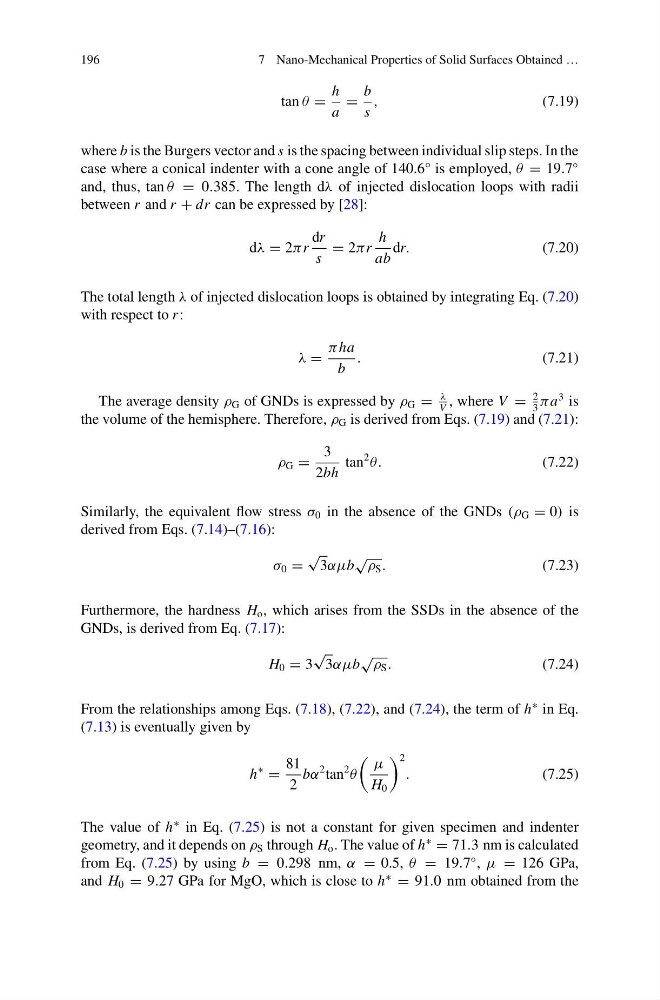
where b is the Burgers vector and s is the spacing between individual slip steps. In the
case where a conical indenter with a cone angle of 140.6° is employed, θ = 19.7
◦
and, thus, tan θ = 0.385. The length dλ of injected dislocation loops with radii
between r and r + dr can be expressed by [28]:
dλ = 2πr
dr
s
= 2πr
h
ab
dr.
(7.20)
The total length λ of injected dislocation loops is obtained by integrating Eq. (7.20)
with respect to r :
λ =
π ha
b
.
(7.21)
The average density ρ G of GNDs is expressed by ρ G =
λ
V
, where V =
2
3
πa
3 is
the volume of the hemisphere. Therefore, ρ G is derived from Eqs. (7.19) and (7.21):
ρ G =
3
2bh
tan
2
θ.
(7.22)
Similarly, the equivalent flow stress σ 0 in the absence of the GNDs (ρ G = 0) is
derived from Eqs. (7.14)–(7.16):
σ 0 =
√
3αμb
√ ρ S .
(7.23)
Furthermore, the hardness H o , which arises from the SSDs in the absence of the
GNDs, is derived from Eq. (7.17):
H 0 = 3
√
3αμb
√ ρ S .
(7.24)
From the relationships among Eqs. (7.18), (7.22), and (7.24), the term of h
∗ in Eq.
(7.13) is eventually given by
h
∗
=
81
2
bα
2 tan
2
θ
μ
H 0
2
.
(7.25)
The value of h
∗ in Eq. (7.25) is not a constant for given specimen and indenter
geometry, and it depends on ρ S through H o . The value of h
∗
= 71.3 nm is calculated
from Eq. (7.25) by using b = 0.298 nm, α = 0.5, θ = 19.7
◦ , μ = 126 GPa,
and H 0 = 9.27 GPa for MgO, which is close to h
∗
= 91.0 nm obtained from the
7 Nano-Mechanical Properties of Solid Surfaces Obtained …
tan θ =
h
a
=
b
s
,
(7.19)
where b is the Burgers vector and s is the spacing between individual slip steps. In the
case where a conical indenter with a cone angle of 140.6° is employed, θ = 19.7
◦
and, thus, tan θ = 0.385. The length dλ of injected dislocation loops with radii
between r and r + dr can be expressed by [28]:
dλ = 2πr
dr
s
= 2πr
h
ab
dr.
(7.20)
The total length λ of injected dislocation loops is obtained by integrating Eq. (7.20)
with respect to r :
λ =
π ha
b
.
(7.21)
The average density ρ G of GNDs is expressed by ρ G =
λ
V
, where V =
2
3
πa
3 is
the volume of the hemisphere. Therefore, ρ G is derived from Eqs. (7.19) and (7.21):
ρ G =
3
2bh
tan
2
θ.
(7.22)
Similarly, the equivalent flow stress σ 0 in the absence of the GNDs (ρ G = 0) is
derived from Eqs. (7.14)–(7.16):
σ 0 =
√
3αμb
√ ρ S .
(7.23)
Furthermore, the hardness H o , which arises from the SSDs in the absence of the
GNDs, is derived from Eq. (7.17):
H 0 = 3
√
3αμb
√ ρ S .
(7.24)
From the relationships among Eqs. (7.18), (7.22), and (7.24), the term of h
∗ in Eq.
(7.13) is eventually given by
h
∗
=
81
2
bα
2 tan
2
θ
μ
H 0
2
.
(7.25)
The value of h
∗ in Eq. (7.25) is not a constant for given specimen and indenter
geometry, and it depends on ρ S through H o . The value of h
∗
= 71.3 nm is calculated
from Eq. (7.25) by using b = 0.298 nm, α = 0.5, θ = 19.7
◦ , μ = 126 GPa,
and H 0 = 9.27 GPa for MgO, which is close to h
∗
= 91.0 nm obtained from the