

7.2 Fundamentals of Nano-Indentation
187
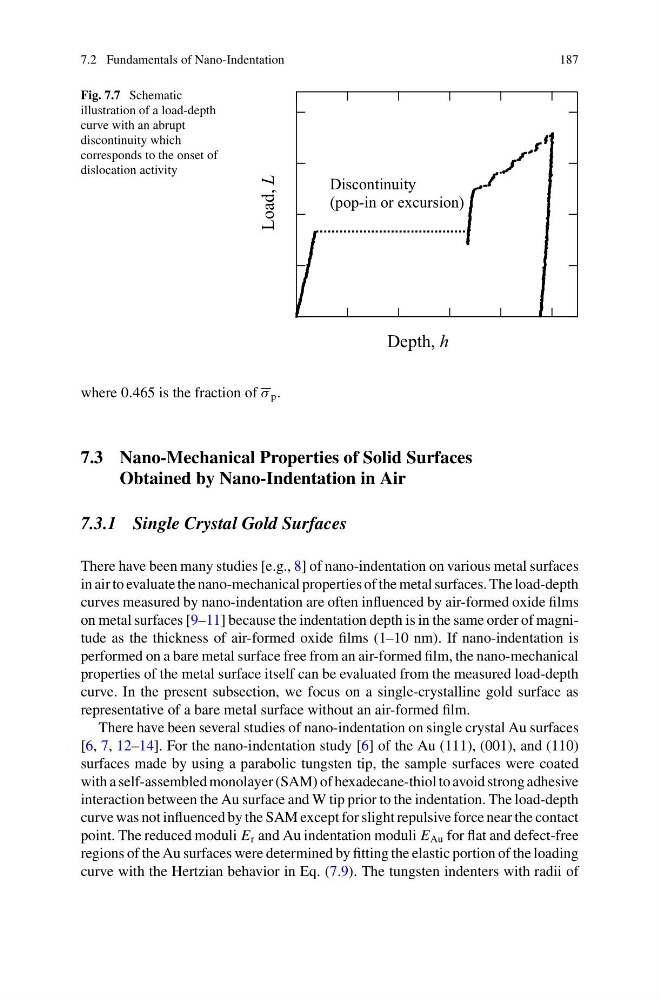
Fig. 7.7 Schematic
illustration of a load-depth
curve with an abrupt
discontinuity which
corresponds to the onset of
dislocation activity
Load,
L
Depth, h
Discontinuity
(pop-in or excursion)
where 0.465 is the fraction of σ p .
7.3 Nano-Mechanical Properties of Solid Surfaces
Obtained by Nano-Indentation in Air
7.3.1 Single Crystal Gold Surfaces
There have been many studies [e.g., 8] of nano-indentation on various metal surfaces
in air to evaluate the nano-mechanical properties of the metal surfaces. The load-depth
curves measured by nano-indentation are often influenced by air-formed oxide films
on metal surfaces [9–11] because the indentation depth is in the same order of magnitude as the thickness of air-formed oxide films (1–10 nm). If nano-indentation is
performed on a bare metal surface free from an air-formed film, the nano-mechanical
properties of the metal surface itself can be evaluated from the measured load-depth
curve. In the present subsection, we focus on a single-crystalline gold surface as
representative of a bare metal surface without an air-formed film.
There have been several studies of nano-indentation on single crystal Au surfaces
[6, 7, 12–14]. For the nano-indentation study [6] of the Au (111), (001), and (110)
surfaces made by using a parabolic tungsten tip, the sample surfaces were coated
with a self-assembled monolayer (SAM) of hexadecane-thiol to avoid strong adhesive
interaction between the Au surface and W tip prior to the indentation. The load-depth
curve was not influenced by the SAM except for slight repulsive force near the contact
point. The reduced moduli E r and Au indentation moduli E Au for flat and defect-free
regions of the Au surfaces were determined by fitting the elastic portion of the loading
curve with the Hertzian behavior in Eq. (7.9). The tungsten indenters with radii of
187
Fig. 7.7 Schematic
illustration of a load-depth
curve with an abrupt
discontinuity which
corresponds to the onset of
dislocation activity
Load,
L
Depth, h
Discontinuity
(pop-in or excursion)
where 0.465 is the fraction of σ p .
7.3 Nano-Mechanical Properties of Solid Surfaces
Obtained by Nano-Indentation in Air
7.3.1 Single Crystal Gold Surfaces
There have been many studies [e.g., 8] of nano-indentation on various metal surfaces
in air to evaluate the nano-mechanical properties of the metal surfaces. The load-depth
curves measured by nano-indentation are often influenced by air-formed oxide films
on metal surfaces [9–11] because the indentation depth is in the same order of magnitude as the thickness of air-formed oxide films (1–10 nm). If nano-indentation is
performed on a bare metal surface free from an air-formed film, the nano-mechanical
properties of the metal surface itself can be evaluated from the measured load-depth
curve. In the present subsection, we focus on a single-crystalline gold surface as
representative of a bare metal surface without an air-formed film.
There have been several studies of nano-indentation on single crystal Au surfaces
[6, 7, 12–14]. For the nano-indentation study [6] of the Au (111), (001), and (110)
surfaces made by using a parabolic tungsten tip, the sample surfaces were coated
with a self-assembled monolayer (SAM) of hexadecane-thiol to avoid strong adhesive
interaction between the Au surface and W tip prior to the indentation. The load-depth
curve was not influenced by the SAM except for slight repulsive force near the contact
point. The reduced moduli E r and Au indentation moduli E Au for flat and defect-free
regions of the Au surfaces were determined by fitting the elastic portion of the loading
curve with the Hertzian behavior in Eq. (7.9). The tungsten indenters with radii of