

6.8 Cathodic Polarization of Anodic Oxide Film
171
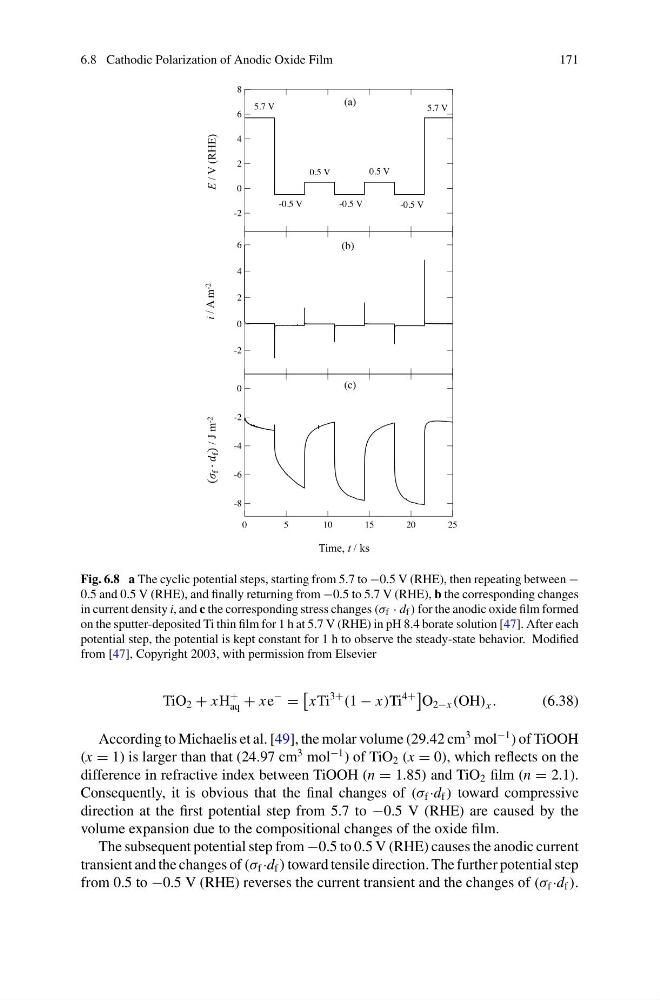
Fig. 6.8 a The cyclic potential steps, starting from 5.7 to −0.5 V (RHE), then repeating between −
0.5 and 0.5 V (RHE), and finally returning from −0.5 to 5.7 V (RHE), b the corresponding changes
in current density i, and c the corresponding stress changes (σ f · d f ) for the anodic oxide film formed
on the sputter-deposited Ti thin film for 1 h at 5.7 V (RHE) in pH 8.4 borate solution [47]. After each
potential step, the potential is kept constant for 1 h to observe the steady-state behavior. Modified
from [47], Copyright 2003, with permission from Elsevier
TiO 2 + xH
+
aq + xe
−
=
xTi
3+
(1 − x)Ti
4+
O 2−x (OH) x .
(6.38)
According to Michaelis et al. [49], the molar volume (29.42 cm
3 mol
−1 ) of TiOOH
(x = 1) is larger than that (24.97 cm
3 mol
−1 ) of TiO 2 (x = 0), which reflects on the
difference in refractive index between TiOOH (n = 1.85) and TiO 2 film (n = 2.1).
Consequently, it is obvious that the final changes of (σ f ·d f ) toward compressive
direction at the first potential step from 5.7 to −0.5 V (RHE) are caused by the
volume expansion due to the compositional changes of the oxide film.
The subsequent potential step from −0.5 to 0.5 V (RHE) causes the anodic current
transient and the changes of (σ f ·d f ) toward tensile direction. The further potential step
from 0.5 to −0.5 V (RHE) reverses the current transient and the changes of (σ f ·d f ).
171
Fig. 6.8 a The cyclic potential steps, starting from 5.7 to −0.5 V (RHE), then repeating between −
0.5 and 0.5 V (RHE), and finally returning from −0.5 to 5.7 V (RHE), b the corresponding changes
in current density i, and c the corresponding stress changes (σ f · d f ) for the anodic oxide film formed
on the sputter-deposited Ti thin film for 1 h at 5.7 V (RHE) in pH 8.4 borate solution [47]. After each
potential step, the potential is kept constant for 1 h to observe the steady-state behavior. Modified
from [47], Copyright 2003, with permission from Elsevier
TiO 2 + xH
+
aq + xe
−
=
xTi
3+
(1 − x)Ti
4+
O 2−x (OH) x .
(6.38)
According to Michaelis et al. [49], the molar volume (29.42 cm
3 mol
−1 ) of TiOOH
(x = 1) is larger than that (24.97 cm
3 mol
−1 ) of TiO 2 (x = 0), which reflects on the
difference in refractive index between TiOOH (n = 1.85) and TiO 2 film (n = 2.1).
Consequently, it is obvious that the final changes of (σ f ·d f ) toward compressive
direction at the first potential step from 5.7 to −0.5 V (RHE) are caused by the
volume expansion due to the compositional changes of the oxide film.
The subsequent potential step from −0.5 to 0.5 V (RHE) causes the anodic current
transient and the changes of (σ f ·d f ) toward tensile direction. The further potential step
from 0.5 to −0.5 V (RHE) reverses the current transient and the changes of (σ f ·d f ).