

164
6 Stresses of Anodic Oxide Films Grown on Metal Electrode
Crystallization and Oxygen Evolution
At the stage (II) in Fig. 6.5, the slope of the V vs. t curve decreases progressively
and then reaches a steady-state value, accompanying the rapid change of κ toward
negative direction corresponding to the development of large compressive stress. The
decrease in slope of the V vs. t curve may come from the decrease in current efficiency
of the film growth due to oxygen evolution associated with the crystallization of the
anodic oxide film [27]. The crystallization provides the increase in density of the
anodic oxide film that tends to induce the film stress toward tensile direction due
to the volume contraction of the film. In the transition from amorphous to anatase
type of TiO 2 film, the volume contraction of 5 cm
3 mol
−1 is estimated from the
difference in density between amorphous (ρ ox = 3.1 g cm
−3
) [31] and anatase type
(ρ ox = 3.84 g cm
−3
) [10] of TiO 2 film. Consequently, the observed large compressive
stress is contradictory to the tensile stress predicted from the volume contraction due
to the crystallization of the anodic oxide film.
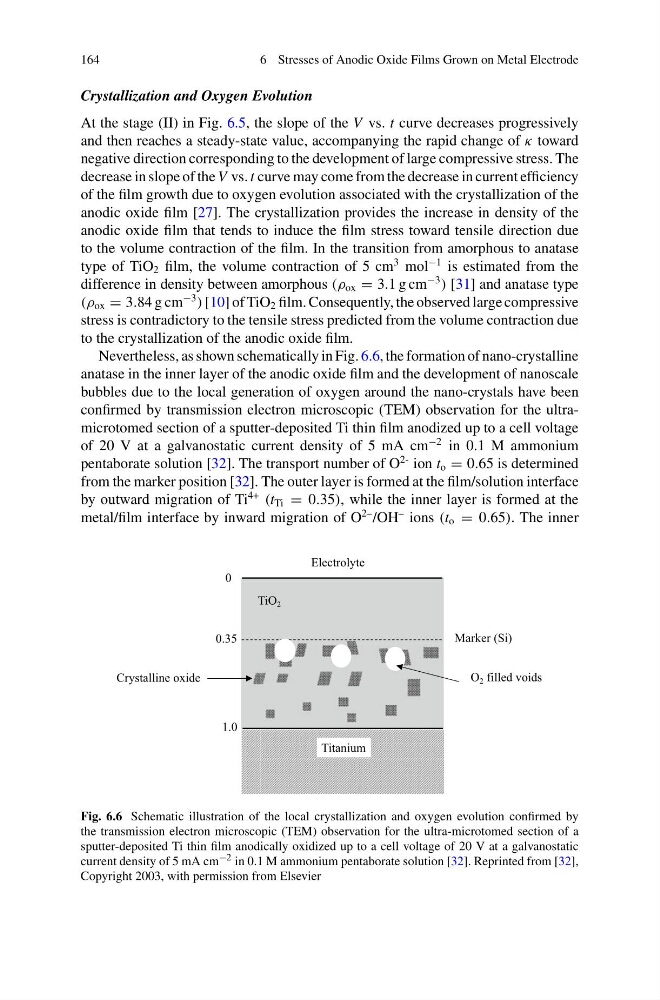
Nevertheless, as shown schematically in Fig. 6.6, the formation of nano-crystalline
anatase in the inner layer of the anodic oxide film and the development of nanoscale
bubbles due to the local generation of oxygen around the nano-crystals have been
confirmed by transmission electron microscopic (TEM) observation for the ultramicrotomed section of a sputter-deposited Ti thin film anodized up to a cell voltage
of 20 V at a galvanostatic current density of 5 mA cm
−2 in 0.1 M ammonium
pentaborate solution [32]. The transport number of O
2- ion t o = 0.65 is determined
from the marker position [32]. The outer layer is formed at the film/solution interface
by outward migration of Ti
4+
(t Ti = 0.35), while the inner layer is formed at the
metal/film interface by inward migration of O
2– /OH
– ions (t o = 0.65). The inner
Electrolyte
TiO 2
Titanium
Marker (Si)
0
0.35
1.0
Crystalline oxide
O 2 filled voids
Fig. 6.6 Schematic illustration of the local crystallization and oxygen evolution confirmed by
the transmission electron microscopic (TEM) observation for the ultra-microtomed section of a
sputter-deposited Ti thin film anodically oxidized up to a cell voltage of 20 V at a galvanostatic
current density of 5 mA cm −2 in 0.1 M ammonium pentaborate solution [32]. Reprinted from [32],
Copyright 2003, with permission from Elsevier
6 Stresses of Anodic Oxide Films Grown on Metal Electrode
Crystallization and Oxygen Evolution
At the stage (II) in Fig. 6.5, the slope of the V vs. t curve decreases progressively
and then reaches a steady-state value, accompanying the rapid change of κ toward
negative direction corresponding to the development of large compressive stress. The
decrease in slope of the V vs. t curve may come from the decrease in current efficiency
of the film growth due to oxygen evolution associated with the crystallization of the
anodic oxide film [27]. The crystallization provides the increase in density of the
anodic oxide film that tends to induce the film stress toward tensile direction due
to the volume contraction of the film. In the transition from amorphous to anatase
type of TiO 2 film, the volume contraction of 5 cm
3 mol
−1 is estimated from the
difference in density between amorphous (ρ ox = 3.1 g cm
−3
) [31] and anatase type
(ρ ox = 3.84 g cm
−3
) [10] of TiO 2 film. Consequently, the observed large compressive
stress is contradictory to the tensile stress predicted from the volume contraction due
to the crystallization of the anodic oxide film.
Nevertheless, as shown schematically in Fig. 6.6, the formation of nano-crystalline
anatase in the inner layer of the anodic oxide film and the development of nanoscale
bubbles due to the local generation of oxygen around the nano-crystals have been
confirmed by transmission electron microscopic (TEM) observation for the ultramicrotomed section of a sputter-deposited Ti thin film anodized up to a cell voltage
of 20 V at a galvanostatic current density of 5 mA cm
−2 in 0.1 M ammonium
pentaborate solution [32]. The transport number of O
2- ion t o = 0.65 is determined
from the marker position [32]. The outer layer is formed at the film/solution interface
by outward migration of Ti
4+
(t Ti = 0.35), while the inner layer is formed at the
metal/film interface by inward migration of O
2– /OH
– ions (t o = 0.65). The inner
Electrolyte
TiO 2
Titanium
Marker (Si)
0
0.35
1.0
Crystalline oxide
O 2 filled voids
Fig. 6.6 Schematic illustration of the local crystallization and oxygen evolution confirmed by
the transmission electron microscopic (TEM) observation for the ultra-microtomed section of a
sputter-deposited Ti thin film anodically oxidized up to a cell voltage of 20 V at a galvanostatic
current density of 5 mA cm −2 in 0.1 M ammonium pentaborate solution [32]. Reprinted from [32],
Copyright 2003, with permission from Elsevier