

1.3 Surface Excess Quantities
7
or
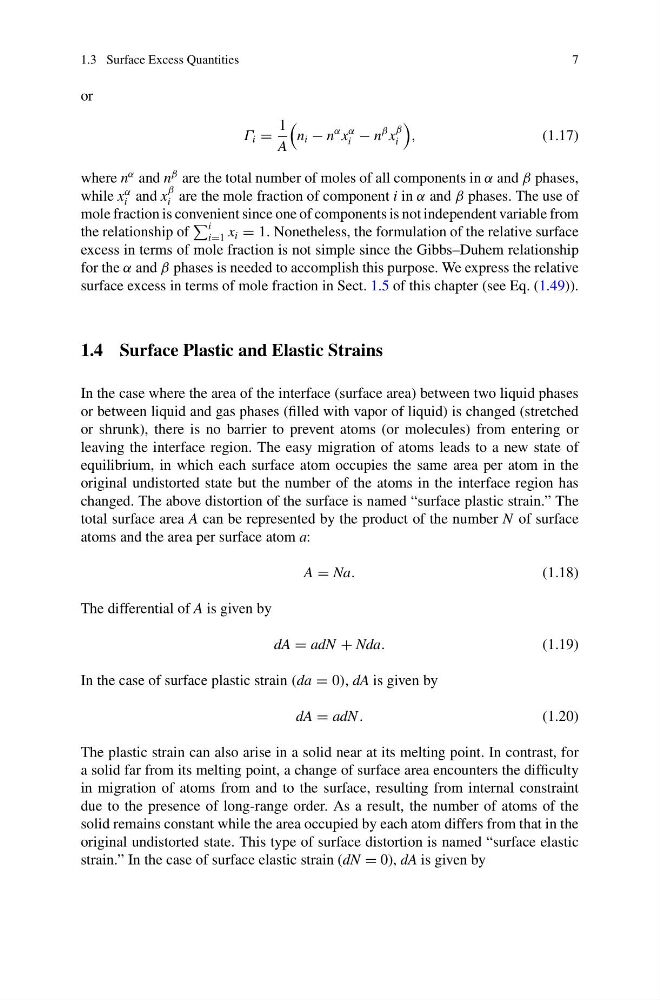
Γ i =
1
A
n i − n
α x
α
i − n
β x
β
i
,
(1.17)
where n
α and n
β are the total number of moles of all components in α and β phases,
while x
α
i and x
β
i are the mole fraction of component i in α and β phases. The use of
mole fraction is convenient since one of components is not independent variable from
the relationship of
i
i=1 x i = 1. Nonetheless, the formulation of the relative surface
excess in terms of mole fraction is not simple since the Gibbs–Duhem relationship
for the α and β phases is needed to accomplish this purpose. We express the relative
surface excess in terms of mole fraction in Sect. 1.5 of this chapter (see Eq. (1.49)).
1.4 Surface Plastic and Elastic Strains
In the case where the area of the interface (surface area) between two liquid phases
or between liquid and gas phases (filled with vapor of liquid) is changed (stretched
or shrunk), there is no barrier to prevent atoms (or molecules) from entering or
leaving the interface region. The easy migration of atoms leads to a new state of
equilibrium, in which each surface atom occupies the same area per atom in the
original undistorted state but the number of the atoms in the interface region has
changed. The above distortion of the surface is named “surface plastic strain.” The
total surface area A can be represented by the product of the number N of surface
atoms and the area per surface atom a:
A = Na.
(1.18)
The differential of A is given by
dA = adN + Nda.
(1.19)
In the case of surface plastic strain (da = 0), dA is given by
dA = adN .
(1.20)
The plastic strain can also arise in a solid near at its melting point. In contrast, for
a solid far from its melting point, a change of surface area encounters the difficulty
in migration of atoms from and to the surface, resulting from internal constraint
due to the presence of long-range order. As a result, the number of atoms of the
solid remains constant while the area occupied by each atom differs from that in the
original undistorted state. This type of surface distortion is named “surface elastic
strain.” In the case of surface elastic strain (dN = 0), dA is given by
7
or
Γ i =
1
A
n i − n
α x
α
i − n
β x
β
i
,
(1.17)
where n
α and n
β are the total number of moles of all components in α and β phases,
while x
α
i and x
β
i are the mole fraction of component i in α and β phases. The use of
mole fraction is convenient since one of components is not independent variable from
the relationship of
i
i=1 x i = 1. Nonetheless, the formulation of the relative surface
excess in terms of mole fraction is not simple since the Gibbs–Duhem relationship
for the α and β phases is needed to accomplish this purpose. We express the relative
surface excess in terms of mole fraction in Sect. 1.5 of this chapter (see Eq. (1.49)).
1.4 Surface Plastic and Elastic Strains
In the case where the area of the interface (surface area) between two liquid phases
or between liquid and gas phases (filled with vapor of liquid) is changed (stretched
or shrunk), there is no barrier to prevent atoms (or molecules) from entering or
leaving the interface region. The easy migration of atoms leads to a new state of
equilibrium, in which each surface atom occupies the same area per atom in the
original undistorted state but the number of the atoms in the interface region has
changed. The above distortion of the surface is named “surface plastic strain.” The
total surface area A can be represented by the product of the number N of surface
atoms and the area per surface atom a:
A = Na.
(1.18)
The differential of A is given by
dA = adN + Nda.
(1.19)
In the case of surface plastic strain (da = 0), dA is given by
dA = adN .
(1.20)
The plastic strain can also arise in a solid near at its melting point. In contrast, for
a solid far from its melting point, a change of surface area encounters the difficulty
in migration of atoms from and to the surface, resulting from internal constraint
due to the presence of long-range order. As a result, the number of atoms of the
solid remains constant while the area occupied by each atom differs from that in the
original undistorted state. This type of surface distortion is named “surface elastic
strain.” In the case of surface elastic strain (dN = 0), dA is given by