

162
6 Stresses of Anodic Oxide Films Grown on Metal Electrode
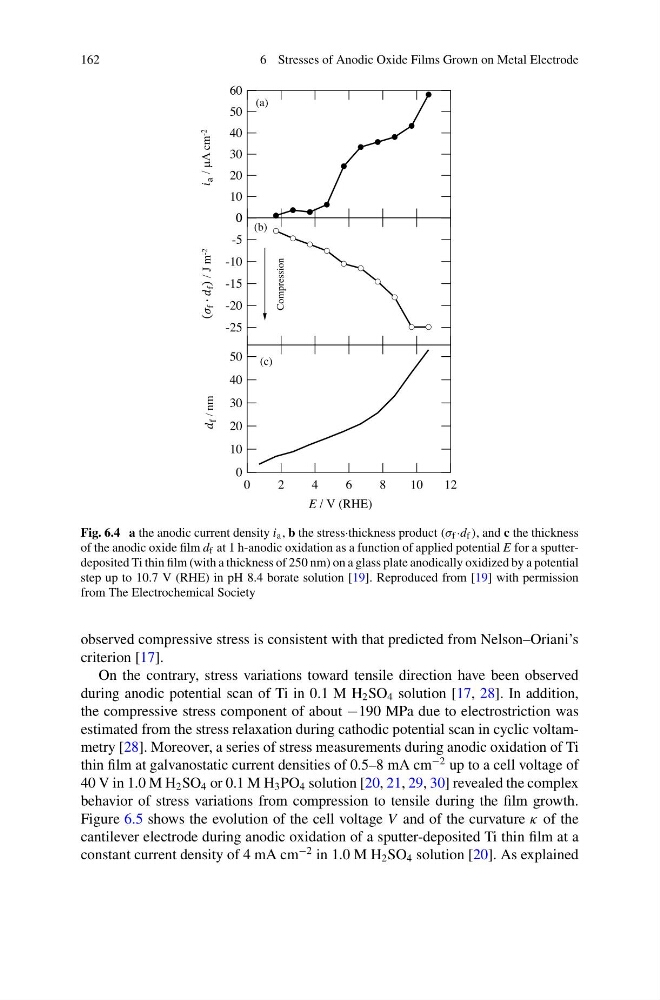
Fig. 6.4 a the anodic current density i a , b the stress·thickness product (σ f ·d f ), and c the thickness
of the anodic oxide film d f at 1 h-anodic oxidation as a function of applied potential E for a sputterdeposited Ti thin film (with a thickness of 250 nm) on a glass plate anodically oxidized by a potential
step up to 10.7 V (RHE) in pH 8.4 borate solution [19]. Reproduced from [19] with permission
from The Electrochemical Society
observed compressive stress is consistent with that predicted from Nelson–Oriani’s
criterion [17].
On the contrary, stress variations toward tensile direction have been observed
during anodic potential scan of Ti in 0.1 M H 2 SO 4 solution [17, 28]. In addition,
the compressive stress component of about −190 MPa due to electrostriction was
estimated from the stress relaxation during cathodic potential scan in cyclic voltammetry [28]. Moreover, a series of stress measurements during anodic oxidation of Ti
thin film at galvanostatic current densities of 0.5–8 mA cm
−2 up to a cell voltage of
40 V in 1.0 M H 2 SO 4 or 0.1 M H 3 PO 4 solution [20, 21, 29, 30] revealed the complex
behavior of stress variations from compression to tensile during the film growth.
Figure 6.5 shows the evolution of the cell voltage V and of the curvature κ of the
cantilever electrode during anodic oxidation of a sputter-deposited Ti thin film at a
constant current density of 4 mA cm
−2 in 1.0 M H 2 SO 4 solution [20]. As explained
6 Stresses of Anodic Oxide Films Grown on Metal Electrode
Fig. 6.4 a the anodic current density i a , b the stress·thickness product (σ f ·d f ), and c the thickness
of the anodic oxide film d f at 1 h-anodic oxidation as a function of applied potential E for a sputterdeposited Ti thin film (with a thickness of 250 nm) on a glass plate anodically oxidized by a potential
step up to 10.7 V (RHE) in pH 8.4 borate solution [19]. Reproduced from [19] with permission
from The Electrochemical Society
observed compressive stress is consistent with that predicted from Nelson–Oriani’s
criterion [17].
On the contrary, stress variations toward tensile direction have been observed
during anodic potential scan of Ti in 0.1 M H 2 SO 4 solution [17, 28]. In addition,
the compressive stress component of about −190 MPa due to electrostriction was
estimated from the stress relaxation during cathodic potential scan in cyclic voltammetry [28]. Moreover, a series of stress measurements during anodic oxidation of Ti
thin film at galvanostatic current densities of 0.5–8 mA cm
−2 up to a cell voltage of
40 V in 1.0 M H 2 SO 4 or 0.1 M H 3 PO 4 solution [20, 21, 29, 30] revealed the complex
behavior of stress variations from compression to tensile during the film growth.
Figure 6.5 shows the evolution of the cell voltage V and of the curvature κ of the
cantilever electrode during anodic oxidation of a sputter-deposited Ti thin film at a
constant current density of 4 mA cm
−2 in 1.0 M H 2 SO 4 solution [20]. As explained