

158
6 Stresses of Anodic Oxide Films Grown on Metal Electrode
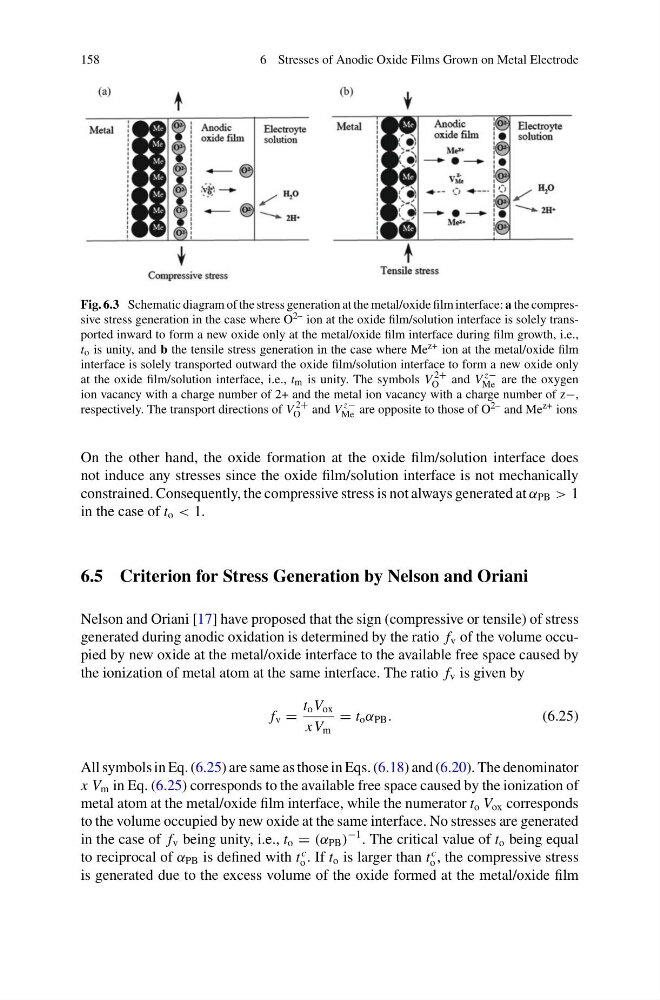
Fig. 6.3 Schematic diagram of the stress generation at the metal/oxide film interface: a the compressive stress generation in the case where O 2– ion at the oxide film/solution interface is solely transported inward to form a new oxide only at the metal/oxide film interface during film growth, i.e.,
t o is unity, and b the tensile stress generation in the case where Me z+ ion at the metal/oxide film
interface is solely transported outward the oxide film/solution interface to form a new oxide only
at the oxide film/solution interface, i.e., t m is unity. The symbols V
2+
O and V
z−
Me are the oxygen
ion vacancy with a charge number of 2+ and the metal ion vacancy with a charge number of z−,
respectively. The transport directions of V
2+
O and V
z−
Me are opposite to those of O 2– and Me z+ ions
On the other hand, the oxide formation at the oxide film/solution interface does
not induce any stresses since the oxide film/solution interface is not mechanically
constrained. Consequently, the compressive stress is not always generated at α PB > 1
in the case of t o < 1.
6.5 Criterion for Stress Generation by Nelson and Oriani
Nelson and Oriani [17] have proposed that the sign (compressive or tensile) of stress
generated during anodic oxidation is determined by the ratio f v of the volume occupied by new oxide at the metal/oxide interface to the available free space caused by
the ionization of metal atom at the same interface. The ratio f v is given by
f v =
t o V ox
x V m
= t o α PB .
(6.25)
All symbols in Eq. (6.25) are same as those in Eqs. (6.18) and (6.20). The denominator
x V m in Eq. (6.25) corresponds to the available free space caused by the ionization of
metal atom at the metal/oxide film interface, while the numerator t o V ox corresponds
to the volume occupied by new oxide at the same interface. No stresses are generated
in the case of f v being unity, i.e., t o = (α PB )
−1 . The critical value of t o being equal
to reciprocal of α PB is defined with t
c
o . If t o is larger than t
c
o , the compressive stress
is generated due to the excess volume of the oxide formed at the metal/oxide film
6 Stresses of Anodic Oxide Films Grown on Metal Electrode
Fig. 6.3 Schematic diagram of the stress generation at the metal/oxide film interface: a the compressive stress generation in the case where O 2– ion at the oxide film/solution interface is solely transported inward to form a new oxide only at the metal/oxide film interface during film growth, i.e.,
t o is unity, and b the tensile stress generation in the case where Me z+ ion at the metal/oxide film
interface is solely transported outward the oxide film/solution interface to form a new oxide only
at the oxide film/solution interface, i.e., t m is unity. The symbols V
2+
O and V
z−
Me are the oxygen
ion vacancy with a charge number of 2+ and the metal ion vacancy with a charge number of z−,
respectively. The transport directions of V
2+
O and V
z−
Me are opposite to those of O 2– and Me z+ ions
On the other hand, the oxide formation at the oxide film/solution interface does
not induce any stresses since the oxide film/solution interface is not mechanically
constrained. Consequently, the compressive stress is not always generated at α PB > 1
in the case of t o < 1.
6.5 Criterion for Stress Generation by Nelson and Oriani
Nelson and Oriani [17] have proposed that the sign (compressive or tensile) of stress
generated during anodic oxidation is determined by the ratio f v of the volume occupied by new oxide at the metal/oxide interface to the available free space caused by
the ionization of metal atom at the same interface. The ratio f v is given by
f v =
t o V ox
x V m
= t o α PB .
(6.25)
All symbols in Eq. (6.25) are same as those in Eqs. (6.18) and (6.20). The denominator
x V m in Eq. (6.25) corresponds to the available free space caused by the ionization of
metal atom at the metal/oxide film interface, while the numerator t o V ox corresponds
to the volume occupied by new oxide at the same interface. No stresses are generated
in the case of f v being unity, i.e., t o = (α PB )
−1 . The critical value of t o being equal
to reciprocal of α PB is defined with t
c
o . If t o is larger than t
c
o , the compressive stress
is generated due to the excess volume of the oxide formed at the metal/oxide film