

154
6 Stresses of Anodic Oxide Films Grown on Metal Electrode
Equation (6.16) shows that at constant φ f and T, d f is inversely proportional to ln t,
which is named “the inverse logarithmic law of oxide growth”. Taking logarithms of
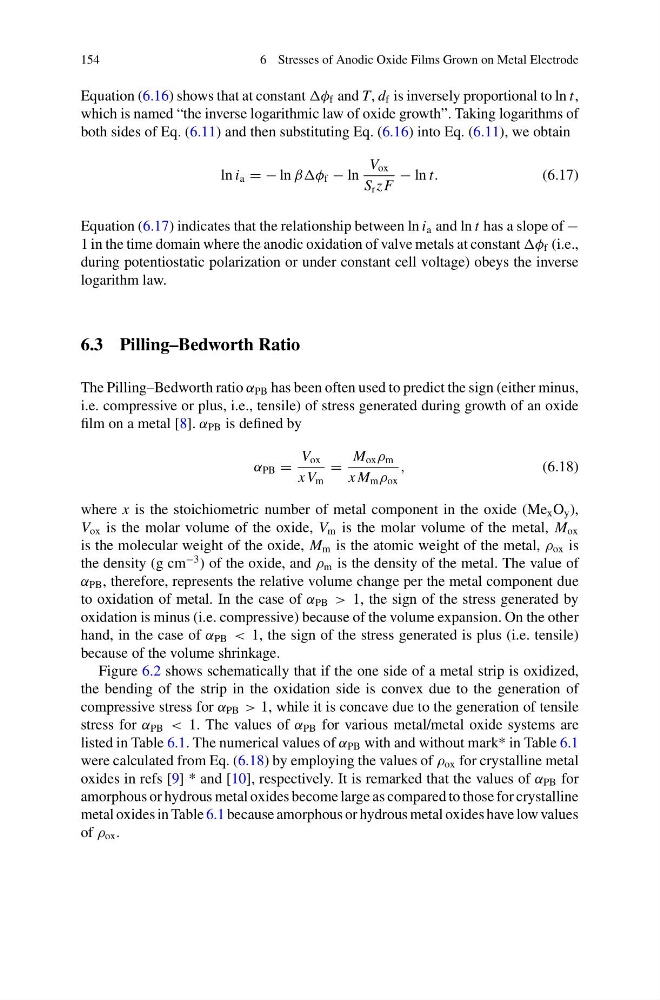
both sides of Eq. (6.11) and then substituting Eq. (6.16) into Eq. (6.11), we obtain
ln i a = − ln ββφ f − ln
V ox
S r z F
− ln t.
(6.17)
Equation (6.17) indicates that the relationship between ln i a and ln t has a slope of −
1 in the time domain where the anodic oxidation of valve metals at constant φ f (i.e.,
during potentiostatic polarization or under constant cell voltage) obeys the inverse
logarithm law.
6.3 Pilling–Bedworth Ratio
The Pilling–Bedworth ratio α PB has been often used to predict the sign (either minus,
i.e. compressive or plus, i.e., tensile) of stress generated during growth of an oxide
film on a metal [8]. α PB is defined by
α PB =
V ox
x V m
=
M ox ρ m
x M m ρ ox
,
(6.18)
where x is the stoichiometric number of metal component in the oxide (Me x O y ),
V ox is the molar volume of the oxide, V m is the molar volume of the metal, M ox
is the molecular weight of the oxide, M m is the atomic weight of the metal, ρ ox is
the density (g cm
−3 ) of the oxide, and ρ m is the density of the metal. The value of
α PB , therefore, represents the relative volume change per the metal component due
to oxidation of metal. In the case of α PB > 1, the sign of the stress generated by
oxidation is minus (i.e. compressive) because of the volume expansion. On the other
hand, in the case of α PB < 1, the sign of the stress generated is plus (i.e. tensile)
because of the volume shrinkage.
Figure 6.2 shows schematically that if the one side of a metal strip is oxidized,
the bending of the strip in the oxidation side is convex due to the generation of
compressive stress for α PB > 1, while it is concave due to the generation of tensile
stress for α PB < 1. The values of α PB for various metal/metal oxide systems are
listed in Table 6.1. The numerical values of α PB with and without mark* in Table 6.1
were calculated from Eq. (6.18) by employing the values of ρ ox for crystalline metal
oxides in refs [9] * and [10], respectively. It is remarked that the values of α PB for
amorphous or hydrous metal oxides become large as compared to those for crystalline
metal oxides in Table 6.1 because amorphous or hydrous metal oxides have low values
of ρ ox .
6 Stresses of Anodic Oxide Films Grown on Metal Electrode
Equation (6.16) shows that at constant φ f and T, d f is inversely proportional to ln t,
which is named “the inverse logarithmic law of oxide growth”. Taking logarithms of
both sides of Eq. (6.11) and then substituting Eq. (6.16) into Eq. (6.11), we obtain
ln i a = − ln ββφ f − ln
V ox
S r z F
− ln t.
(6.17)
Equation (6.17) indicates that the relationship between ln i a and ln t has a slope of −
1 in the time domain where the anodic oxidation of valve metals at constant φ f (i.e.,
during potentiostatic polarization or under constant cell voltage) obeys the inverse
logarithm law.
6.3 Pilling–Bedworth Ratio
The Pilling–Bedworth ratio α PB has been often used to predict the sign (either minus,
i.e. compressive or plus, i.e., tensile) of stress generated during growth of an oxide
film on a metal [8]. α PB is defined by
α PB =
V ox
x V m
=
M ox ρ m
x M m ρ ox
,
(6.18)
where x is the stoichiometric number of metal component in the oxide (Me x O y ),
V ox is the molar volume of the oxide, V m is the molar volume of the metal, M ox
is the molecular weight of the oxide, M m is the atomic weight of the metal, ρ ox is
the density (g cm
−3 ) of the oxide, and ρ m is the density of the metal. The value of
α PB , therefore, represents the relative volume change per the metal component due
to oxidation of metal. In the case of α PB > 1, the sign of the stress generated by
oxidation is minus (i.e. compressive) because of the volume expansion. On the other
hand, in the case of α PB < 1, the sign of the stress generated is plus (i.e. tensile)
because of the volume shrinkage.
Figure 6.2 shows schematically that if the one side of a metal strip is oxidized,
the bending of the strip in the oxidation side is convex due to the generation of
compressive stress for α PB > 1, while it is concave due to the generation of tensile
stress for α PB < 1. The values of α PB for various metal/metal oxide systems are
listed in Table 6.1. The numerical values of α PB with and without mark* in Table 6.1
were calculated from Eq. (6.18) by employing the values of ρ ox for crystalline metal
oxides in refs [9] * and [10], respectively. It is remarked that the values of α PB for
amorphous or hydrous metal oxides become large as compared to those for crystalline
metal oxides in Table 6.1 because amorphous or hydrous metal oxides have low values
of ρ ox .