

5.3 Incompatibility of Shuttleworth Equation with Hermann’s …
145
equation is not consistent with Hermann’s formulation of the mathematical structure of thermodynamics. In addition, Bottomley et al. [27] claimed that one may
define a three-dimensional space represented with respect to an orthogonal basis,
the axes representing the state function F and the state variables A and γ , so that
there does not seem to be any problem to represent F
s , A, and γ in a Euclidean
space, where these quantities obey the equation F
s
= γ A. Afterward, there seems
to be no replies between the above prominent researchers and, the derivation of the
Shuttleworth equation remains unsolved problem up to now. The final decision of
the above arguments may be achieved by whether the validity of the Shuttleworth
equation is experimentally confirmed or not.
5.4 Thermodynamic Issues Associated with Shuttleworth
Equation and with Surface Stress Measurement
by a Cantilever Bending Method
Thermodynamic issues have arisen for the application of the Shuttleworth equation
(g = γ +
∂γ
∂ε
) to an electrified, isotropic solid electrode in electrolyte solution [15].
The first derivative of the Shuttleworth equation with respective to potential has been
often described in the literature [e.g., 28–30] as follows:
∂g
∂E
= −q −
∂q
∂ε
(5.17)
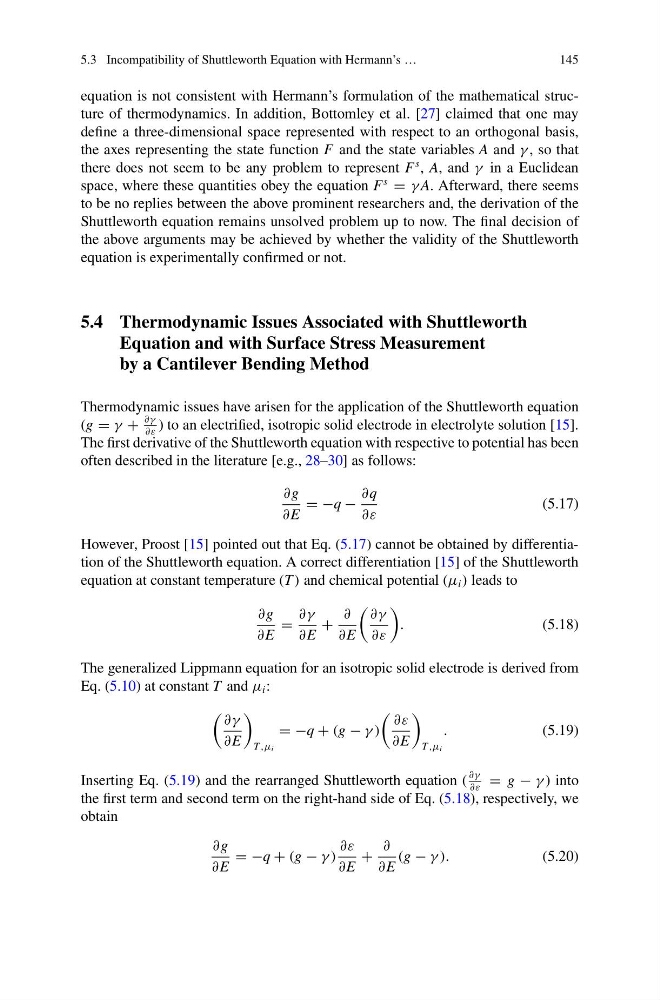
However, Proost [15] pointed out that Eq. (5.17) cannot be obtained by differentiation of the Shuttleworth equation. A correct differentiation [15] of the Shuttleworth
equation at constant temperature (T ) and chemical potential (μ i ) leads to
∂g
∂E
=
∂γ
∂E
+
∂
∂E
∂γ
∂ε
.
(5.18)
The generalized Lippmann equation for an isotropic solid electrode is derived from
Eq. (5.10) at constant T and μ i :
∂γ
∂E
T ,μ i
= −q + (g − γ )
∂ε
∂E
T ,μ i
.
(5.19)
Inserting Eq. (5.19) and the rearranged Shuttleworth equation (
∂γ
∂ε
= g − γ ) into
the first term and second term on the right-hand side of Eq. (5.18), respectively, we
obtain
∂g
∂E
= −q + (g − γ )
∂ε
∂E
+
∂
∂E
(g − γ ).
(5.20)
145
equation is not consistent with Hermann’s formulation of the mathematical structure of thermodynamics. In addition, Bottomley et al. [27] claimed that one may
define a three-dimensional space represented with respect to an orthogonal basis,
the axes representing the state function F and the state variables A and γ , so that
there does not seem to be any problem to represent F
s , A, and γ in a Euclidean
space, where these quantities obey the equation F
s
= γ A. Afterward, there seems
to be no replies between the above prominent researchers and, the derivation of the
Shuttleworth equation remains unsolved problem up to now. The final decision of
the above arguments may be achieved by whether the validity of the Shuttleworth
equation is experimentally confirmed or not.
5.4 Thermodynamic Issues Associated with Shuttleworth
Equation and with Surface Stress Measurement
by a Cantilever Bending Method
Thermodynamic issues have arisen for the application of the Shuttleworth equation
(g = γ +
∂γ
∂ε
) to an electrified, isotropic solid electrode in electrolyte solution [15].
The first derivative of the Shuttleworth equation with respective to potential has been
often described in the literature [e.g., 28–30] as follows:
∂g
∂E
= −q −
∂q
∂ε
(5.17)
However, Proost [15] pointed out that Eq. (5.17) cannot be obtained by differentiation of the Shuttleworth equation. A correct differentiation [15] of the Shuttleworth
equation at constant temperature (T ) and chemical potential (μ i ) leads to
∂g
∂E
=
∂γ
∂E
+
∂
∂E
∂γ
∂ε
.
(5.18)
The generalized Lippmann equation for an isotropic solid electrode is derived from
Eq. (5.10) at constant T and μ i :
∂γ
∂E
T ,μ i
= −q + (g − γ )
∂ε
∂E
T ,μ i
.
(5.19)
Inserting Eq. (5.19) and the rearranged Shuttleworth equation (
∂γ
∂ε
= g − γ ) into
the first term and second term on the right-hand side of Eq. (5.18), respectively, we
obtain
∂g
∂E
= −q + (g − γ )
∂ε
∂E
+
∂
∂E
(g − γ ).
(5.20)