

122
4 Changes in Surface Stress Associated with Underpotential …
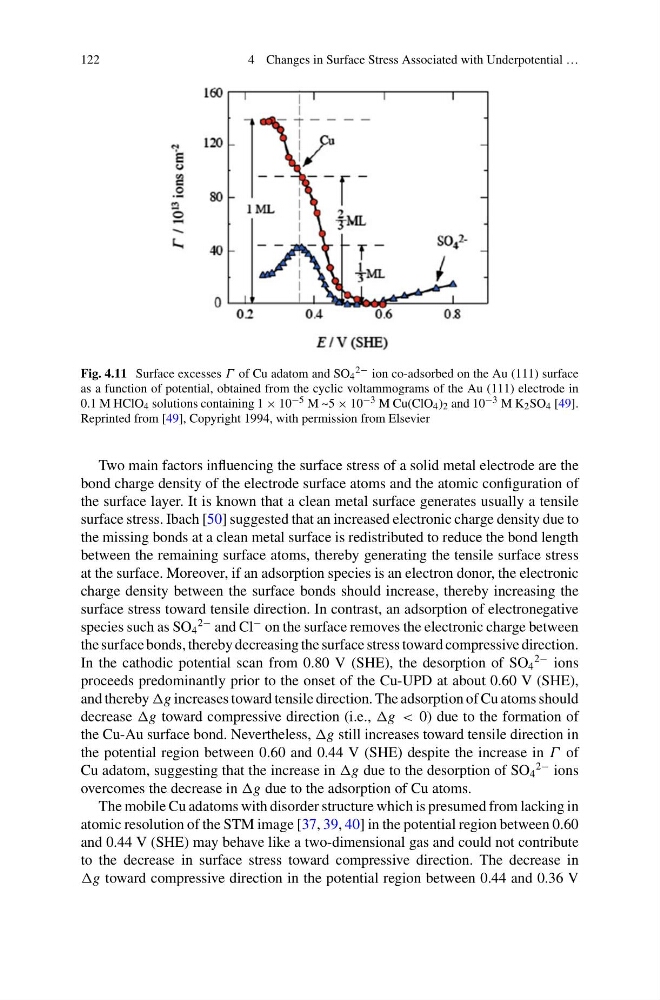
Fig. 4.11 Surface excesses Γ of Cu adatom and SO 4
2− ion co-adsorbed on the Au (111) surface
as a function of potential, obtained from the cyclic voltammograms of the Au (111) electrode in
0.1 M HClO 4 solutions containing 1 × 10 −5 M ~5 × 10 −3 M Cu(ClO 4 ) 2 and 10 −3 M K 2 SO 4 [49].
Reprinted from [49], Copyright 1994, with permission from Elsevier
Two main factors influencing the surface stress of a solid metal electrode are the
bond charge density of the electrode surface atoms and the atomic configuration of
the surface layer. It is known that a clean metal surface generates usually a tensile
surface stress. Ibach [50] suggested that an increased electronic charge density due to
the missing bonds at a clean metal surface is redistributed to reduce the bond length
between the remaining surface atoms, thereby generating the tensile surface stress
at the surface. Moreover, if an adsorption species is an electron donor, the electronic
charge density between the surface bonds should increase, thereby increasing the
surface stress toward tensile direction. In contrast, an adsorption of electronegative
species such as SO 4
2− and Cl
− on the surface removes the electronic charge between
the surface bonds, thereby decreasing the surface stress toward compressive direction.
In the cathodic potential scan from 0.80 V (SHE), the desorption of SO 4
2− ions
proceeds predominantly prior to the onset of the Cu-UPD at about 0.60 V (SHE),
and thereby g increases toward tensile direction. The adsorption of Cu atoms should
decrease g toward compressive direction (i.e., g < 0) due to the formation of
the Cu-Au surface bond. Nevertheless, g still increases toward tensile direction in
the potential region between 0.60 and 0.44 V (SHE) despite the increase in Γ of
Cu adatom, suggesting that the increase in g due to the desorption of SO 4
2− ions
overcomes the decrease in g due to the adsorption of Cu atoms.
The mobile Cu adatoms with disorder structure which is presumed from lacking in
atomic resolution of the STM image [37, 39, 40] in the potential region between 0.60
and 0.44 V (SHE) may behave like a two-dimensional gas and could not contribute
to the decrease in surface stress toward compressive direction. The decrease in
g toward compressive direction in the potential region between 0.44 and 0.36 V
4 Changes in Surface Stress Associated with Underpotential …
Fig. 4.11 Surface excesses Γ of Cu adatom and SO 4
2− ion co-adsorbed on the Au (111) surface
as a function of potential, obtained from the cyclic voltammograms of the Au (111) electrode in
0.1 M HClO 4 solutions containing 1 × 10 −5 M ~5 × 10 −3 M Cu(ClO 4 ) 2 and 10 −3 M K 2 SO 4 [49].
Reprinted from [49], Copyright 1994, with permission from Elsevier
Two main factors influencing the surface stress of a solid metal electrode are the
bond charge density of the electrode surface atoms and the atomic configuration of
the surface layer. It is known that a clean metal surface generates usually a tensile
surface stress. Ibach [50] suggested that an increased electronic charge density due to
the missing bonds at a clean metal surface is redistributed to reduce the bond length
between the remaining surface atoms, thereby generating the tensile surface stress
at the surface. Moreover, if an adsorption species is an electron donor, the electronic
charge density between the surface bonds should increase, thereby increasing the
surface stress toward tensile direction. In contrast, an adsorption of electronegative
species such as SO 4
2− and Cl
− on the surface removes the electronic charge between
the surface bonds, thereby decreasing the surface stress toward compressive direction.
In the cathodic potential scan from 0.80 V (SHE), the desorption of SO 4
2− ions
proceeds predominantly prior to the onset of the Cu-UPD at about 0.60 V (SHE),
and thereby g increases toward tensile direction. The adsorption of Cu atoms should
decrease g toward compressive direction (i.e., g < 0) due to the formation of
the Cu-Au surface bond. Nevertheless, g still increases toward tensile direction in
the potential region between 0.60 and 0.44 V (SHE) despite the increase in Γ of
Cu adatom, suggesting that the increase in g due to the desorption of SO 4
2− ions
overcomes the decrease in g due to the adsorption of Cu atoms.
The mobile Cu adatoms with disorder structure which is presumed from lacking in
atomic resolution of the STM image [37, 39, 40] in the potential region between 0.60
and 0.44 V (SHE) may behave like a two-dimensional gas and could not contribute
to the decrease in surface stress toward compressive direction. The decrease in
g toward compressive direction in the potential region between 0.44 and 0.36 V