

3.3 Adsorption of Electrolyte Anions
81
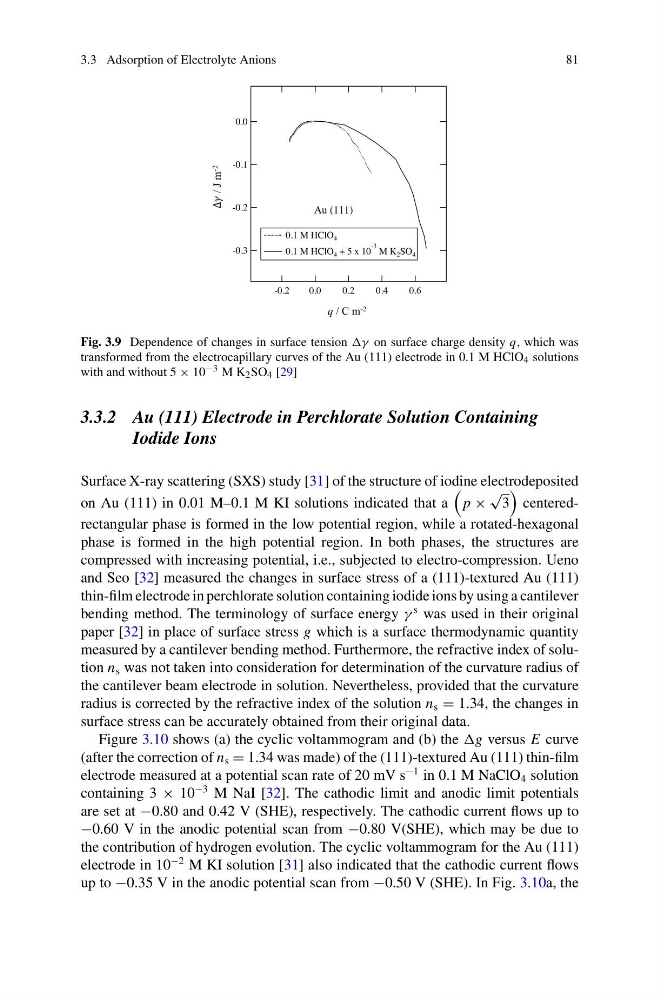
Fig. 3.9 Dependence of changes in surface tension γ on surface charge density q, which was
transformed from the electrocapillary curves of the Au (111) electrode in 0.1 M HClO 4 solutions
with and without 5 × 10 −3 M K 2 SO 4 [29]
3.3.2 Au (111) Electrode in Perchlorate Solution Containing
Iodide Ions
Surface X-ray scattering (SXS) study [31] of the structure of iodine electrodeposited
on Au (111) in 0.01 M–0.1 M KI solutions indicated that a
p ×
√
3
centeredrectangular phase is formed in the low potential region, while a rotated-hexagonal
phase is formed in the high potential region. In both phases, the structures are
compressed with increasing potential, i.e., subjected to electro-compression. Ueno
and Seo [32] measured the changes in surface stress of a (111)-textured Au (111)
thin-film electrode in perchlorate solution containing iodide ions by using a cantilever
bending method. The terminology of surface energy γ
s was used in their original
paper [32] in place of surface stress g which is a surface thermodynamic quantity
measured by a cantilever bending method. Furthermore, the refractive index of solution n s was not taken into consideration for determination of the curvature radius of
the cantilever beam electrode in solution. Nevertheless, provided that the curvature
radius is corrected by the refractive index of the solution n s = 1.34, the changes in
surface stress can be accurately obtained from their original data.
Figure 3.10 shows (a) the cyclic voltammogram and (b) the versus E curve
(after the correction of n s = 1.34 was made) of the (111)-textured Au (111) thin-film
electrode measured at a potential scan rate of 20 mV s
−1 in 0.1 M NaClO 4 solution
containing 3 × 10
−3 M NaI [32]. The cathodic limit and anodic limit potentials
are set at −0.80 and 0.42 V (SHE), respectively. The cathodic current flows up to
−0.60 V in the anodic potential scan from −0.80 V(SHE), which may be due to
the contribution of hydrogen evolution. The cyclic voltammogram for the Au (111)
electrode in 10
−2 M KI solution [31] also indicated that the cathodic current flows
up to −0.35 V in the anodic potential scan from −0.50 V (SHE). In Fig. 3.10a, the
81
Fig. 3.9 Dependence of changes in surface tension γ on surface charge density q, which was
transformed from the electrocapillary curves of the Au (111) electrode in 0.1 M HClO 4 solutions
with and without 5 × 10 −3 M K 2 SO 4 [29]
3.3.2 Au (111) Electrode in Perchlorate Solution Containing
Iodide Ions
Surface X-ray scattering (SXS) study [31] of the structure of iodine electrodeposited
on Au (111) in 0.01 M–0.1 M KI solutions indicated that a
p ×
√
3
centeredrectangular phase is formed in the low potential region, while a rotated-hexagonal
phase is formed in the high potential region. In both phases, the structures are
compressed with increasing potential, i.e., subjected to electro-compression. Ueno
and Seo [32] measured the changes in surface stress of a (111)-textured Au (111)
thin-film electrode in perchlorate solution containing iodide ions by using a cantilever
bending method. The terminology of surface energy γ
s was used in their original
paper [32] in place of surface stress g which is a surface thermodynamic quantity
measured by a cantilever bending method. Furthermore, the refractive index of solution n s was not taken into consideration for determination of the curvature radius of
the cantilever beam electrode in solution. Nevertheless, provided that the curvature
radius is corrected by the refractive index of the solution n s = 1.34, the changes in
surface stress can be accurately obtained from their original data.
Figure 3.10 shows (a) the cyclic voltammogram and (b) the versus E curve
(after the correction of n s = 1.34 was made) of the (111)-textured Au (111) thin-film
electrode measured at a potential scan rate of 20 mV s
−1 in 0.1 M NaClO 4 solution
containing 3 × 10
−3 M NaI [32]. The cathodic limit and anodic limit potentials
are set at −0.80 and 0.42 V (SHE), respectively. The cathodic current flows up to
−0.60 V in the anodic potential scan from −0.80 V(SHE), which may be due to
the contribution of hydrogen evolution. The cyclic voltammogram for the Au (111)
electrode in 10
−2 M KI solution [31] also indicated that the cathodic current flows
up to −0.35 V in the anodic potential scan from −0.50 V (SHE). In Fig. 3.10a, the