

70
3 Potential- or Adsorbate-Induced Changes in Surface Stress …
2]. Surface stress g as well as surface tension γ may play vital roles in reconstruction of the electrode surfaces. The changes in surface stress for the reconstructed and
unreconstructed surfaces for Au (100) and (111) electrodes in 0.1 M HClO 4 solution
have been measured as a function of applied potential by a cantilever bending method
[8, 9]. We discuss the roles of g and γ in reconstruction for the Au (100) and (111)
electrodes to understand the reconstruction phenomena.
3.2.1 Au (100) Surface
The reconstructed Au (100)-(hex) electrode surface is transformed (i.e., rifted) to the
unreconstructed Au (100)-(1 × 1) surface by anodic polarization at potentials more
positive than a critical potential [1, 2]. The critical potential for rifting can be determined from the potential at a spike of anodic current during anodic potential scan.
The critical potential of rifting shifts toward negative direction in accordance with the
order of the adsorption strength of electrolyte anions, Cl
− > HSO 4
− > ClO 4
− [10].
The reconstructed surface, however, is restored by cathodic polarization at potentials more negative than the critical potential after the lifting to the unreconstructed
surface. The critical potential for restoration to the reconstructed surface does not
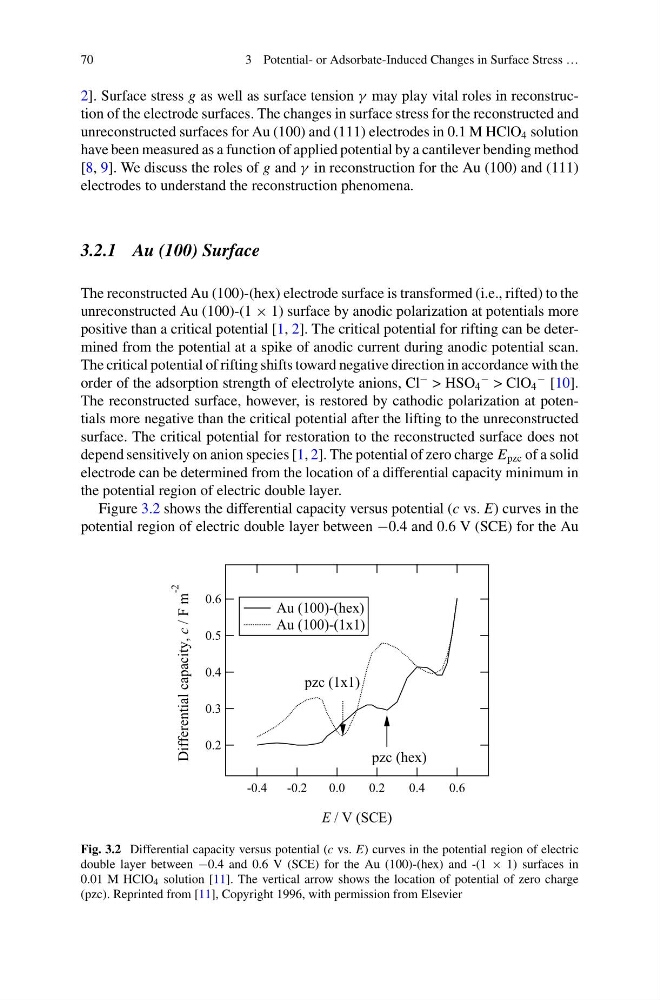
depend sensitively on anion species [1, 2]. The potential of zero charge E pzc of a solid
electrode can be determined from the location of a differential capacity minimum in
the potential region of electric double layer.
Figure 3.2 shows the differential capacity versus potential (c vs. E) curves in the
potential region of electric double layer between −0.4 and 0.6 V (SCE) for the Au
0.6
0.5
0.4
0.3
0.2
Differential capacity,
c / F m
-2
0.6
0.4
0.2
0.0
-0.2
-0.4
E / V (SCE)
Au (100)-(hex)
Au (100)-(1x1)
pzc (1x1)
pzc (hex)
Fig. 3.2 Differential capacity versus potential (c vs. E) curves in the potential region of electric
double layer between −0.4 and 0.6 V (SCE) for the Au (100)-(hex) and -(1 × 1) surfaces in
0.01 M HClO 4 solution [11]. The vertical arrow shows the location of potential of zero charge
(pzc). Reprinted from [11], Copyright 1996, with permission from Elsevier
3 Potential- or Adsorbate-Induced Changes in Surface Stress …
2]. Surface stress g as well as surface tension γ may play vital roles in reconstruction of the electrode surfaces. The changes in surface stress for the reconstructed and
unreconstructed surfaces for Au (100) and (111) electrodes in 0.1 M HClO 4 solution
have been measured as a function of applied potential by a cantilever bending method
[8, 9]. We discuss the roles of g and γ in reconstruction for the Au (100) and (111)
electrodes to understand the reconstruction phenomena.
3.2.1 Au (100) Surface
The reconstructed Au (100)-(hex) electrode surface is transformed (i.e., rifted) to the
unreconstructed Au (100)-(1 × 1) surface by anodic polarization at potentials more
positive than a critical potential [1, 2]. The critical potential for rifting can be determined from the potential at a spike of anodic current during anodic potential scan.
The critical potential of rifting shifts toward negative direction in accordance with the
order of the adsorption strength of electrolyte anions, Cl
− > HSO 4
− > ClO 4
− [10].
The reconstructed surface, however, is restored by cathodic polarization at potentials more negative than the critical potential after the lifting to the unreconstructed
surface. The critical potential for restoration to the reconstructed surface does not
depend sensitively on anion species [1, 2]. The potential of zero charge E pzc of a solid
electrode can be determined from the location of a differential capacity minimum in
the potential region of electric double layer.
Figure 3.2 shows the differential capacity versus potential (c vs. E) curves in the
potential region of electric double layer between −0.4 and 0.6 V (SCE) for the Au
0.6
0.5
0.4
0.3
0.2
Differential capacity,
c / F m
-2
0.6
0.4
0.2
0.0
-0.2
-0.4
E / V (SCE)
Au (100)-(hex)
Au (100)-(1x1)
pzc (1x1)
pzc (hex)
Fig. 3.2 Differential capacity versus potential (c vs. E) curves in the potential region of electric
double layer between −0.4 and 0.6 V (SCE) for the Au (100)-(hex) and -(1 × 1) surfaces in
0.01 M HClO 4 solution [11]. The vertical arrow shows the location of potential of zero charge
(pzc). Reprinted from [11], Copyright 1996, with permission from Elsevier