

64
2 Methods for Investigating Electro-Chemo-Mechanical …
commercial reference electrode (Ag/AgCl/3 M KCl), is separated from the counter
electrode compartment by a glass frit [48]. The reference electrode is in a Teflon
tube with a porous membrane (ceramic/conducting polymer) at the junction with
low electrolyte leakage. The counter electrode is a porous Pt which is the same
material as the samples. The changes in sample length are transmitted to an inductive
displacement sensor via a pushrod (made from silica) loaded by a contact pressure
of 20 cN [47]. The sample space of the dilatometer is connected to a bath thermostat
to maintain a steady-state temperature of 283 ± 0.1 K. For synchronization between
dilatometric detection and electrochemical measurement, the output signal of the
dilatometer is supplied to the external input channel of the potentiostat and then is
saved together with current and net charge in a same data file [47].
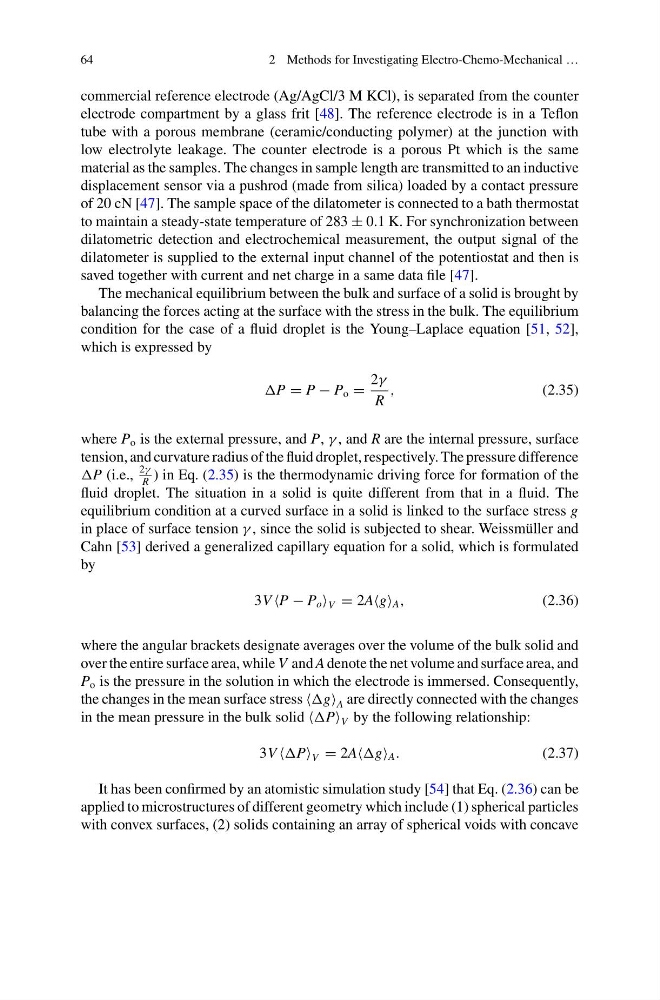
The mechanical equilibrium between the bulk and surface of a solid is brought by
balancing the forces acting at the surface with the stress in the bulk. The equilibrium
condition for the case of a fluid droplet is the Young–Laplace equation [51, 52],
which is expressed by
P = P − P o =
2γ
R
,
(2.35)
where P o is the external pressure, and P, γ , and R are the internal pressure, surface
tension, and curvature radius of the fluid droplet, respectively. The pressure difference
P (i.e.,
2γ
R
) in Eq. (2.35) is the thermodynamic driving force for formation of the
fluid droplet. The situation in a solid is quite different from that in a fluid. The
equilibrium condition at a curved surface in a solid is linked to the surface stress g
in place of surface tension γ , since the solid is subjected to shear. Weissmüller and
Cahn [53] derived a generalized capillary equation for a solid, which is formulated
by
3V P − P o V = 2Ag A ,
(2.36)
where the angular brackets designate averages over the volume of the bulk solid and
over the entire surface area, while V and A denote the net volume and surface area, and
P o is the pressure in the solution in which the electrode is immersed. Consequently,
the changes in the mean surface stress g A are directly connected with the changes
in the mean pressure in the bulk solid P V by the following relationship:
3V P V = 2Ag A .
(2.37)
It has been confirmed by an atomistic simulation study [54] that Eq. (2.36) can be
applied to microstructures of different geometry which include (1) spherical particles
with convex surfaces, (2) solids containing an array of spherical voids with concave
2 Methods for Investigating Electro-Chemo-Mechanical …
commercial reference electrode (Ag/AgCl/3 M KCl), is separated from the counter
electrode compartment by a glass frit [48]. The reference electrode is in a Teflon
tube with a porous membrane (ceramic/conducting polymer) at the junction with
low electrolyte leakage. The counter electrode is a porous Pt which is the same
material as the samples. The changes in sample length are transmitted to an inductive
displacement sensor via a pushrod (made from silica) loaded by a contact pressure
of 20 cN [47]. The sample space of the dilatometer is connected to a bath thermostat
to maintain a steady-state temperature of 283 ± 0.1 K. For synchronization between
dilatometric detection and electrochemical measurement, the output signal of the
dilatometer is supplied to the external input channel of the potentiostat and then is
saved together with current and net charge in a same data file [47].
The mechanical equilibrium between the bulk and surface of a solid is brought by
balancing the forces acting at the surface with the stress in the bulk. The equilibrium
condition for the case of a fluid droplet is the Young–Laplace equation [51, 52],
which is expressed by
P = P − P o =
2γ
R
,
(2.35)
where P o is the external pressure, and P, γ , and R are the internal pressure, surface
tension, and curvature radius of the fluid droplet, respectively. The pressure difference
P (i.e.,
2γ
R
) in Eq. (2.35) is the thermodynamic driving force for formation of the
fluid droplet. The situation in a solid is quite different from that in a fluid. The
equilibrium condition at a curved surface in a solid is linked to the surface stress g
in place of surface tension γ , since the solid is subjected to shear. Weissmüller and
Cahn [53] derived a generalized capillary equation for a solid, which is formulated
by
3V P − P o V = 2Ag A ,
(2.36)
where the angular brackets designate averages over the volume of the bulk solid and
over the entire surface area, while V and A denote the net volume and surface area, and
P o is the pressure in the solution in which the electrode is immersed. Consequently,
the changes in the mean surface stress g A are directly connected with the changes
in the mean pressure in the bulk solid P V by the following relationship:
3V P V = 2Ag A .
(2.37)
It has been confirmed by an atomistic simulation study [54] that Eq. (2.36) can be
applied to microstructures of different geometry which include (1) spherical particles
with convex surfaces, (2) solids containing an array of spherical voids with concave