

202
7 Nano-Mechanical Properties of Solid Surfaces Obtained …
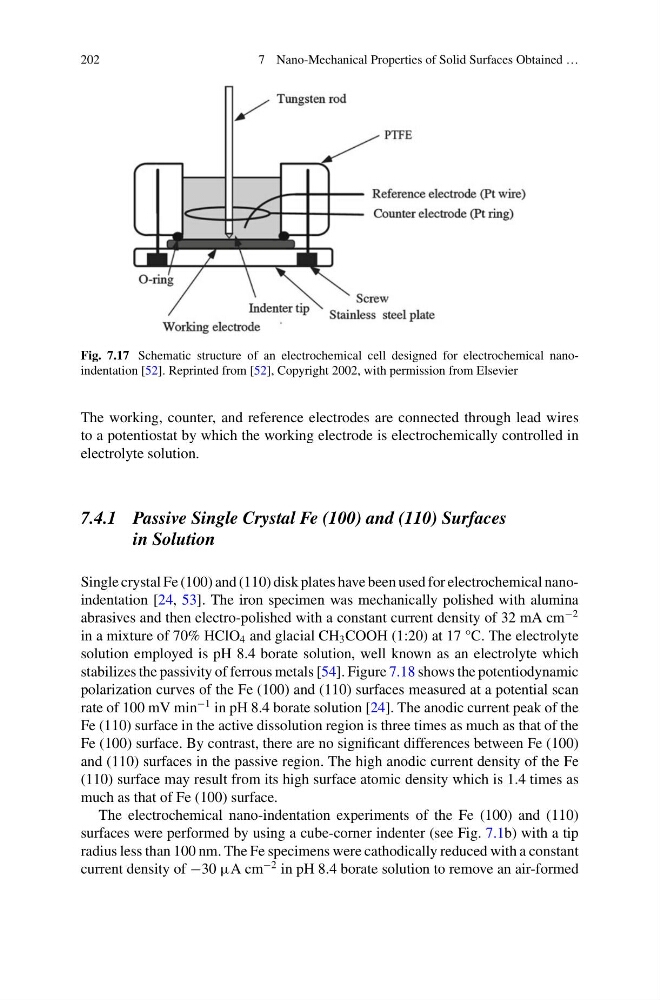
Fig. 7.17 Schematic structure of an electrochemical cell designed for electrochemical nanoindentation [52]. Reprinted from [52], Copyright 2002, with permission from Elsevier
The working, counter, and reference electrodes are connected through lead wires
to a potentiostat by which the working electrode is electrochemically controlled in
electrolyte solution.
7.4.1 Passive Single Crystal Fe (100) and (110) Surfaces
in Solution
Single crystal Fe (100) and (110) disk plates have been used for electrochemical nanoindentation [24, 53]. The iron specimen was mechanically polished with alumina
abrasives and then electro-polished with a constant current density of 32 mA cm
−2
in a mixture of 70% HClO 4 and glacial CH 3 COOH (1:20) at 17 °C. The electrolyte
solution employed is pH 8.4 borate solution, well known as an electrolyte which
stabilizes the passivity of ferrous metals [54]. Figure 7.18 shows the potentiodynamic
polarization curves of the Fe (100) and (110) surfaces measured at a potential scan
rate of 100 mV min
−1 in pH 8.4 borate solution [24]. The anodic current peak of the
Fe (110) surface in the active dissolution region is three times as much as that of the
Fe (100) surface. By contrast, there are no significant differences between Fe (100)
and (110) surfaces in the passive region. The high anodic current density of the Fe
(110) surface may result from its high surface atomic density which is 1.4 times as
much as that of Fe (100) surface.
The electrochemical nano-indentation experiments of the Fe (100) and (110)
surfaces were performed by using a cube-corner indenter (see Fig. 7.1b) with a tip
radius less than 100 nm. The Fe specimens were cathodically reduced with a constant
current density of −30 µA cm
−2 in pH 8.4 borate solution to remove an air-formed
7 Nano-Mechanical Properties of Solid Surfaces Obtained …
Fig. 7.17 Schematic structure of an electrochemical cell designed for electrochemical nanoindentation [52]. Reprinted from [52], Copyright 2002, with permission from Elsevier
The working, counter, and reference electrodes are connected through lead wires
to a potentiostat by which the working electrode is electrochemically controlled in
electrolyte solution.
7.4.1 Passive Single Crystal Fe (100) and (110) Surfaces
in Solution
Single crystal Fe (100) and (110) disk plates have been used for electrochemical nanoindentation [24, 53]. The iron specimen was mechanically polished with alumina
abrasives and then electro-polished with a constant current density of 32 mA cm
−2
in a mixture of 70% HClO 4 and glacial CH 3 COOH (1:20) at 17 °C. The electrolyte
solution employed is pH 8.4 borate solution, well known as an electrolyte which
stabilizes the passivity of ferrous metals [54]. Figure 7.18 shows the potentiodynamic
polarization curves of the Fe (100) and (110) surfaces measured at a potential scan
rate of 100 mV min
−1 in pH 8.4 borate solution [24]. The anodic current peak of the
Fe (110) surface in the active dissolution region is three times as much as that of the
Fe (100) surface. By contrast, there are no significant differences between Fe (100)
and (110) surfaces in the passive region. The high anodic current density of the Fe
(110) surface may result from its high surface atomic density which is 1.4 times as
much as that of Fe (100) surface.
The electrochemical nano-indentation experiments of the Fe (100) and (110)
surfaces were performed by using a cube-corner indenter (see Fig. 7.1b) with a tip
radius less than 100 nm. The Fe specimens were cathodically reduced with a constant
current density of −30 µA cm
−2 in pH 8.4 borate solution to remove an air-formed