

198
7 Nano-Mechanical Properties of Solid Surfaces Obtained …
which has a unit of MPa m
1/2 , and this unit is same as that of a toughness. H LSF−micro
for micro-indentation is derived from Eqs. (7.24) and (7.25):
H LSF−micro =
9
√
2
αμ tan θ
√
b.
(7.29)
In nano-indentation, an indent with constant slope is not entirely consistent with
the approximation of a constant strain gradient, and thus, the dislocation spacing
becomes non-uniform in the plastic zone which leads to a higher density of GNDs
at the center of the indent. In this case, ρ G, max is given by [28]:
ρ G, max =
1
2bh
tan
2
θ
(7.30)
The use of Eq. (7.30) in place of Eq. (7.22) leads to the characteristic scale length
h
∗
nano for nano-indentation:
h
∗
nano =
27
2
bα
2 tan
2
θ
μ
H 0, nano
2
.
(7.31)
Consequently, H LSF−nano for nano-indentation is given by
160
140
120
100
80
H
2
/ GPa
2
20x10
-3
15
10
5
0
h
-1 / nm
-1
Nano-indentation
H o, nano = 10.6 GPa
h* nano = 19.0 nm
Micro-indentation
H o, micro = 9.27 GPa
h* micro = 91.0 nm
Indentation data for MgO
by Feng and Nix [27]
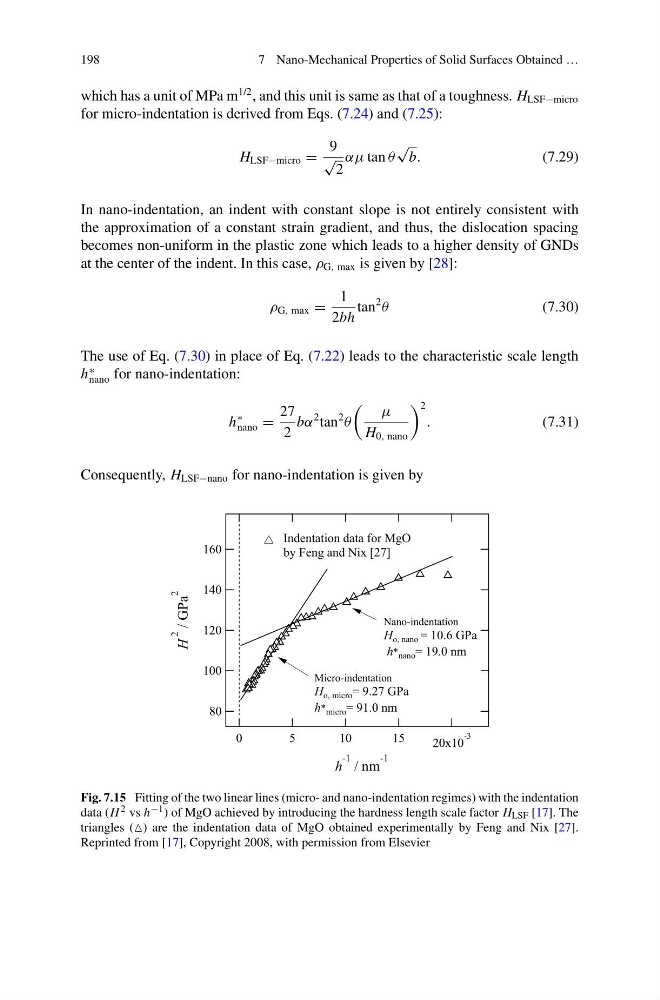
Fig. 7.15 Fitting of the two linear lines (micro- and nano-indentation regimes) with the indentation
data (H 2 vs h −1 ) of MgO achieved by introducing the hardness length scale factor H LSF [17]. The
triangles ( are the indentation data of MgO obtained experimentally by Feng and Nix [27].
Reprinted from [17], Copyright 2008, with permission from Elsevier
7 Nano-Mechanical Properties of Solid Surfaces Obtained …
which has a unit of MPa m
1/2 , and this unit is same as that of a toughness. H LSF−micro
for micro-indentation is derived from Eqs. (7.24) and (7.25):
H LSF−micro =
9
√
2
αμ tan θ
√
b.
(7.29)
In nano-indentation, an indent with constant slope is not entirely consistent with
the approximation of a constant strain gradient, and thus, the dislocation spacing
becomes non-uniform in the plastic zone which leads to a higher density of GNDs
at the center of the indent. In this case, ρ G, max is given by [28]:
ρ G, max =
1
2bh
tan
2
θ
(7.30)
The use of Eq. (7.30) in place of Eq. (7.22) leads to the characteristic scale length
h
∗
nano for nano-indentation:
h
∗
nano =
27
2
bα
2 tan
2
θ
μ
H 0, nano
2
.
(7.31)
Consequently, H LSF−nano for nano-indentation is given by
160
140
120
100
80
H
2
/ GPa
2
20x10
-3
15
10
5
0
h
-1 / nm
-1
Nano-indentation
H o, nano = 10.6 GPa
h* nano = 19.0 nm
Micro-indentation
H o, micro = 9.27 GPa
h* micro = 91.0 nm
Indentation data for MgO
by Feng and Nix [27]
Fig. 7.15 Fitting of the two linear lines (micro- and nano-indentation regimes) with the indentation
data (H 2 vs h −1 ) of MgO achieved by introducing the hardness length scale factor H LSF [17]. The
triangles ( are the indentation data of MgO obtained experimentally by Feng and Nix [27].
Reprinted from [17], Copyright 2008, with permission from Elsevier