

6.5 Criterion for Stress Generation by Nelson and Oriani
159
interface. By contrast, if t o is less than t
c
o , the tensile stress is generated due to the
free space remaining in the metal side at the metal/oxide film interface. However,
it is reminded that the other factors influencing the sign of the film stress such
as electrostriction and crystallization are not taken into consideration for Nelson–
Oriani’s criterion [17].
As explained in the next section, the compressive stress due to the electrostriction
is generated in the oxide film grown during anodic oxidation and can be measured
from the stress relaxation caused by switching off the galvanostatic current or by
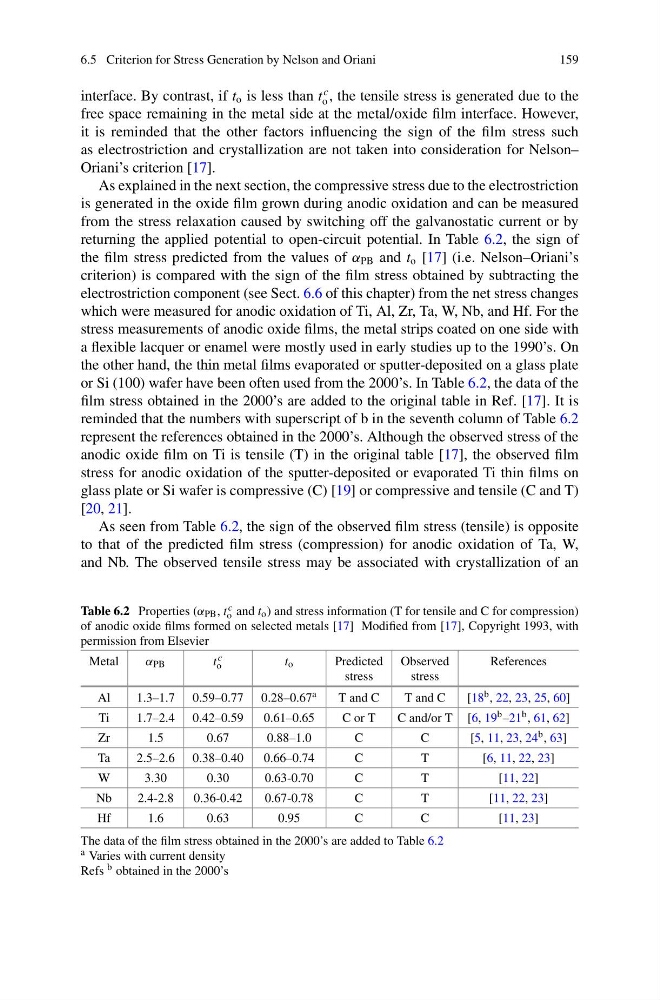
returning the applied potential to open-circuit potential. In Table 6.2, the sign of
the film stress predicted from the values of α PB and t o [17] (i.e. Nelson–Oriani’s
criterion) is compared with the sign of the film stress obtained by subtracting the
electrostriction component (see Sect. 6.6 of this chapter) from the net stress changes
which were measured for anodic oxidation of Ti, Al, Zr, Ta, W, Nb, and Hf. For the
stress measurements of anodic oxide films, the metal strips coated on one side with
a flexible lacquer or enamel were mostly used in early studies up to the 1990’s. On
the other hand, the thin metal films evaporated or sputter-deposited on a glass plate
or Si (100) wafer have been often used from the 2000’s. In Table 6.2, the data of the
film stress obtained in the 2000’s are added to the original table in Ref. [17]. It is
reminded that the numbers with superscript of b in the seventh column of Table 6.2
represent the references obtained in the 2000’s. Although the observed stress of the
anodic oxide film on Ti is tensile (T) in the original table [17], the observed film
stress for anodic oxidation of the sputter-deposited or evaporated Ti thin films on
glass plate or Si wafer is compressive (C) [19] or compressive and tensile (C and T)
[20, 21].
As seen from Table 6.2, the sign of the observed film stress (tensile) is opposite
to that of the predicted film stress (compression) for anodic oxidation of Ta, W,
and Nb. The observed tensile stress may be associated with crystallization of an
Table 6.2 Properties (α PB , t c
o and t o ) and stress information (T for tensile and C for compression)
of anodic oxide films formed on selected metals [17] Modified from [17], Copyright 1993, with
permission from Elsevier
Metal
α PB
t c
o
t o
Predicted
stress
Observed
stress
References
Al
1.3–1.7 0.59–0.77 0.28–0.67 a
T and C
T and C
[18 b , 22, 23, 25, 60]
Ti
1.7–2.4 0.42–0.59
0.61–0.65
C or T
C and/or T [6, 19 b –21 b , 61, 62]
Zr
1.5
0.67
0.88–1.0
C
C
[5, 11, 23, 24 b , 63]
Ta
2.5–2.6 0.38–0.40
0.66–0.74
C
T
[6, 11, 22, 23]
W
3.30
0.30
0.63-0.70
C
T
[11, 22]
Nb
2.4-2.8
0.36-0.42
0.67-0.78
C
T
[11, 22, 23]
Hf
1.6
0.63
0.95
C
C
[11, 23]
The data of the film stress obtained in the 2000’s are added to Table 6.2
a Varies with current density
Refs b obtained in the 2000’s
159
interface. By contrast, if t o is less than t
c
o , the tensile stress is generated due to the
free space remaining in the metal side at the metal/oxide film interface. However,
it is reminded that the other factors influencing the sign of the film stress such
as electrostriction and crystallization are not taken into consideration for Nelson–
Oriani’s criterion [17].
As explained in the next section, the compressive stress due to the electrostriction
is generated in the oxide film grown during anodic oxidation and can be measured
from the stress relaxation caused by switching off the galvanostatic current or by
returning the applied potential to open-circuit potential. In Table 6.2, the sign of
the film stress predicted from the values of α PB and t o [17] (i.e. Nelson–Oriani’s
criterion) is compared with the sign of the film stress obtained by subtracting the
electrostriction component (see Sect. 6.6 of this chapter) from the net stress changes
which were measured for anodic oxidation of Ti, Al, Zr, Ta, W, Nb, and Hf. For the
stress measurements of anodic oxide films, the metal strips coated on one side with
a flexible lacquer or enamel were mostly used in early studies up to the 1990’s. On
the other hand, the thin metal films evaporated or sputter-deposited on a glass plate
or Si (100) wafer have been often used from the 2000’s. In Table 6.2, the data of the
film stress obtained in the 2000’s are added to the original table in Ref. [17]. It is
reminded that the numbers with superscript of b in the seventh column of Table 6.2
represent the references obtained in the 2000’s. Although the observed stress of the
anodic oxide film on Ti is tensile (T) in the original table [17], the observed film
stress for anodic oxidation of the sputter-deposited or evaporated Ti thin films on
glass plate or Si wafer is compressive (C) [19] or compressive and tensile (C and T)
[20, 21].
As seen from Table 6.2, the sign of the observed film stress (tensile) is opposite
to that of the predicted film stress (compression) for anodic oxidation of Ta, W,
and Nb. The observed tensile stress may be associated with crystallization of an
Table 6.2 Properties (α PB , t c
o and t o ) and stress information (T for tensile and C for compression)
of anodic oxide films formed on selected metals [17] Modified from [17], Copyright 1993, with
permission from Elsevier
Metal
α PB
t c
o
t o
Predicted
stress
Observed
stress
References
Al
1.3–1.7 0.59–0.77 0.28–0.67 a
T and C
T and C
[18 b , 22, 23, 25, 60]
Ti
1.7–2.4 0.42–0.59
0.61–0.65
C or T
C and/or T [6, 19 b –21 b , 61, 62]
Zr
1.5
0.67
0.88–1.0
C
C
[5, 11, 23, 24 b , 63]
Ta
2.5–2.6 0.38–0.40
0.66–0.74
C
T
[6, 11, 22, 23]
W
3.30
0.30
0.63-0.70
C
T
[11, 22]
Nb
2.4-2.8
0.36-0.42
0.67-0.78
C
T
[11, 22, 23]
Hf
1.6
0.63
0.95
C
C
[11, 23]
The data of the film stress obtained in the 2000’s are added to Table 6.2
a Varies with current density
Refs b obtained in the 2000’s