

6.2 High Field Model for Growth of Anodic Oxide Film
153
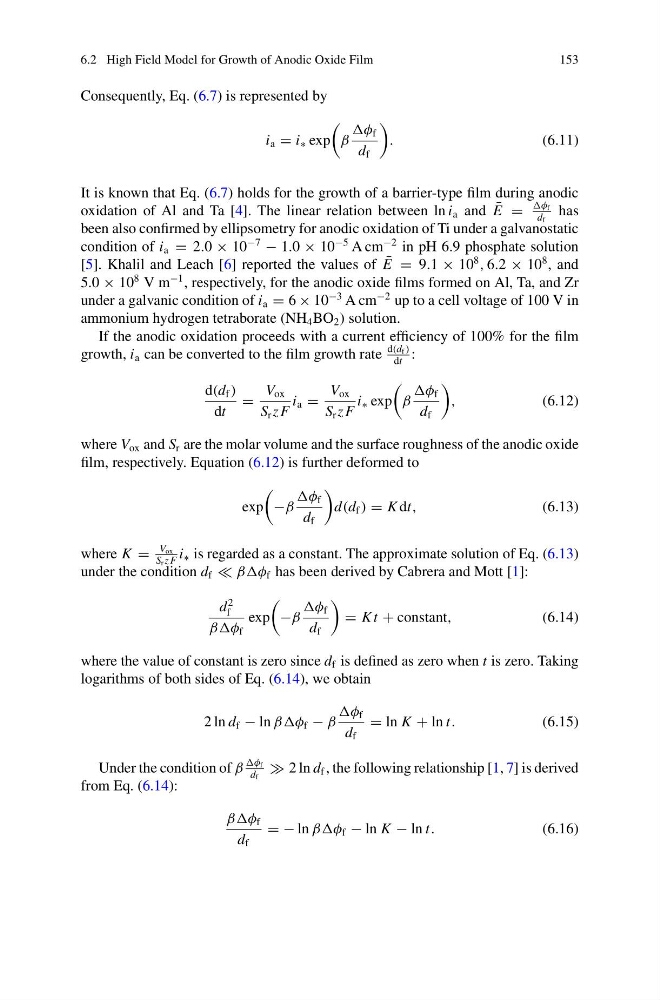
Consequently, Eq. (6.7) is represented by
i a = i ∗ exp
β
φ f
d f
.
(6.11)
It is known that Eq. (6.7) holds for the growth of a barrier-type film during anodic
oxidation of Al and Ta [4]. The linear relation between ln i a and ¯
E =
φ f
d f
has
been also confirmed by ellipsometry for anodic oxidation of Ti under a galvanostatic
condition of i a = 2.0 × 10
−7
− 1.0 × 10
−5 A cm
−2 in pH 6.9 phosphate solution
[5]. Khalil and Leach [6] reported the values of ¯
E = 9.1 × 10
8
, 6.2 × 10
8 , and
5.0 × 10
8 V m
−1 , respectively, for the anodic oxide films formed on Al, Ta, and Zr
under a galvanic condition of i a = 6 × 10
−3 A cm
−2 up to a cell voltage of 100 V in
ammonium hydrogen tetraborate (NH 4 BO 2 ) solution.
If the anodic oxidation proceeds with a current efficiency of 100% for the film
growth, i a can be converted to the film growth rate
d(d f )
dt
:
d(d f )
dt
=
V ox
S r z F
i a =
V ox
S r z F
i ∗ exp
β
φ f
d f
,
(6.12)
where V ox and S r are the molar volume and the surface roughness of the anodic oxide
film, respectively. Equation (6.12) is further deformed to
exp
−β
φ f
d f
d(d f ) = K dt,
(6.13)
where K =
V ox
S r z F
i ∗ is regarded as a constant. The approximate solution of Eq. (6.13)
under the condition d f ββφ f has been derived by Cabrera and Mott [1]:
d
2
f
ββφ f
exp
−β
φ f
d f
= K t + constant,
(6.14)
where the value of constant is zero since d f is defined as zero when t is zero. Taking
logarithms of both sides of Eq. (6.14), we obtain
2 ln d f − ln ββφ f − β
φ f
d f
= ln K + ln t.
(6.15)
Under the condition of β
φ f
d f
2 ln d f , the following relationship [1, 7] is derived
from Eq. (6.14):
ββφ f
d f
= − ln ββφ f − ln K − ln t.
(6.16)
153
Consequently, Eq. (6.7) is represented by
i a = i ∗ exp
β
φ f
d f
.
(6.11)
It is known that Eq. (6.7) holds for the growth of a barrier-type film during anodic
oxidation of Al and Ta [4]. The linear relation between ln i a and ¯
E =
φ f
d f
has
been also confirmed by ellipsometry for anodic oxidation of Ti under a galvanostatic
condition of i a = 2.0 × 10
−7
− 1.0 × 10
−5 A cm
−2 in pH 6.9 phosphate solution
[5]. Khalil and Leach [6] reported the values of ¯
E = 9.1 × 10
8
, 6.2 × 10
8 , and
5.0 × 10
8 V m
−1 , respectively, for the anodic oxide films formed on Al, Ta, and Zr
under a galvanic condition of i a = 6 × 10
−3 A cm
−2 up to a cell voltage of 100 V in
ammonium hydrogen tetraborate (NH 4 BO 2 ) solution.
If the anodic oxidation proceeds with a current efficiency of 100% for the film
growth, i a can be converted to the film growth rate
d(d f )
dt
:
d(d f )
dt
=
V ox
S r z F
i a =
V ox
S r z F
i ∗ exp
β
φ f
d f
,
(6.12)
where V ox and S r are the molar volume and the surface roughness of the anodic oxide
film, respectively. Equation (6.12) is further deformed to
exp
−β
φ f
d f
d(d f ) = K dt,
(6.13)
where K =
V ox
S r z F
i ∗ is regarded as a constant. The approximate solution of Eq. (6.13)
under the condition d f ββφ f has been derived by Cabrera and Mott [1]:
d
2
f
ββφ f
exp
−β
φ f
d f
= K t + constant,
(6.14)
where the value of constant is zero since d f is defined as zero when t is zero. Taking
logarithms of both sides of Eq. (6.14), we obtain
2 ln d f − ln ββφ f − β
φ f
d f
= ln K + ln t.
(6.15)
Under the condition of β
φ f
d f
2 ln d f , the following relationship [1, 7] is derived
from Eq. (6.14):
ββφ f
d f
= − ln ββφ f − ln K − ln t.
(6.16)