

6.2 High Field Model for Growth of Anodic Oxide Film
151
(In the absence of applied electric field)
(In the presence of applied electric field)
Potential energy,
U
Distance, x
U b
a
S 1
Q 1
S 2
Q 2
E = 0
E > 0
U b
azFE
azFE
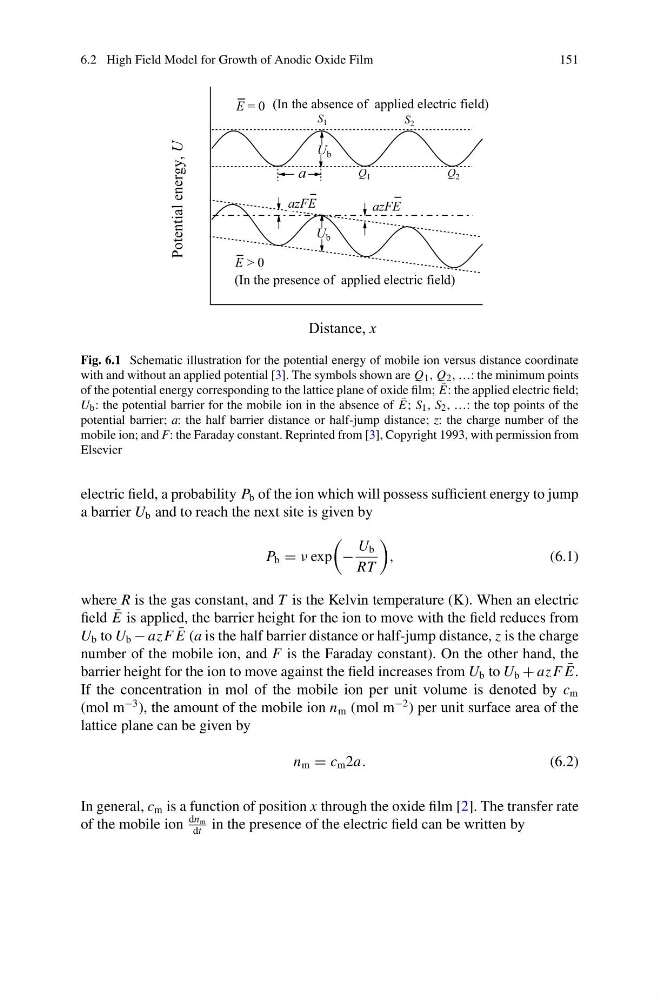
Fig. 6.1 Schematic illustration for the potential energy of mobile ion versus distance coordinate
with and without an applied potential [3]. The symbols shown are Q 1 , Q 2 , …: the minimum points
of the potential energy corresponding to the lattice plane of oxide film; ¯
E: the applied electric field;
U b : the potential barrier for the mobile ion in the absence of ¯
E; S 1 , S 2 , …: the top points of the
potential barrier; a: the half barrier distance or half-jump distance; z: the charge number of the
mobile ion; and F: the Faraday constant. Reprinted from [3], Copyright 1993, with permission from
Elsevier
electric field, a probability P b of the ion which will possess sufficient energy to jump
a barrier U b and to reach the next site is given by
P b = ν exp
−
U b
RT
,
(6.1)
where R is the gas constant, and T is the Kelvin temperature (K). When an electric
field ¯
E is applied, the barrier height for the ion to move with the field reduces from
U b to U b − az F ¯
E (a is the half barrier distance or half-jump distance, z is the charge
number of the mobile ion, and F is the Faraday constant). On the other hand, the
barrier height for the ion to move against the field increases from U b to U b + az F ¯
E.
If the concentration in mol of the mobile ion per unit volume is denoted by c m
(mol m
−3 ), the amount of the mobile ion n m (mol m
−2 ) per unit surface area of the
lattice plane can be given by
n m = c m 2a.
(6.2)
In general, c m is a function of position x through the oxide film [2]. The transfer rate
of the mobile ion
dn m
dt
in the presence of the electric field can be written by
151
(In the absence of applied electric field)
(In the presence of applied electric field)
Potential energy,
U
Distance, x
U b
a
S 1
Q 1
S 2
Q 2
E = 0
E > 0
U b
azFE
azFE
Fig. 6.1 Schematic illustration for the potential energy of mobile ion versus distance coordinate
with and without an applied potential [3]. The symbols shown are Q 1 , Q 2 , …: the minimum points
of the potential energy corresponding to the lattice plane of oxide film; ¯
E: the applied electric field;
U b : the potential barrier for the mobile ion in the absence of ¯
E; S 1 , S 2 , …: the top points of the
potential barrier; a: the half barrier distance or half-jump distance; z: the charge number of the
mobile ion; and F: the Faraday constant. Reprinted from [3], Copyright 1993, with permission from
Elsevier
electric field, a probability P b of the ion which will possess sufficient energy to jump
a barrier U b and to reach the next site is given by
P b = ν exp
−
U b
RT
,
(6.1)
where R is the gas constant, and T is the Kelvin temperature (K). When an electric
field ¯
E is applied, the barrier height for the ion to move with the field reduces from
U b to U b − az F ¯
E (a is the half barrier distance or half-jump distance, z is the charge
number of the mobile ion, and F is the Faraday constant). On the other hand, the
barrier height for the ion to move against the field increases from U b to U b + az F ¯
E.
If the concentration in mol of the mobile ion per unit volume is denoted by c m
(mol m
−3 ), the amount of the mobile ion n m (mol m
−2 ) per unit surface area of the
lattice plane can be given by
n m = c m 2a.
(6.2)
In general, c m is a function of position x through the oxide film [2]. The transfer rate
of the mobile ion
dn m
dt
in the presence of the electric field can be written by