

1.3 Surface Excess Quantities
5
In addition, a quantity which is of interest in connection with adsorption and
segregation phenomena is the excess amount of material or excess number of moles
with relation to the interface. The surface excess number of moles n
σ
i of component
i is defined as
n
σ
i = n i −
n
α
i + n
β
i
= n i −
c
α
i V
α
+ c
β
i V
β
= n i − c
α
i V +
c
α
i − c
β
i
V
β
,
(1.9)
where n i is the total number of moles of component i in the entire system, n
α
i and
n
β
i the numbers of moles of component i, c
α
i and c
β
i the concentrations (moles per
unit volume) of component i in the homogenous α and β phases, respectively, and V
is the sum of V
α and V
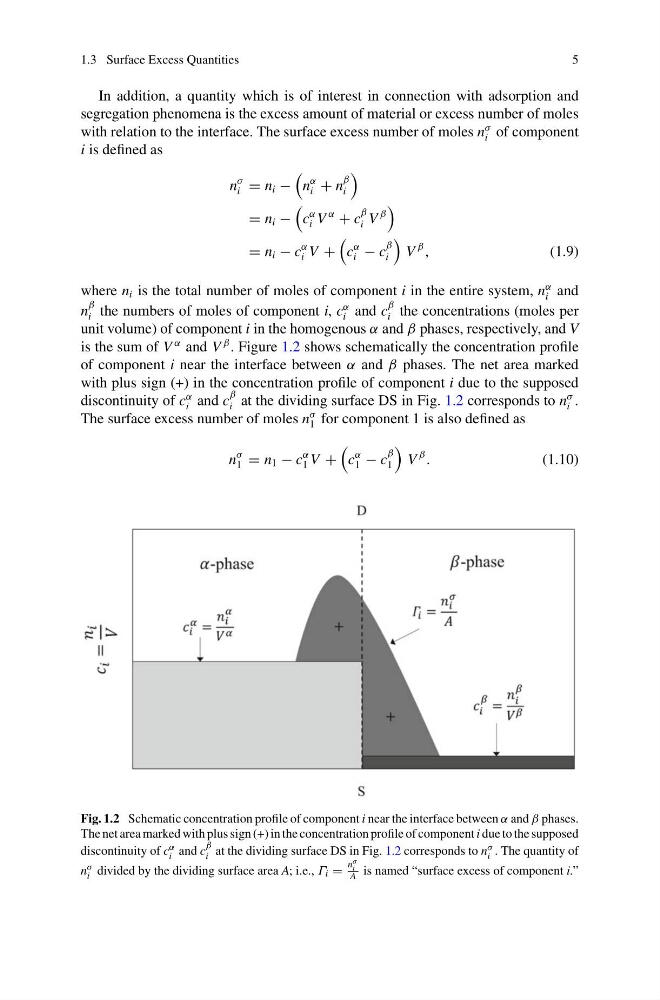
β . Figure 1.2 shows schematically the concentration profile
of component i near the interface between α and β phases. The net area marked
with plus sign (+) in the concentration profile of component i due to the supposed
discontinuity of c
α
i and c
β
i at the dividing surface DS in Fig. 1.2 corresponds to n
σ
i .
The surface excess number of moles n
σ
1 for component 1 is also defined as
n
σ
1 = n 1 − c
α
1 V +
c
α
1 − c
β
1
V
β
.
(1.10)
Fig. 1.2 Schematic concentration profile of component i near the interface between α and β phases.
The net area marked with plus sign (+) in the concentration profile of component i due to the supposed
discontinuity of c α
i and c
β
i at the dividing surface DS in Fig. 1.2 corresponds to n σ
i . The quantity of
n σ
i divided by the dividing surface area A; i.e., Γ i =
n σ
i
A is named “surface excess of component i.”
5
In addition, a quantity which is of interest in connection with adsorption and
segregation phenomena is the excess amount of material or excess number of moles
with relation to the interface. The surface excess number of moles n
σ
i of component
i is defined as
n
σ
i = n i −
n
α
i + n
β
i
= n i −
c
α
i V
α
+ c
β
i V
β
= n i − c
α
i V +
c
α
i − c
β
i
V
β
,
(1.9)
where n i is the total number of moles of component i in the entire system, n
α
i and
n
β
i the numbers of moles of component i, c
α
i and c
β
i the concentrations (moles per
unit volume) of component i in the homogenous α and β phases, respectively, and V
is the sum of V
α and V
β . Figure 1.2 shows schematically the concentration profile
of component i near the interface between α and β phases. The net area marked
with plus sign (+) in the concentration profile of component i due to the supposed
discontinuity of c
α
i and c
β
i at the dividing surface DS in Fig. 1.2 corresponds to n
σ
i .
The surface excess number of moles n
σ
1 for component 1 is also defined as
n
σ
1 = n 1 − c
α
1 V +
c
α
1 − c
β
1
V
β
.
(1.10)
Fig. 1.2 Schematic concentration profile of component i near the interface between α and β phases.
The net area marked with plus sign (+) in the concentration profile of component i due to the supposed
discontinuity of c α
i and c
β
i at the dividing surface DS in Fig. 1.2 corresponds to n σ
i . The quantity of
n σ
i divided by the dividing surface area A; i.e., Γ i =
n σ
i
A is named “surface excess of component i.”