

84
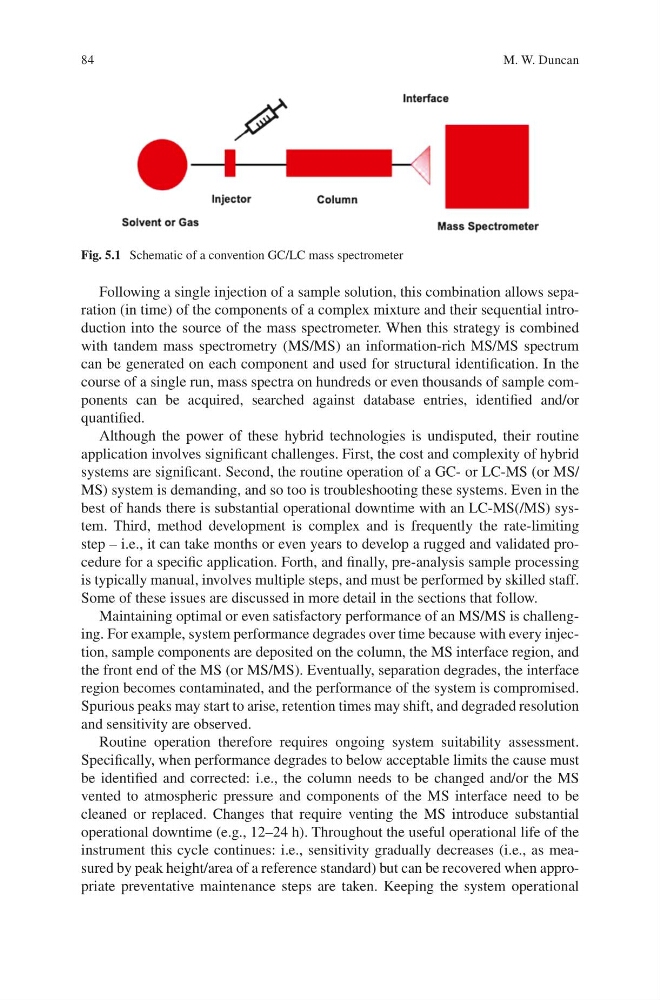
Following a single injection of a sample solution, this combination allows separation (in time) of the components of a complex mixture and their sequential introduction into the source of the mass spectrometer. When this strategy is combined
with tandem mass spectrometry (MS/MS) an information-rich MS/MS spectrum
can be generated on each component and used for structural identification. In the
course of a single run, mass spectra on hundreds or even thousands of sample components can be acquired, searched against database entries, identified and/or
quantified.
Although the power of these hybrid technologies is undisputed, their routine
application involves significant challenges. First, the cost and complexity of hybrid
systems are significant. Second, the routine operation of a GC- or LC-MS (or MS/
MS) system is demanding, and so too is troubleshooting these systems. Even in the
best of hands there is substantial operational downtime with an LC-MS(/MS) system. Third, method development is complex and is frequently the rate-limiting
step – i.e., it can take months or even years to develop a rugged and validated procedure for a specific application. Forth, and finally, pre-analysis sample processing
is typically manual, involves multiple steps, and must be performed by skilled staff.
Some of these issues are discussed in more detail in the sections that follow.
Maintaining optimal or even satisfactory performance of an MS/MS is challenging. For example, system performance degrades over time because with every injection, sample components are deposited on the column, the MS interface region, and
the front end of the MS (or MS/MS). Eventually, separation degrades, the interface
region becomes contaminated, and the performance of the system is compromised.
Spurious peaks may start to arise, retention times may shift, and degraded resolution
and sensitivity are observed.
Routine operation therefore requires ongoing system suitability assessment.
Specifically, when performance degrades to below acceptable limits the cause must
be identified and corrected: i.e., the column needs to be changed and/or the MS
vented to atmospheric pressure and components of the MS interface need to be
cleaned or replaced. Changes that require venting the MS introduce substantial
operational downtime (e.g., 12–24 h). Throughout the useful operational life of the
instrument this cycle continues: i.e., sensitivity gradually decreases (i.e., as measured by peak height/area of a reference standard) but can be recovered when appropriate preventative maintenance steps are taken. Keeping the system operational
Fig. 5.1 Schematic of a convention GC/LC mass spectrometer
M. W. Duncan
Following a single injection of a sample solution, this combination allows separation (in time) of the components of a complex mixture and their sequential introduction into the source of the mass spectrometer. When this strategy is combined
with tandem mass spectrometry (MS/MS) an information-rich MS/MS spectrum
can be generated on each component and used for structural identification. In the
course of a single run, mass spectra on hundreds or even thousands of sample components can be acquired, searched against database entries, identified and/or
quantified.
Although the power of these hybrid technologies is undisputed, their routine
application involves significant challenges. First, the cost and complexity of hybrid
systems are significant. Second, the routine operation of a GC- or LC-MS (or MS/
MS) system is demanding, and so too is troubleshooting these systems. Even in the
best of hands there is substantial operational downtime with an LC-MS(/MS) system. Third, method development is complex and is frequently the rate-limiting
step – i.e., it can take months or even years to develop a rugged and validated procedure for a specific application. Forth, and finally, pre-analysis sample processing
is typically manual, involves multiple steps, and must be performed by skilled staff.
Some of these issues are discussed in more detail in the sections that follow.
Maintaining optimal or even satisfactory performance of an MS/MS is challenging. For example, system performance degrades over time because with every injection, sample components are deposited on the column, the MS interface region, and
the front end of the MS (or MS/MS). Eventually, separation degrades, the interface
region becomes contaminated, and the performance of the system is compromised.
Spurious peaks may start to arise, retention times may shift, and degraded resolution
and sensitivity are observed.
Routine operation therefore requires ongoing system suitability assessment.
Specifically, when performance degrades to below acceptable limits the cause must
be identified and corrected: i.e., the column needs to be changed and/or the MS
vented to atmospheric pressure and components of the MS interface need to be
cleaned or replaced. Changes that require venting the MS introduce substantial
operational downtime (e.g., 12–24 h). Throughout the useful operational life of the
instrument this cycle continues: i.e., sensitivity gradually decreases (i.e., as measured by peak height/area of a reference standard) but can be recovered when appropriate preventative maintenance steps are taken. Keeping the system operational
Fig. 5.1 Schematic of a convention GC/LC mass spectrometer
M. W. Duncan