

50
two (MS/MS or MS
2
) or more (MS
n
) sequential stages of mass analysis (which can
be spatially or temporally separated) in order to examine selectively the dissociations of given ions in a mixture of ions. For small molecules, ion dissociation can be
induced by collision with a gas, such as nitrogen, argon, helium, occurring in a collision cell (q) located after the first analyzer, or inside an ion trap.
Different instrumental setup can be used in tandem mass spectrometry, such as
sectors (B,E; E,B), triple quadrupoles (QqQ), ion traps, QqToF, Q-Orbitrap, FT-ICR,
ToF/ToF.
3.4 Study of Complex Mixtures by MS
In the study of complex mixtures by MS, the classical approach consists in an
extraction, a preliminary purification of the sample and a coupling of MS with gas
chromatography (GC) for volatile compounds or with high performance liquid
chromatography (HPLC) for polar compounds. Thus GC-MS(/MS) and HPLC-MS(/
MS) couplings are extensively used when complex mixtures have to be analyzed.
This approach increases specificity and selectivity of the analysis, because, for each
compound, in addition to its mass spectrum, its retention time is also obtained. So,
even if different compounds might yield the same mass spectrum, they will have
different retention times.
A new tendency is to reduce at minimum or remove at all the extraction and
purification steps and to introduce the entire sample inside the ion source. This can
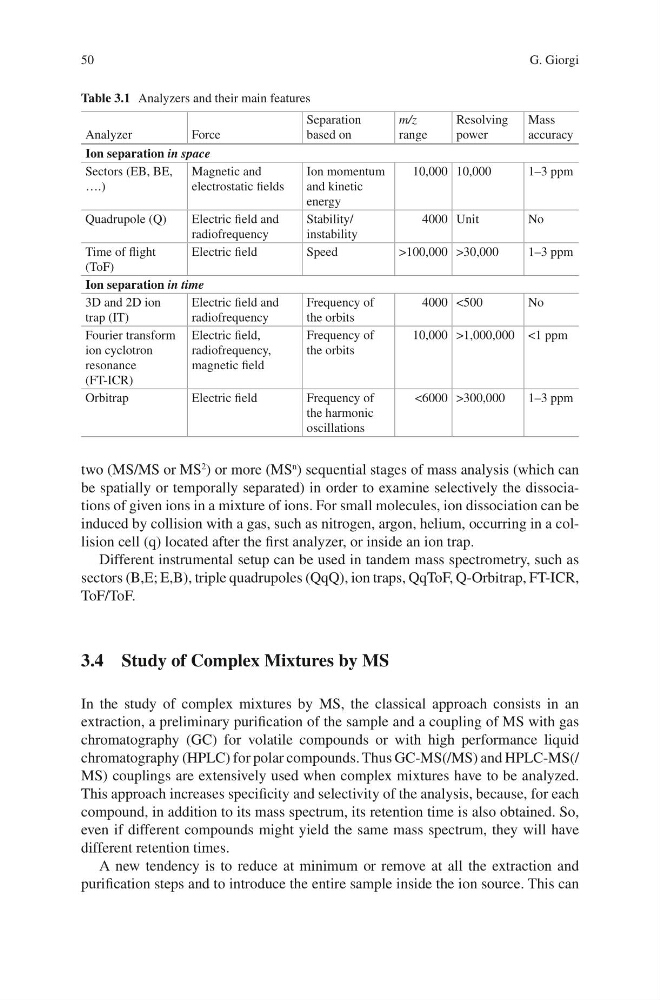
Table 3.1 Analyzers and their main features
Analyzer
Force
Separation
based on
m/z
range
Resolving
power
Mass
accuracy
Ion separation in space
Sectors (EB, BE,
….)
Magnetic and
electrostatic fields
Ion momentum
and kinetic
energy
10,000 10,000
1–3 ppm
Quadrupole (Q)
Electric field and
radiofrequency
Stability/
instability
4000 Unit
No
Time of flight
(ToF)
Electric field
Speed
>100,000 >30,000
1–3 ppm
Ion separation in time
3D and 2D ion
trap (IT)
Electric field and
radiofrequency
Frequency of
the orbits
4000 <500
No
Fourier transform
ion cyclotron
resonance
(FT-ICR)
Electric field,
radiofrequency,
magnetic field
Frequency of
the orbits
10,000 >1,000,000 <1 ppm
Orbitrap
Electric field
Frequency of
the harmonic
oscillations
<6000 >300,000
1–3 ppm
G. Giorgi
two (MS/MS or MS
2
) or more (MS
n
) sequential stages of mass analysis (which can
be spatially or temporally separated) in order to examine selectively the dissociations of given ions in a mixture of ions. For small molecules, ion dissociation can be
induced by collision with a gas, such as nitrogen, argon, helium, occurring in a collision cell (q) located after the first analyzer, or inside an ion trap.
Different instrumental setup can be used in tandem mass spectrometry, such as
sectors (B,E; E,B), triple quadrupoles (QqQ), ion traps, QqToF, Q-Orbitrap, FT-ICR,
ToF/ToF.
3.4 Study of Complex Mixtures by MS
In the study of complex mixtures by MS, the classical approach consists in an
extraction, a preliminary purification of the sample and a coupling of MS with gas
chromatography (GC) for volatile compounds or with high performance liquid
chromatography (HPLC) for polar compounds. Thus GC-MS(/MS) and HPLC-MS(/
MS) couplings are extensively used when complex mixtures have to be analyzed.
This approach increases specificity and selectivity of the analysis, because, for each
compound, in addition to its mass spectrum, its retention time is also obtained. So,
even if different compounds might yield the same mass spectrum, they will have
different retention times.
A new tendency is to reduce at minimum or remove at all the extraction and
purification steps and to introduce the entire sample inside the ion source. This can
Table 3.1 Analyzers and their main features
Analyzer
Force
Separation
based on
m/z
range
Resolving
power
Mass
accuracy
Ion separation in space
Sectors (EB, BE,
….)
Magnetic and
electrostatic fields
Ion momentum
and kinetic
energy
10,000 10,000
1–3 ppm
Quadrupole (Q)
Electric field and
radiofrequency
Stability/
instability
4000 Unit
No
Time of flight
(ToF)
Electric field
Speed
>100,000 >30,000
1–3 ppm
Ion separation in time
3D and 2D ion
trap (IT)
Electric field and
radiofrequency
Frequency of
the orbits
4000 <500
No
Fourier transform
ion cyclotron
resonance
(FT-ICR)
Electric field,
radiofrequency,
magnetic field
Frequency of
the orbits
10,000 >1,000,000 <1 ppm
Orbitrap
Electric field
Frequency of
the harmonic
oscillations
<6000 >300,000
1–3 ppm
G. Giorgi