

249
long-range atmospheric transport to even remote regions of the world. Their ubiquitous distribution in both indoor and outdoor environments make them of emerging
toxic chemical compounds, thus motivating the development of methods for their
reliable quantification.
23.2 Analytical Strategy
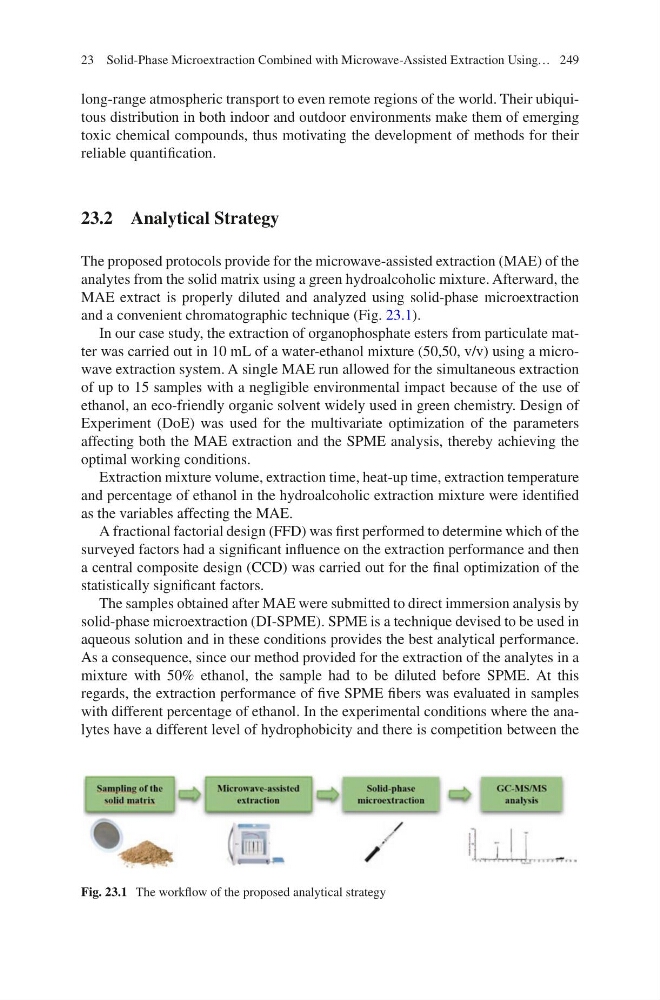
The proposed protocols provide for the microwave-assisted extraction (MAE) of the
analytes from the solid matrix using a green hydroalcoholic mixture. Afterward, the
MAE extract is properly diluted and analyzed using solid-phase microextraction
and a convenient chromatographic technique (Fig. 23.1).
In our case study, the extraction of organophosphate esters from particulate matter was carried out in 10 mL of a water-ethanol mixture (50,50, v/v) using a microwave extraction system. A single MAE run allowed for the simultaneous extraction
of up to 15 samples with a negligible environmental impact because of the use of
ethanol, an eco-friendly organic solvent widely used in green chemistry. Design of
Experiment (DoE) was used for the multivariate optimization of the parameters
affecting both the MAE extraction and the SPME analysis, thereby achieving the
optimal working conditions.
Extraction mixture volume, extraction time, heat-up time, extraction temperature
and percentage of ethanol in the hydroalcoholic extraction mixture were identified
as the variables affecting the MAE.
A fractional factorial design (FFD) was first performed to determine which of the
surveyed factors had a significant influence on the extraction performance and then
a central composite design (CCD) was carried out for the final optimization of the
statistically significant factors.
The samples obtained after MAE were submitted to direct immersion analysis by
solid-phase microextraction (DI-SPME). SPME is a technique devised to be used in
aqueous solution and in these conditions provides the best analytical performance.
As a consequence, since our method provided for the extraction of the analytes in a
mixture with 50% ethanol, the sample had to be diluted before SPME. At this
regards, the extraction performance of five SPME fibers was evaluated in samples
with different percentage of ethanol. In the experimental conditions where the analytes have a different level of hydrophobicity and there is competition between the
Fig. 23.1 The workflow of the proposed analytical strategy
23 Solid-Phase Microextraction Combined with Microwave-Assisted Extraction Using…
long-range atmospheric transport to even remote regions of the world. Their ubiquitous distribution in both indoor and outdoor environments make them of emerging
toxic chemical compounds, thus motivating the development of methods for their
reliable quantification.
23.2 Analytical Strategy
The proposed protocols provide for the microwave-assisted extraction (MAE) of the
analytes from the solid matrix using a green hydroalcoholic mixture. Afterward, the
MAE extract is properly diluted and analyzed using solid-phase microextraction
and a convenient chromatographic technique (Fig. 23.1).
In our case study, the extraction of organophosphate esters from particulate matter was carried out in 10 mL of a water-ethanol mixture (50,50, v/v) using a microwave extraction system. A single MAE run allowed for the simultaneous extraction
of up to 15 samples with a negligible environmental impact because of the use of
ethanol, an eco-friendly organic solvent widely used in green chemistry. Design of
Experiment (DoE) was used for the multivariate optimization of the parameters
affecting both the MAE extraction and the SPME analysis, thereby achieving the
optimal working conditions.
Extraction mixture volume, extraction time, heat-up time, extraction temperature
and percentage of ethanol in the hydroalcoholic extraction mixture were identified
as the variables affecting the MAE.
A fractional factorial design (FFD) was first performed to determine which of the
surveyed factors had a significant influence on the extraction performance and then
a central composite design (CCD) was carried out for the final optimization of the
statistically significant factors.
The samples obtained after MAE were submitted to direct immersion analysis by
solid-phase microextraction (DI-SPME). SPME is a technique devised to be used in
aqueous solution and in these conditions provides the best analytical performance.
As a consequence, since our method provided for the extraction of the analytes in a
mixture with 50% ethanol, the sample had to be diluted before SPME. At this
regards, the extraction performance of five SPME fibers was evaluated in samples
with different percentage of ethanol. In the experimental conditions where the analytes have a different level of hydrophobicity and there is competition between the
Fig. 23.1 The workflow of the proposed analytical strategy
23 Solid-Phase Microextraction Combined with Microwave-Assisted Extraction Using…