

240
smartphones and other light detectors, cell-based biosensors have been also integrated into compact analytical devices. However, the scarce robustness of living
cells still represents an issue and several immobilization methods have been developed for improving cell’s shelf-life and obtain ready-to-use biosensors. More
recently, cell- free transcription-translation (TX-TL) systems have been proposed as
an alternative to cell-based biosensors. Conversely to whole-cell biosensors, TX-TL
systems do not rely on living cells but rather include the biological machinery and
energy source to express a reporter protein as consequence of target activation.
Whole-cell and cell-free biosensors have become preferential alternatives to conventional analytical methods for rapid detection of analytes of environmental interest as they are cost effective and easy to implement into portable devices. The choice
of reporter genes in biosensors, is also a key factor especially for on-site monitoring. A reporter gene is a gene which can be easily and quantitatively distinguished
over a background of endogenous proteins. Several reporter genes have been widely
employed to monitor cellular events associated to signal transduction, including the
application in biosensors.
We report a side-by-side investigation of whole-cell and cell-free transcriptional
and translational system for rapid detection of heavy metal and bacterial contamination in water [1].
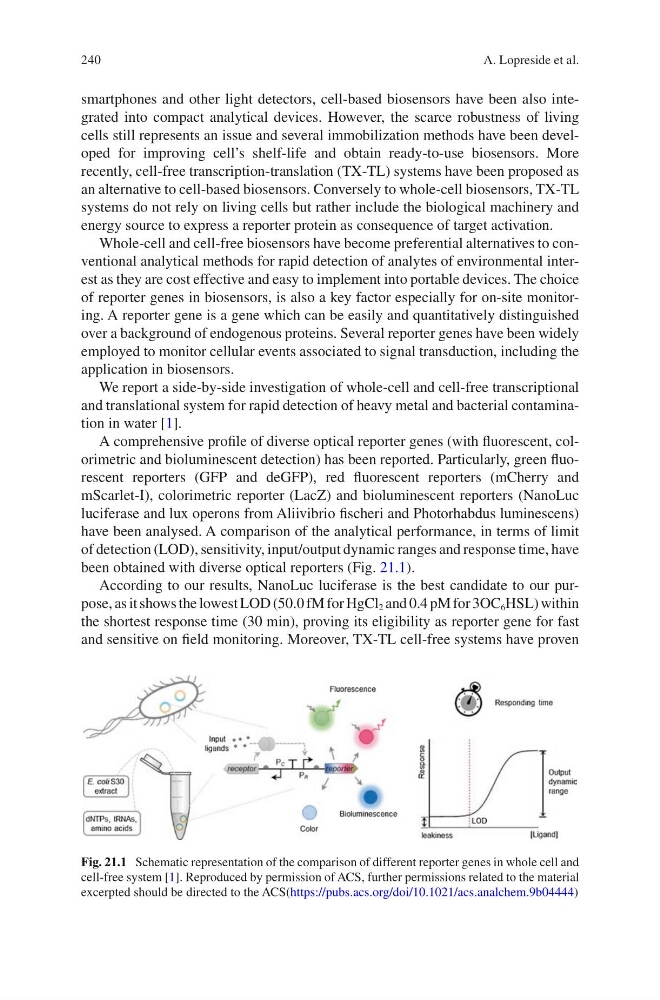
A comprehensive profile of diverse optical reporter genes (with fluorescent, colorimetric and bioluminescent detection) has been reported. Particularly, green fluorescent reporters (GFP and deGFP), red fluorescent reporters (mCherry and
mScarlet-I), colorimetric reporter (LacZ) and bioluminescent reporters (NanoLuc
luciferase and lux operons from Aliivibrio fischeri and Photorhabdus luminescens)
have been analysed. A comparison of the analytical performance, in terms of limit
of detection (LOD), sensitivity, input/output dynamic ranges and response time, have
been obtained with diverse optical reporters (Fig. 21.1).
According to our results, NanoLuc luciferase is the best candidate to our purpose, as it shows the lowest LOD (50.0 fM for HgCl 2 and 0.4 pM for 3OC 6 HSL) within
the shortest response time (30 min), proving its eligibility as reporter gene for fast
and sensitive on field monitoring. Moreover, TX-TL cell-free systems have proven
Fig. 21.1 Schematic representation of the comparison of different reporter genes in whole cell and
cell-free system [1]. Reproduced by permission of ACS, further permissions related to the material
excerpted should be directed to the ACS(https://pubs.acs.org/doi/10.1021/acs.analchem.9b04444)
A. Lopreside et al.
smartphones and other light detectors, cell-based biosensors have been also integrated into compact analytical devices. However, the scarce robustness of living
cells still represents an issue and several immobilization methods have been developed for improving cell’s shelf-life and obtain ready-to-use biosensors. More
recently, cell- free transcription-translation (TX-TL) systems have been proposed as
an alternative to cell-based biosensors. Conversely to whole-cell biosensors, TX-TL
systems do not rely on living cells but rather include the biological machinery and
energy source to express a reporter protein as consequence of target activation.
Whole-cell and cell-free biosensors have become preferential alternatives to conventional analytical methods for rapid detection of analytes of environmental interest as they are cost effective and easy to implement into portable devices. The choice
of reporter genes in biosensors, is also a key factor especially for on-site monitoring. A reporter gene is a gene which can be easily and quantitatively distinguished
over a background of endogenous proteins. Several reporter genes have been widely
employed to monitor cellular events associated to signal transduction, including the
application in biosensors.
We report a side-by-side investigation of whole-cell and cell-free transcriptional
and translational system for rapid detection of heavy metal and bacterial contamination in water [1].
A comprehensive profile of diverse optical reporter genes (with fluorescent, colorimetric and bioluminescent detection) has been reported. Particularly, green fluorescent reporters (GFP and deGFP), red fluorescent reporters (mCherry and
mScarlet-I), colorimetric reporter (LacZ) and bioluminescent reporters (NanoLuc
luciferase and lux operons from Aliivibrio fischeri and Photorhabdus luminescens)
have been analysed. A comparison of the analytical performance, in terms of limit
of detection (LOD), sensitivity, input/output dynamic ranges and response time, have
been obtained with diverse optical reporters (Fig. 21.1).
According to our results, NanoLuc luciferase is the best candidate to our purpose, as it shows the lowest LOD (50.0 fM for HgCl 2 and 0.4 pM for 3OC 6 HSL) within
the shortest response time (30 min), proving its eligibility as reporter gene for fast
and sensitive on field monitoring. Moreover, TX-TL cell-free systems have proven
Fig. 21.1 Schematic representation of the comparison of different reporter genes in whole cell and
cell-free system [1]. Reproduced by permission of ACS, further permissions related to the material
excerpted should be directed to the ACS(https://pubs.acs.org/doi/10.1021/acs.analchem.9b04444)
A. Lopreside et al.