

237
aiming at pointing out the perpetrator of the criminal act, whereas the correct safeguard of the incident scene is a must for civilian haz-mat specialists working in
close contact with police forces. These remarkable differences often lead to dissimilar standard operating procedures, SOPs, and this is frequently a problem, when
major emergency events occur and a joint effort by civilian and military organizations is required.
Anyway, notwithstanding such fundamentally diverse approaches, detection systems and tools used for on-site DIM operations are essentially the same. Lightweight deployable gas-chromatograph mass-spectrometry (on-field GC-MS)
instruments, photoionization-based detectors (PID) and ion mobility spectrometry
devices (IMS; either with open-loop or closed-loop technology) proved to be among
the most reliable and effective instruments for the on-site detection of hazardous
chemicals and are all now widely employed. Although most of them were designed
and developed in the last Cold War period for military use to reveal the use of CWAs
on battlefields, this class of portable instruments was then successfully adapted to
be detectors for civilian haz-mat specialists of the fire brigade, police forces, civil
protection or emergency medical service. This shift from military to civilian application had, in particular, a relevant boost after the attacks to the Twin Towers in
2001, when the increasing threat of use of CWAs or highly toxic chemicals for terrorist attacks, sabotage actions or illicit purposes started to attract a major attention
by governmental first response agencies.
As in other fields, also in the selection of the most suitable detection equipment
and tools, a unique approach and only one class of instruments cannot provide a
solution for all cases. It is, however, crucial that civilian and military on-field operators as well as academic researchers are all aware of these major gaps, especially
when a multi-agency response to emergency situations is needed and a clear and
timely exchange of expertise, scientific results and technical data is required from
all of the actors involved in the response, in order to provide professionals and wide
population with the most reliable and correct information.
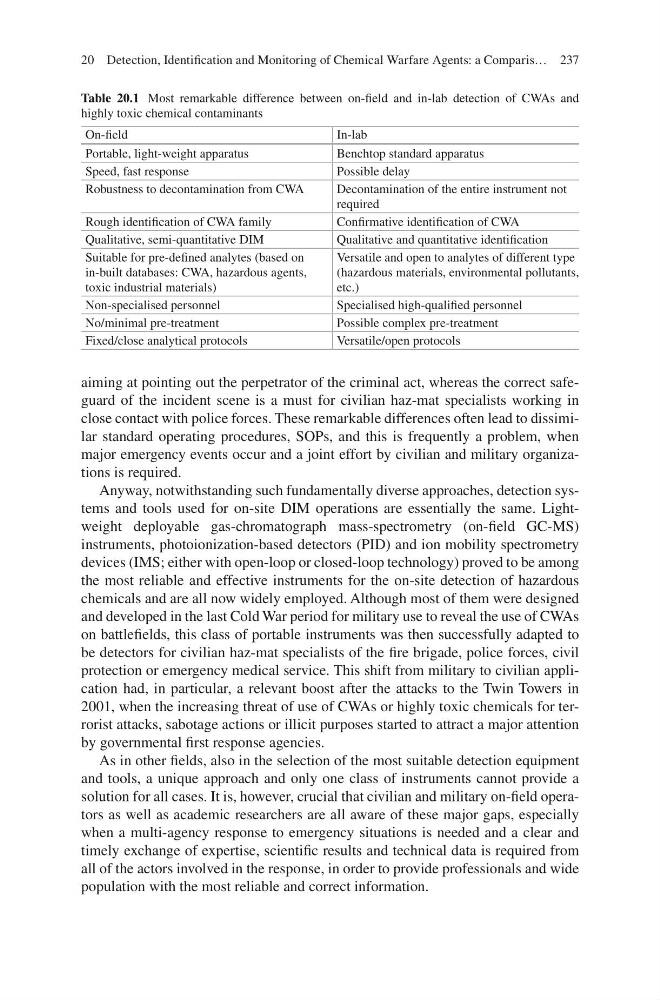
Table 20.1 Most remarkable difference between on-field and in-lab detection of CWAs and
highly toxic chemical contaminants
On-field
In-lab
Portable, light-weight apparatus
Benchtop standard apparatus
Speed, fast response
Possible delay
Robustness to decontamination from CWA
Decontamination of the entire instrument not
required
Rough identification of CWA family
Confirmative identification of CWA
Qualitative, semi-quantitative DIM
Qualitative and quantitative identification
Suitable for pre-defined analytes (based on
in-built databases: CWA, hazardous agents,
toxic industrial materials)
Versatile and open to analytes of different type
(hazardous materials, environmental pollutants,
etc.)
Non-specialised personnel
Specialised high-qualified personnel
No/minimal pre-treatment
Possible complex pre-treatment
Fixed/close analytical protocols
Versatile/open protocols
20 Detection, Identification and Monitoring of Chemical Warfare Agents: a Comparis…
aiming at pointing out the perpetrator of the criminal act, whereas the correct safeguard of the incident scene is a must for civilian haz-mat specialists working in
close contact with police forces. These remarkable differences often lead to dissimilar standard operating procedures, SOPs, and this is frequently a problem, when
major emergency events occur and a joint effort by civilian and military organizations is required.
Anyway, notwithstanding such fundamentally diverse approaches, detection systems and tools used for on-site DIM operations are essentially the same. Lightweight deployable gas-chromatograph mass-spectrometry (on-field GC-MS)
instruments, photoionization-based detectors (PID) and ion mobility spectrometry
devices (IMS; either with open-loop or closed-loop technology) proved to be among
the most reliable and effective instruments for the on-site detection of hazardous
chemicals and are all now widely employed. Although most of them were designed
and developed in the last Cold War period for military use to reveal the use of CWAs
on battlefields, this class of portable instruments was then successfully adapted to
be detectors for civilian haz-mat specialists of the fire brigade, police forces, civil
protection or emergency medical service. This shift from military to civilian application had, in particular, a relevant boost after the attacks to the Twin Towers in
2001, when the increasing threat of use of CWAs or highly toxic chemicals for terrorist attacks, sabotage actions or illicit purposes started to attract a major attention
by governmental first response agencies.
As in other fields, also in the selection of the most suitable detection equipment
and tools, a unique approach and only one class of instruments cannot provide a
solution for all cases. It is, however, crucial that civilian and military on-field operators as well as academic researchers are all aware of these major gaps, especially
when a multi-agency response to emergency situations is needed and a clear and
timely exchange of expertise, scientific results and technical data is required from
all of the actors involved in the response, in order to provide professionals and wide
population with the most reliable and correct information.
Table 20.1 Most remarkable difference between on-field and in-lab detection of CWAs and
highly toxic chemical contaminants
On-field
In-lab
Portable, light-weight apparatus
Benchtop standard apparatus
Speed, fast response
Possible delay
Robustness to decontamination from CWA
Decontamination of the entire instrument not
required
Rough identification of CWA family
Confirmative identification of CWA
Qualitative, semi-quantitative DIM
Qualitative and quantitative identification
Suitable for pre-defined analytes (based on
in-built databases: CWA, hazardous agents,
toxic industrial materials)
Versatile and open to analytes of different type
(hazardous materials, environmental pollutants,
etc.)
Non-specialised personnel
Specialised high-qualified personnel
No/minimal pre-treatment
Possible complex pre-treatment
Fixed/close analytical protocols
Versatile/open protocols
20 Detection, Identification and Monitoring of Chemical Warfare Agents: a Comparis…