

212
The Algerian industry is required to make progress to overcome the challenges it
faces. Meanwhile upgrading old industrial plants within five (5) years, the limit
values for discharges of liquid and airborne effluents from industry support the
antiquity of these Industrial installations by determining a tolerance concerning discharges from industrial liquid and atmospheric effluents from these facilities. In
addition and due to the peculiarities of the technologies used, specific tolerance
limit values are also granted by the relevant industrial categories [7].
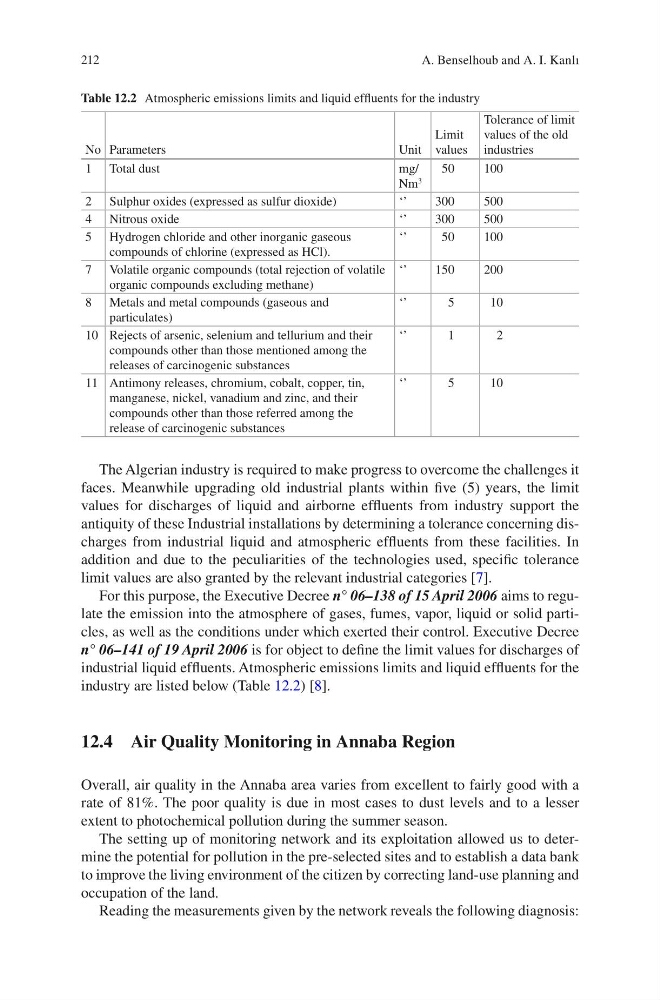
For this purpose, the Executive Decree n° 06–138 of 15 April 2006 aims to regulate the emission into the atmosphere of gases, fumes, vapor, liquid or solid particles, as well as the conditions under which exerted their control. Executive Decree
n° 06–141 of 19 April 2006 is for object to define the limit values for discharges of
industrial liquid effluents. Atmospheric emissions limits and liquid effluents for the
industry are listed below (Table 12.2) [8].
12.4 Air Quality Monitoring in Annaba Region
Overall, air quality in the Annaba area varies from excellent to fairly good with a
rate of 81%. The poor quality is due in most cases to dust levels and to a lesser
extent to photochemical pollution during the summer season.
The setting up of monitoring network and its exploitation allowed us to determine the potential for pollution in the pre-selected sites and to establish a data bank
to improve the living environment of the citizen by correcting land-use planning and
occupation of the land.
Reading the measurements given by the network reveals the following diagnosis:
Table 12.2 Atmospheric emissions limits and liquid effluents for the industry
No Parameters
Unit
Limit
values
Tolerance of limit
values of the old
industries
1 Total dust
mg/
Nm
3
50
100
2 Sulphur oxides (expressed as sulfur dioxide)
‘’
300
500
4 Nitrous oxide
‘’
300
500
5 Hydrogen chloride and other inorganic gaseous
compounds of chlorine (expressed as HCl).
‘’
50
100
7 Volatile organic compounds (total rejection of volatile
organic compounds excluding methane)
‘’
150
200
8 Metals and metal compounds (gaseous and
particulates)
‘’
5
10
10 Rejects of arsenic, selenium and tellurium and their
compounds other than those mentioned among the
releases of carcinogenic substances
‘’
1
2
11 Antimony releases, chromium, cobalt, copper, tin,
manganese, nickel, vanadium and zinc, and their
compounds other than those referred among the
release of carcinogenic substances
‘’
5
10
A. Benselhoub and A. I. Kanlı
The Algerian industry is required to make progress to overcome the challenges it
faces. Meanwhile upgrading old industrial plants within five (5) years, the limit
values for discharges of liquid and airborne effluents from industry support the
antiquity of these Industrial installations by determining a tolerance concerning discharges from industrial liquid and atmospheric effluents from these facilities. In
addition and due to the peculiarities of the technologies used, specific tolerance
limit values are also granted by the relevant industrial categories [7].
For this purpose, the Executive Decree n° 06–138 of 15 April 2006 aims to regulate the emission into the atmosphere of gases, fumes, vapor, liquid or solid particles, as well as the conditions under which exerted their control. Executive Decree
n° 06–141 of 19 April 2006 is for object to define the limit values for discharges of
industrial liquid effluents. Atmospheric emissions limits and liquid effluents for the
industry are listed below (Table 12.2) [8].
12.4 Air Quality Monitoring in Annaba Region
Overall, air quality in the Annaba area varies from excellent to fairly good with a
rate of 81%. The poor quality is due in most cases to dust levels and to a lesser
extent to photochemical pollution during the summer season.
The setting up of monitoring network and its exploitation allowed us to determine the potential for pollution in the pre-selected sites and to establish a data bank
to improve the living environment of the citizen by correcting land-use planning and
occupation of the land.
Reading the measurements given by the network reveals the following diagnosis:
Table 12.2 Atmospheric emissions limits and liquid effluents for the industry
No Parameters
Unit
Limit
values
Tolerance of limit
values of the old
industries
1 Total dust
mg/
Nm
3
50
100
2 Sulphur oxides (expressed as sulfur dioxide)
‘’
300
500
4 Nitrous oxide
‘’
300
500
5 Hydrogen chloride and other inorganic gaseous
compounds of chlorine (expressed as HCl).
‘’
50
100
7 Volatile organic compounds (total rejection of volatile
organic compounds excluding methane)
‘’
150
200
8 Metals and metal compounds (gaseous and
particulates)
‘’
5
10
10 Rejects of arsenic, selenium and tellurium and their
compounds other than those mentioned among the
releases of carcinogenic substances
‘’
1
2
11 Antimony releases, chromium, cobalt, copper, tin,
manganese, nickel, vanadium and zinc, and their
compounds other than those referred among the
release of carcinogenic substances
‘’
5
10
A. Benselhoub and A. I. Kanlı