

182
11.2.3 Category C Agents
Presently, Category C biological agents are not considered to be high risk, but rather
as possible emergent diseases that could pose a threat to public health. The
Category C comprises the Nipah virus and hantavirus, yellow fever, influenza,
rabies, tick-borne encephalitis viruses, severe acute respiratory syndrome- associated
coronavirus (SARS-CoV), as well as certain other types of drug/antibiotic-resistant
pathogens, such as tuberculosis-causing mycobacteria.
In addition, the NIAID Category C agents include pathogens commonly found
circulating in the general population as Hepatitis A and C and HIV.
11.3 Immunology: Origins and Development
Immunology is a rather young science (a little more than 60 years old, with this
explicit name). However, the first information on the existence and validity of immune
defenses go back indeed to Edward Jenner with his “vaccination” practices in the
1790s and probably to some older but analogous Chinese medicine practices [14].
The first “immunological” experiment by Jenner is something that would not be
ethically feasible today by any medical deontological rules! He started from the observation that English milkmaids who caught cowpox (a benign form of skin eruptions
from contacts with diseased cows) did not develop the human form of the smallpox
disease; therefore, he voluntarily and deliberately exposed his gardener’s son (James
Phipps) to biological materials from cowpox pustules (causing a fever illness in the
recipient); after recovery, Jenner challenged the boy with human smallpox, verifying
his attained “immunity” also to the human disease [15].
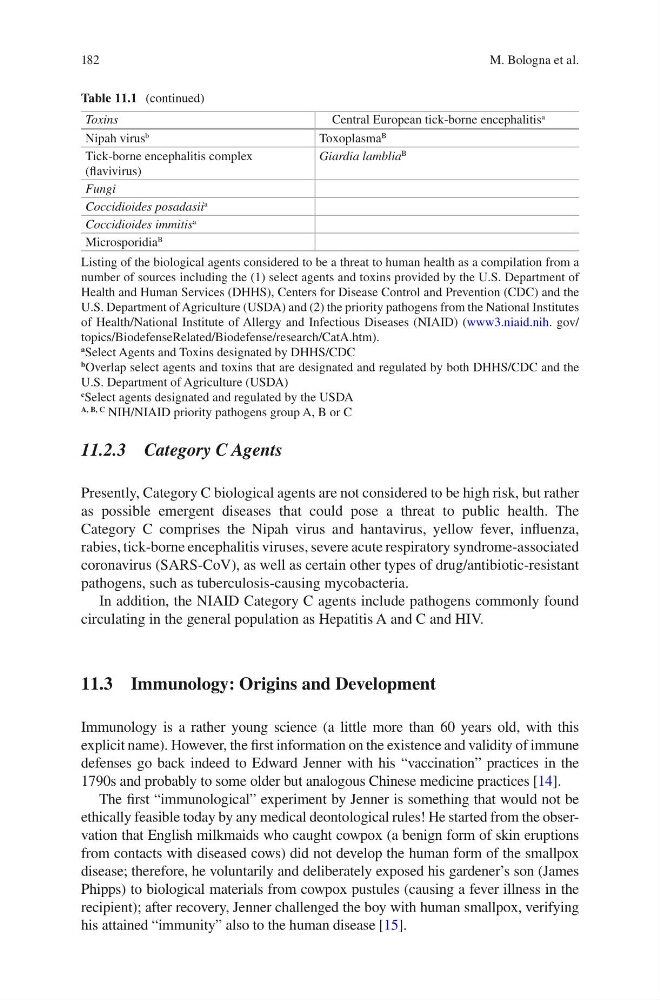
Table 11.1 (continued)
Toxins
Central European tick-borne encephalitis
a
Nipah virus
b
Toxoplasma
B
Tick-borne encephalitis complex
(flavivirus)
Giardia lamblia
B
Fungi
Coccidioides posadasii
a
Coccidioides immitis
a
Microsporidia
B
Listing of the biological agents considered to be a threat to human health as a compilation from a
number of sources including the (1) select agents and toxins provided by the U.S. Department of
Health and Human Services (DHHS), Centers for Disease Control and Prevention (CDC) and the
U.S. Department of Agriculture (USDA) and (2) the priority pathogens from the National Institutes
of Health/National Institute of Allergy and Infectious Diseases (NIAID) (www3.niaid.nih. gov/
topics/BiodefenseRelated/Biodefense/research/CatA.htm).
a
Select Agents and Toxins designated by DHHS/CDC
b Overlap select agents and toxins that are designated and regulated by both DHHS/CDC and the
U.S. Department of Agriculture (USDA)
c
Select agents designated and regulated by the USDA
A, B, C NIH/NIAID priority pathogens group A, B or C
M. Bologna et al.
11.2.3 Category C Agents
Presently, Category C biological agents are not considered to be high risk, but rather
as possible emergent diseases that could pose a threat to public health. The
Category C comprises the Nipah virus and hantavirus, yellow fever, influenza,
rabies, tick-borne encephalitis viruses, severe acute respiratory syndrome- associated
coronavirus (SARS-CoV), as well as certain other types of drug/antibiotic-resistant
pathogens, such as tuberculosis-causing mycobacteria.
In addition, the NIAID Category C agents include pathogens commonly found
circulating in the general population as Hepatitis A and C and HIV.
11.3 Immunology: Origins and Development
Immunology is a rather young science (a little more than 60 years old, with this
explicit name). However, the first information on the existence and validity of immune
defenses go back indeed to Edward Jenner with his “vaccination” practices in the
1790s and probably to some older but analogous Chinese medicine practices [14].
The first “immunological” experiment by Jenner is something that would not be
ethically feasible today by any medical deontological rules! He started from the observation that English milkmaids who caught cowpox (a benign form of skin eruptions
from contacts with diseased cows) did not develop the human form of the smallpox
disease; therefore, he voluntarily and deliberately exposed his gardener’s son (James
Phipps) to biological materials from cowpox pustules (causing a fever illness in the
recipient); after recovery, Jenner challenged the boy with human smallpox, verifying
his attained “immunity” also to the human disease [15].
Table 11.1 (continued)
Toxins
Central European tick-borne encephalitis
a
Nipah virus
b
Toxoplasma
B
Tick-borne encephalitis complex
(flavivirus)
Giardia lamblia
B
Fungi
Coccidioides posadasii
a
Coccidioides immitis
a
Microsporidia
B
Listing of the biological agents considered to be a threat to human health as a compilation from a
number of sources including the (1) select agents and toxins provided by the U.S. Department of
Health and Human Services (DHHS), Centers for Disease Control and Prevention (CDC) and the
U.S. Department of Agriculture (USDA) and (2) the priority pathogens from the National Institutes
of Health/National Institute of Allergy and Infectious Diseases (NIAID) (www3.niaid.nih. gov/
topics/BiodefenseRelated/Biodefense/research/CatA.htm).
a
Select Agents and Toxins designated by DHHS/CDC
b Overlap select agents and toxins that are designated and regulated by both DHHS/CDC and the
U.S. Department of Agriculture (USDA)
c
Select agents designated and regulated by the USDA
A, B, C NIH/NIAID priority pathogens group A, B or C
M. Bologna et al.