

156
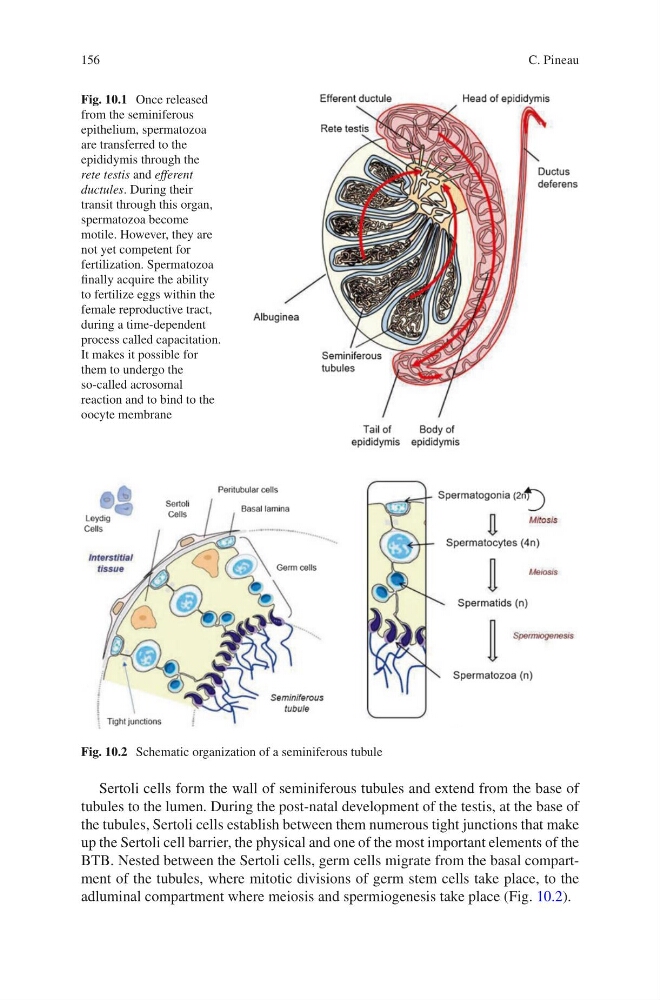
Sertoli cells form the wall of seminiferous tubules and extend from the base of
tubules to the lumen. During the post-natal development of the testis, at the base of
the tubules, Sertoli cells establish between them numerous tight junctions that make
up the Sertoli cell barrier, the physical and one of the most important elements of the
BTB. Nested between the Sertoli cells, germ cells migrate from the basal compartment of the tubules, where mitotic divisions of germ stem cells take place, to the
adluminal compartment where meiosis and spermiogenesis take place (Fig. 10.2).
Fig. 10.1 Once released
from the seminiferous
epithelium, spermatozoa
are transferred to the
epididymis through the
rete testis and efferent
ductules. During their
transit through this organ,
spermatozoa become
motile. However, they are
not yet competent for
fertilization. Spermatozoa
finally acquire the ability
to fertilize eggs within the
female reproductive tract,
during a time-dependent
process called capacitation.
It makes it possible for
them to undergo the
so-called acrosomal
reaction and to bind to the
oocyte membrane
Fig. 10.2 Schematic organization of a seminiferous tubule
C. Pineau
Sertoli cells form the wall of seminiferous tubules and extend from the base of
tubules to the lumen. During the post-natal development of the testis, at the base of
the tubules, Sertoli cells establish between them numerous tight junctions that make
up the Sertoli cell barrier, the physical and one of the most important elements of the
BTB. Nested between the Sertoli cells, germ cells migrate from the basal compartment of the tubules, where mitotic divisions of germ stem cells take place, to the
adluminal compartment where meiosis and spermiogenesis take place (Fig. 10.2).
Fig. 10.1 Once released
from the seminiferous
epithelium, spermatozoa
are transferred to the
epididymis through the
rete testis and efferent
ductules. During their
transit through this organ,
spermatozoa become
motile. However, they are
not yet competent for
fertilization. Spermatozoa
finally acquire the ability
to fertilize eggs within the
female reproductive tract,
during a time-dependent
process called capacitation.
It makes it possible for
them to undergo the
so-called acrosomal
reaction and to bind to the
oocyte membrane
Fig. 10.2 Schematic organization of a seminiferous tubule
C. Pineau