

112
7.4 Unravelling Molecular Complexity Using IMS
The molecular complexity of biological tissues can pose a challenge to molecular
identification by IMS. Even with a high mass resolution instrument such as an
FT-ICR instrument, separation of closely isobaric species can considerably lengthen
acquisition times. Ion mobility provides separations dependent on size, shape, and
mass-to-charge ratio of the ions. One approach is to add a separation technology to
help deconvolute the ion complexity. Ion mobility can be integrated with IMS and
thereby enhance specificity and improve molecular coverage [17].
Multiple types of ion mobility separations exist, including drift tube ion mobility
[18, 19], traveling-wave ion mobility spectrometry [20, 21], and field asymmetric
waveform ion mobility spectrometry [22, 23]. These techniques have been coupled
with imaging mass spectrometry for studying metabolites [24, 25], lipids [26], peptides [27, 28], and proteins [28, 29], improving the separation, specificity, and identification of molecular species. Trapped ion mobility spectrometry (TIMS) [30, 31]
is a relatively new advancement in the field that provides increased ion mobility
resolving power [32]. TIMS utilizes an electric field gradient (EFG) to trap and
sequentially elute ions with ascending mobilities. TIMS separations are capable of
resolving powers >200 for singly and multiply charged ions.
The recently developed MALDI timsTOF instrument incorporates a high
throughput, high spatial resolution MALDI source with a high-performance TIMS
platform [17]. The unique combination of spatial resolution and high-performance
gas phase separations is critical for advanced molecular imaging applications, particularly for metabolite and lipid analysis where mass redundancy and structural
isomers are prevalent [17].
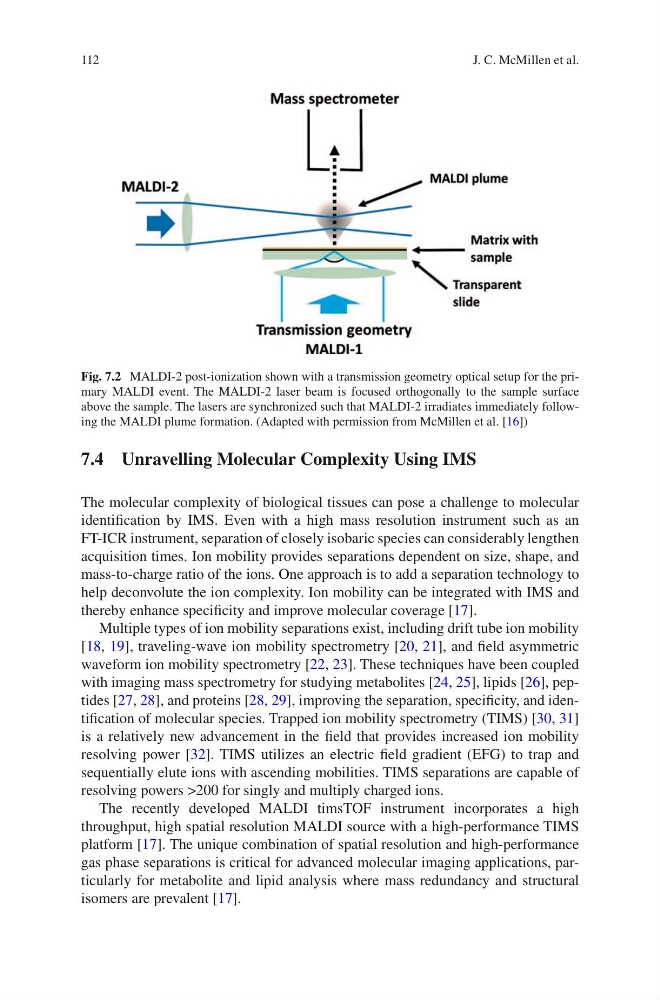
Fig. 7.2 MALDI-2 post-ionization shown with a transmission geometry optical setup for the primary MALDI event. The MALDI-2 laser beam is focused orthogonally to the sample surface
above the sample. The lasers are synchronized such that MALDI-2 irradiates immediately following the MALDI plume formation. (Adapted with permission from McMillen et al. [16])
J. C. McMillen et al.
7.4 Unravelling Molecular Complexity Using IMS
The molecular complexity of biological tissues can pose a challenge to molecular
identification by IMS. Even with a high mass resolution instrument such as an
FT-ICR instrument, separation of closely isobaric species can considerably lengthen
acquisition times. Ion mobility provides separations dependent on size, shape, and
mass-to-charge ratio of the ions. One approach is to add a separation technology to
help deconvolute the ion complexity. Ion mobility can be integrated with IMS and
thereby enhance specificity and improve molecular coverage [17].
Multiple types of ion mobility separations exist, including drift tube ion mobility
[18, 19], traveling-wave ion mobility spectrometry [20, 21], and field asymmetric
waveform ion mobility spectrometry [22, 23]. These techniques have been coupled
with imaging mass spectrometry for studying metabolites [24, 25], lipids [26], peptides [27, 28], and proteins [28, 29], improving the separation, specificity, and identification of molecular species. Trapped ion mobility spectrometry (TIMS) [30, 31]
is a relatively new advancement in the field that provides increased ion mobility
resolving power [32]. TIMS utilizes an electric field gradient (EFG) to trap and
sequentially elute ions with ascending mobilities. TIMS separations are capable of
resolving powers >200 for singly and multiply charged ions.
The recently developed MALDI timsTOF instrument incorporates a high
throughput, high spatial resolution MALDI source with a high-performance TIMS
platform [17]. The unique combination of spatial resolution and high-performance
gas phase separations is critical for advanced molecular imaging applications, particularly for metabolite and lipid analysis where mass redundancy and structural
isomers are prevalent [17].
Fig. 7.2 MALDI-2 post-ionization shown with a transmission geometry optical setup for the primary MALDI event. The MALDI-2 laser beam is focused orthogonally to the sample surface
above the sample. The lasers are synchronized such that MALDI-2 irradiates immediately following the MALDI plume formation. (Adapted with permission from McMillen et al. [16])
J. C. McMillen et al.