

102
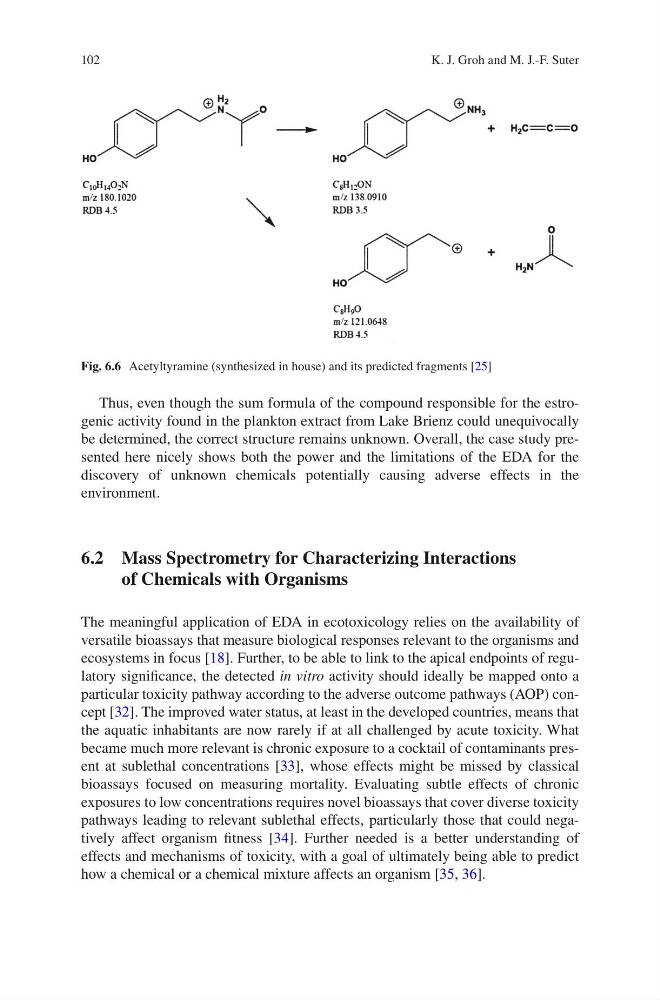
Thus, even though the sum formula of the compound responsible for the estrogenic activity found in the plankton extract from Lake Brienz could unequivocally
be determined, the correct structure remains unknown. Overall, the case study presented here nicely shows both the power and the limitations of the EDA for the
discovery of unknown chemicals potentially causing adverse effects in the
environment.
6.2 Mass Spectrometry for Characterizing Interactions
of Chemicals with Organisms
The meaningful application of EDA in ecotoxicology relies on the availability of
versatile bioassays that measure biological responses relevant to the organisms and
ecosystems in focus [18]. Further, to be able to link to the apical endpoints of regulatory significance, the detected in vitro activity should ideally be mapped onto a
particular toxicity pathway according to the adverse outcome pathways (AOP) concept [32]. The improved water status, at least in the developed countries, means that
the aquatic inhabitants are now rarely if at all challenged by acute toxicity. What
became much more relevant is chronic exposure to a cocktail of contaminants present at sublethal concentrations [33], whose effects might be missed by classical
bioassays focused on measuring mortality. Evaluating subtle effects of chronic
exposures to low concentrations requires novel bioassays that cover diverse toxicity
pathways leading to relevant sublethal effects, particularly those that could negatively affect organism fitness [34]. Further needed is a better understanding of
effects and mechanisms of toxicity, with a goal of ultimately being able to predict
how a chemical or a chemical mixture affects an organism [35, 36].
Fig. 6.6 Acetyltyramine (synthesized in house) and its predicted fragments [25]
K. J. Groh and M. J.-F. Suter
Thus, even though the sum formula of the compound responsible for the estrogenic activity found in the plankton extract from Lake Brienz could unequivocally
be determined, the correct structure remains unknown. Overall, the case study presented here nicely shows both the power and the limitations of the EDA for the
discovery of unknown chemicals potentially causing adverse effects in the
environment.
6.2 Mass Spectrometry for Characterizing Interactions
of Chemicals with Organisms
The meaningful application of EDA in ecotoxicology relies on the availability of
versatile bioassays that measure biological responses relevant to the organisms and
ecosystems in focus [18]. Further, to be able to link to the apical endpoints of regulatory significance, the detected in vitro activity should ideally be mapped onto a
particular toxicity pathway according to the adverse outcome pathways (AOP) concept [32]. The improved water status, at least in the developed countries, means that
the aquatic inhabitants are now rarely if at all challenged by acute toxicity. What
became much more relevant is chronic exposure to a cocktail of contaminants present at sublethal concentrations [33], whose effects might be missed by classical
bioassays focused on measuring mortality. Evaluating subtle effects of chronic
exposures to low concentrations requires novel bioassays that cover diverse toxicity
pathways leading to relevant sublethal effects, particularly those that could negatively affect organism fitness [34]. Further needed is a better understanding of
effects and mechanisms of toxicity, with a goal of ultimately being able to predict
how a chemical or a chemical mixture affects an organism [35, 36].
Fig. 6.6 Acetyltyramine (synthesized in house) and its predicted fragments [25]
K. J. Groh and M. J.-F. Suter