

No heat engine can be more efficient than a reversible one operating between the same
temperatures.
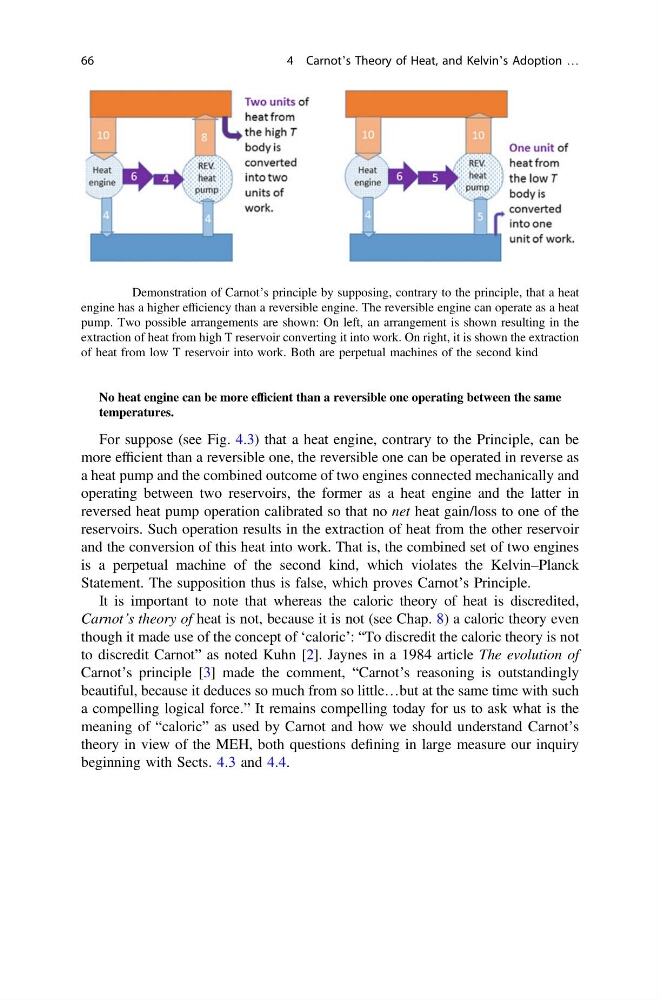
For suppose (see Fig. 4.3) that a heat engine, contrary to the Principle, can be
more efficient than a reversible one, the reversible one can be operated in reverse as
a heat pump and the combined outcome of two engines connected mechanically and
operating between two reservoirs, the former as a heat engine and the latter in
reversed heat pump operation calibrated so that no net heat gain/loss to one of the
reservoirs. Such operation results in the extraction of heat from the other reservoir
and the conversion of this heat into work. That is, the combined set of two engines
is a perpetual machine of the second kind, which violates the Kelvin–Planck
Statement. The supposition thus is false, which proves Carnot’s Principle.
It is important to note that whereas the caloric theory of heat is discredited,
Carnot’s theory of heat is not, because it is not (see Chap. 8) a caloric theory even
though it made use of the concept of ‘caloric’: “To discredit the caloric theory is not
to discredit Carnot” as noted Kuhn [2]. Jaynes in a 1984 article The evolution of
Carnot’s principle [3] made the comment, “Carnot’s reasoning is outstandingly
beautiful, because it deduces so much from so little…but at the same time with such
a compelling logical force.” It remains compelling today for us to ask what is the
meaning of “caloric” as used by Carnot and how we should understand Carnot’s
theory in view of the MEH, both questions defining in large measure our inquiry
beginning with Sects. 4.3 and 4.4.
Fig. 4.3 Demonstration of Carnot’s principle by supposing, contrary to the principle, that a heat
engine has a higher efficiency than a reversible engine. The reversible engine can operate as a heat
pump. Two possible arrangements are shown: On left, an arrangement is shown resulting in the
extraction of heat from high T reservoir converting it into work. On right, it is shown the extraction
of heat from low T reservoir into work. Both are perpetual machines of the second kind
66
4 Carnot’s Theory of Heat, and Kelvin’s Adoption …
temperatures.
For suppose (see Fig. 4.3) that a heat engine, contrary to the Principle, can be
more efficient than a reversible one, the reversible one can be operated in reverse as
a heat pump and the combined outcome of two engines connected mechanically and
operating between two reservoirs, the former as a heat engine and the latter in
reversed heat pump operation calibrated so that no net heat gain/loss to one of the
reservoirs. Such operation results in the extraction of heat from the other reservoir
and the conversion of this heat into work. That is, the combined set of two engines
is a perpetual machine of the second kind, which violates the Kelvin–Planck
Statement. The supposition thus is false, which proves Carnot’s Principle.
It is important to note that whereas the caloric theory of heat is discredited,
Carnot’s theory of heat is not, because it is not (see Chap. 8) a caloric theory even
though it made use of the concept of ‘caloric’: “To discredit the caloric theory is not
to discredit Carnot” as noted Kuhn [2]. Jaynes in a 1984 article The evolution of
Carnot’s principle [3] made the comment, “Carnot’s reasoning is outstandingly
beautiful, because it deduces so much from so little…but at the same time with such
a compelling logical force.” It remains compelling today for us to ask what is the
meaning of “caloric” as used by Carnot and how we should understand Carnot’s
theory in view of the MEH, both questions defining in large measure our inquiry
beginning with Sects. 4.3 and 4.4.
Fig. 4.3 Demonstration of Carnot’s principle by supposing, contrary to the principle, that a heat
engine has a higher efficiency than a reversible engine. The reversible engine can operate as a heat
pump. Two possible arrangements are shown: On left, an arrangement is shown resulting in the
extraction of heat from high T reservoir converting it into work. On right, it is shown the extraction
of heat from low T reservoir into work. Both are perpetual machines of the second kind
66
4 Carnot’s Theory of Heat, and Kelvin’s Adoption …