

Clausius Statement of the second law: No process is possible in which the sole result is
the transfer of heat from a cooler to a hotter body (Fig. 4.1, 1b).
The frictional kind of spontaneous processes is schematically represented in
Fig. 4.1, 2a. The impossibility of a spontaneous change in the opposite direction,
i.e., heat spontaneously transformed into work, is formally stated as the
Kelvin-Planck Statement of the second law: No process is possible in which the sole
result is the absorption of heat from a reservoir and its complete conversion into work
W (Fig. 4.1, 2b).
In the above Kelvin–Planck Statement, Kelvin hypothesized that, while it is
common knowledge that work can be converted to heat without limit, heat may not
be completely converted into work (see Sect. 4.6). Thus, heat and work do not have
a reciprocal relation; but Kelvin was not consistent on this important point in his
writing and famously he experienced a change of mind as reflected from his
pre-1851 writings to his writings afterward. In this inconsistency it rests what ills
the MEH-based mechanical theory of heat or the energetic theory of heat. This
disquisition aims to address this incoherency of the energetic theory, beginning
with Sects. 4.7 and 4.8, and the full resolution of the incoherency will be given in
Chap. 8. It suffices, for now, to say that MEH, or the first law, does not deal with the
question of the amount of the driving force that is expended in the driving of a
process. The cause, i.e., the driving force that is expended, of the processes is the
purview of the second law of thermodynamics. The energetic bias of the MEHbased mechanical theory of heat prevents us from appreciating this point and, in
fact, prevents us from understanding, correctly, heat and energy themselves. The
development toward a full meaning of the second law and that understanding will
be treated in Chaps. 5, 7, and 8.
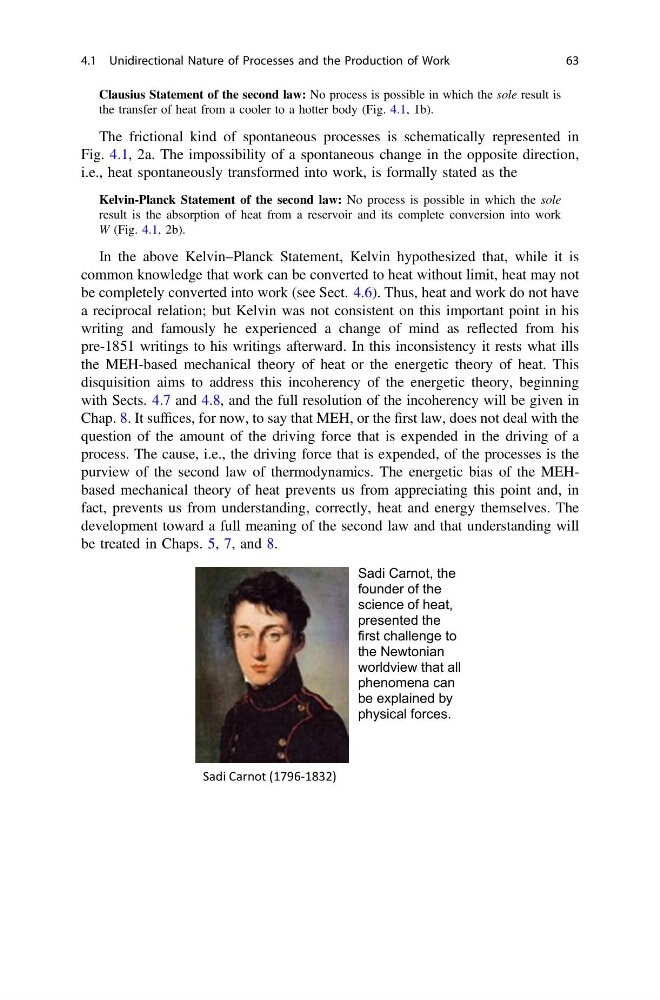
Sadi Carnot, the
founder of the
science of heat,
presented the
first challenge to
the Newtonian
worldview that all
phenomena can
be explained by
physical forces.
Sadi Carnot (1796-1832)
4.1 Unidirectional Nature of Processes and the Production of Work
63
the transfer of heat from a cooler to a hotter body (Fig. 4.1, 1b).
The frictional kind of spontaneous processes is schematically represented in
Fig. 4.1, 2a. The impossibility of a spontaneous change in the opposite direction,
i.e., heat spontaneously transformed into work, is formally stated as the
Kelvin-Planck Statement of the second law: No process is possible in which the sole
result is the absorption of heat from a reservoir and its complete conversion into work
W (Fig. 4.1, 2b).
In the above Kelvin–Planck Statement, Kelvin hypothesized that, while it is
common knowledge that work can be converted to heat without limit, heat may not
be completely converted into work (see Sect. 4.6). Thus, heat and work do not have
a reciprocal relation; but Kelvin was not consistent on this important point in his
writing and famously he experienced a change of mind as reflected from his
pre-1851 writings to his writings afterward. In this inconsistency it rests what ills
the MEH-based mechanical theory of heat or the energetic theory of heat. This
disquisition aims to address this incoherency of the energetic theory, beginning
with Sects. 4.7 and 4.8, and the full resolution of the incoherency will be given in
Chap. 8. It suffices, for now, to say that MEH, or the first law, does not deal with the
question of the amount of the driving force that is expended in the driving of a
process. The cause, i.e., the driving force that is expended, of the processes is the
purview of the second law of thermodynamics. The energetic bias of the MEHbased mechanical theory of heat prevents us from appreciating this point and, in
fact, prevents us from understanding, correctly, heat and energy themselves. The
development toward a full meaning of the second law and that understanding will
be treated in Chaps. 5, 7, and 8.
Sadi Carnot, the
founder of the
science of heat,
presented the
first challenge to
the Newtonian
worldview that all
phenomena can
be explained by
physical forces.
Sadi Carnot (1796-1832)
4.1 Unidirectional Nature of Processes and the Production of Work
63