

Substituting p in terms of p 1 V
k
1 and V
k , we get
W ¼ p 1 V
k
1
Z 2
1
V
Àk dV ¼ p 1 V
k
1 Á
1
Àk þ 1
Á V
Àk þ 1
À
Á
2
À V
Àk þ 1
À
Á
1
Â
Ã
¼
p 1 V 2 Á V 1 =V 2
ð
Þ
k Àp 1 V 1
À k À 1
ð
Þ
¼
p 2 V 2 À p 1 V 1
À k À 1
ð
Þ
¼
NRT 2 À NRT 1
À R=c V
ð
Þ
¼ Nc V T 1 À T 2
ð
Þ
That is, the work done by a system is derived from decrease of the system’s internal energy; conversely, a work done to the system will increase the
system’s internal energy.
If there is 0.1 kmol of air, which is initially kept at a temperature of 0 °C,
or 273.15 K, and the gas is compressed from a volume of 4–1 m
3 , determine
the compression W.
We can determine first the initial pressure
p 1 ¼
0:1 Â 8:3143 Â 273:15
4
¼ 56:78kPa
The final pressure is (from Table A-2, Cengel/Boles Property Tables
Booklet/thermodynamics, k = 1.4)
p 2 ¼ p 1 Â V 1 =V 2
ð
Þ
k ¼ 56:78 Â ð4Þ
1:4 ¼ 395:41kPa
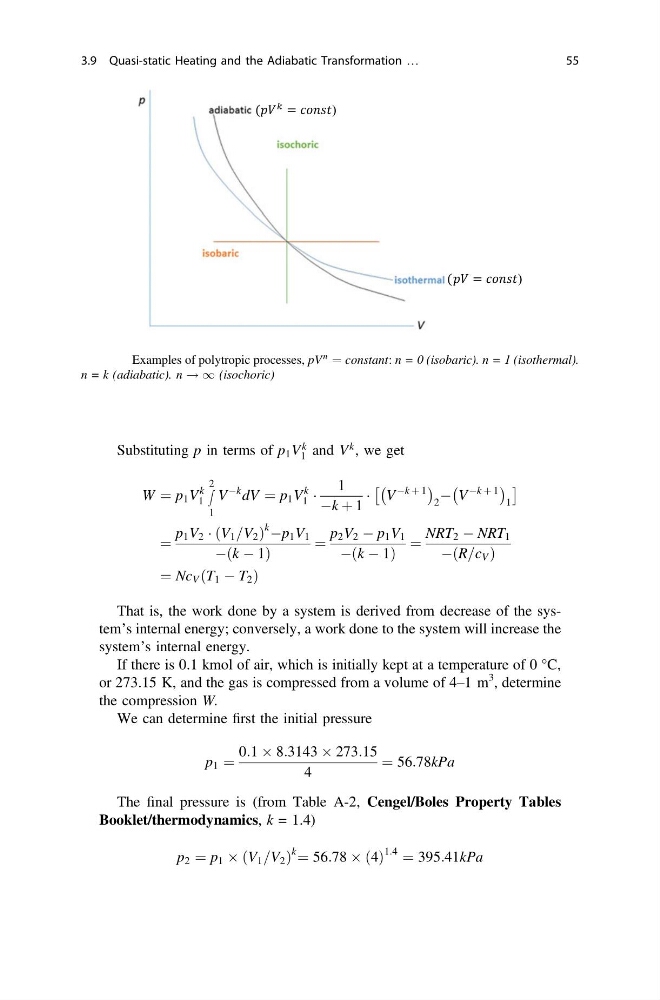
Fig. 3.1 Examples of polytropic processes, pV
n ¼ constant: n = 0 (isobaric). n = 1 (isothermal).
n = k (adiabatic). n ! 1 (isochoric)
3.9 Quasi-static Heating and the Adiabatic Transformation …
55
k
1 and V
k , we get
W ¼ p 1 V
k
1
Z 2
1
V
Àk dV ¼ p 1 V
k
1 Á
1
Àk þ 1
Á V
Àk þ 1
À
Á
2
À V
Àk þ 1
À
Á
1
Â
Ã
¼
p 1 V 2 Á V 1 =V 2
ð
Þ
k Àp 1 V 1
À k À 1
ð
Þ
¼
p 2 V 2 À p 1 V 1
À k À 1
ð
Þ
¼
NRT 2 À NRT 1
À R=c V
ð
Þ
¼ Nc V T 1 À T 2
ð
Þ
That is, the work done by a system is derived from decrease of the system’s internal energy; conversely, a work done to the system will increase the
system’s internal energy.
If there is 0.1 kmol of air, which is initially kept at a temperature of 0 °C,
or 273.15 K, and the gas is compressed from a volume of 4–1 m
3 , determine
the compression W.
We can determine first the initial pressure
p 1 ¼
0:1 Â 8:3143 Â 273:15
4
¼ 56:78kPa
The final pressure is (from Table A-2, Cengel/Boles Property Tables
Booklet/thermodynamics, k = 1.4)
p 2 ¼ p 1 Â V 1 =V 2
ð
Þ
k ¼ 56:78 Â ð4Þ
1:4 ¼ 395:41kPa
Fig. 3.1 Examples of polytropic processes, pV
n ¼ constant: n = 0 (isobaric). n = 1 (isothermal).
n = k (adiabatic). n ! 1 (isochoric)
3.9 Quasi-static Heating and the Adiabatic Transformation …
55