

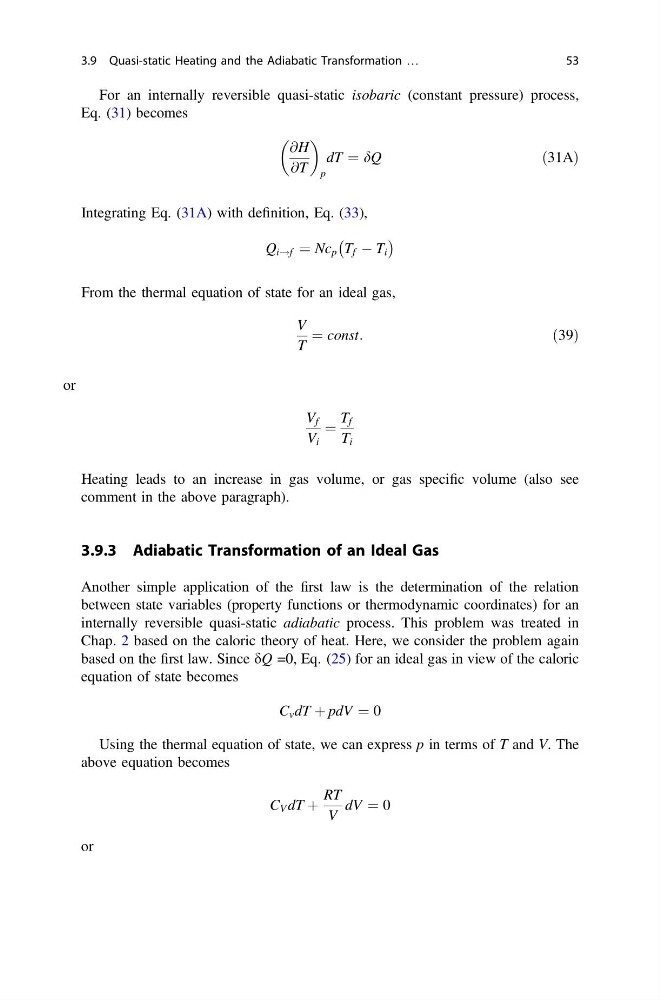
For an internally reversible quasi-static isobaric (constant pressure) process,
Eq. (31) becomes
@H
@T
p
dT ¼ dQ
ð31AÞ
Integrating Eq. (31A) with definition, Eq. (33),
Q i!f ¼ Nc p T f À T i
À
Á
From the thermal equation of state for an ideal gas,
V
T
¼ const:
ð39Þ
or
V f
V i
¼
T f
T i
Heating leads to an increase in gas volume, or gas specific volume (also see
comment in the above paragraph).
3.9.3 Adiabatic Transformation of an Ideal Gas
Another simple application of the first law is the determination of the relation
between state variables (property functions or thermodynamic coordinates) for an
internally reversible quasi-static adiabatic process. This problem was treated in
Chap. 2 based on the caloric theory of heat. Here, we consider the problem again
based on the first law. Since dQ =0, Eq. (25) for an ideal gas in view of the caloric
equation of state becomes
C v dT þ pdV ¼ 0
Using the thermal equation of state, we can express p in terms of T and V. The
above equation becomes
C V dT þ
RT
V
dV ¼ 0
or
3.9 Quasi-static Heating and the Adiabatic Transformation …
53
Eq. (31) becomes
@H
@T
p
dT ¼ dQ
ð31AÞ
Integrating Eq. (31A) with definition, Eq. (33),
Q i!f ¼ Nc p T f À T i
À
Á
From the thermal equation of state for an ideal gas,
V
T
¼ const:
ð39Þ
or
V f
V i
¼
T f
T i
Heating leads to an increase in gas volume, or gas specific volume (also see
comment in the above paragraph).
3.9.3 Adiabatic Transformation of an Ideal Gas
Another simple application of the first law is the determination of the relation
between state variables (property functions or thermodynamic coordinates) for an
internally reversible quasi-static adiabatic process. This problem was treated in
Chap. 2 based on the caloric theory of heat. Here, we consider the problem again
based on the first law. Since dQ =0, Eq. (25) for an ideal gas in view of the caloric
equation of state becomes
C v dT þ pdV ¼ 0
Using the thermal equation of state, we can express p in terms of T and V. The
above equation becomes
C V dT þ
RT
V
dV ¼ 0
or
3.9 Quasi-static Heating and the Adiabatic Transformation …
53