

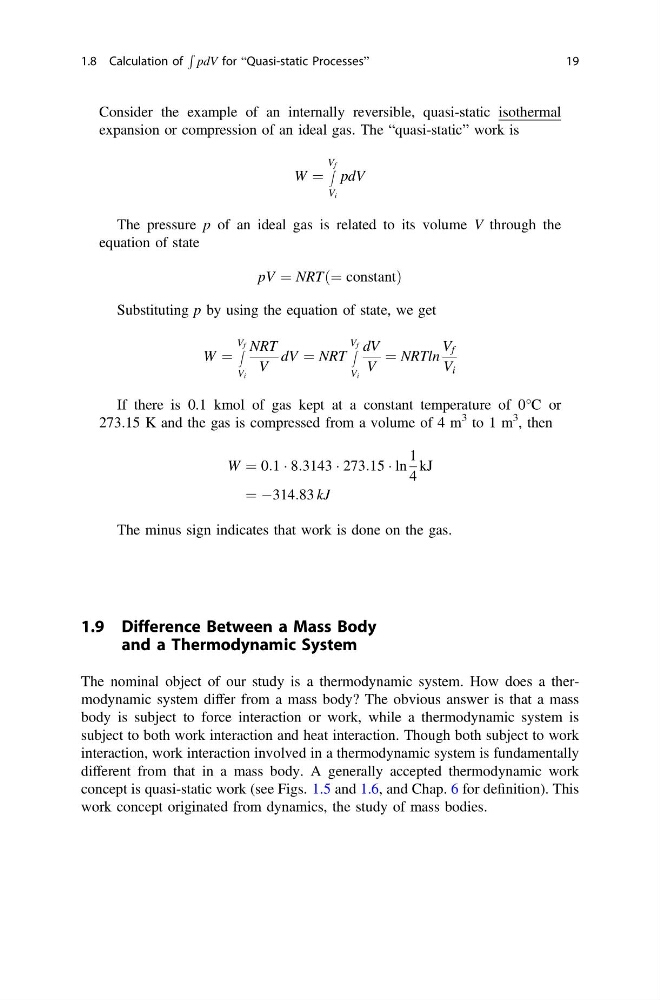
Consider the example of an internally reversible, quasi-static isothermal
expansion or compression of an ideal gas. The “quasi-static” work is
W ¼
Z
V f
V i
pdV
The pressure p of an ideal gas is related to its volume V through the
equation of state
pV ¼ NRT ¼ constant
ð
Þ
Substituting p by using the equation of state, we get
W ¼
Z
V f
V i
NRT
V
dV ¼ NRT
Z
V f
V i
dV
V
¼ NRTln
V f
V i
If there is 0.1 kmol of gas kept at a constant temperature of 0°C or
273.15 K and the gas is compressed from a volume of 4 m
3 to 1 m
3 , then
W ¼ 0:1 Á 8:3143 Á 273:15 Á ln
1
4
kJ
¼ À314:83 kJ
The minus sign indicates that work is done on the gas.
1.9 Difference Between a Mass Body
and a Thermodynamic System
The nominal object of our study is a thermodynamic system. How does a thermodynamic system differ from a mass body? The obvious answer is that a mass
body is subject to force interaction or work, while a thermodynamic system is
subject to both work interaction and heat interaction. Though both subject to work
interaction, work interaction involved in a thermodynamic system is fundamentally
different from that in a mass body. A generally accepted thermodynamic work
concept is quasi-static work (see Figs. 1.5 and 1.6, and Chap. 6 for definition). This
work concept originated from dynamics, the study of mass bodies.
1.8 Calculation of
R
pdV for “Quasi-static Processes”
19
expansion or compression of an ideal gas. The “quasi-static” work is
W ¼
Z
V f
V i
pdV
The pressure p of an ideal gas is related to its volume V through the
equation of state
pV ¼ NRT ¼ constant
ð
Þ
Substituting p by using the equation of state, we get
W ¼
Z
V f
V i
NRT
V
dV ¼ NRT
Z
V f
V i
dV
V
¼ NRTln
V f
V i
If there is 0.1 kmol of gas kept at a constant temperature of 0°C or
273.15 K and the gas is compressed from a volume of 4 m
3 to 1 m
3 , then
W ¼ 0:1 Á 8:3143 Á 273:15 Á ln
1
4
kJ
¼ À314:83 kJ
The minus sign indicates that work is done on the gas.
1.9 Difference Between a Mass Body
and a Thermodynamic System
The nominal object of our study is a thermodynamic system. How does a thermodynamic system differ from a mass body? The obvious answer is that a mass
body is subject to force interaction or work, while a thermodynamic system is
subject to both work interaction and heat interaction. Though both subject to work
interaction, work interaction involved in a thermodynamic system is fundamentally
different from that in a mass body. A generally accepted thermodynamic work
concept is quasi-static work (see Figs. 1.5 and 1.6, and Chap. 6 for definition). This
work concept originated from dynamics, the study of mass bodies.
1.8 Calculation of
R
pdV for “Quasi-static Processes”
19