

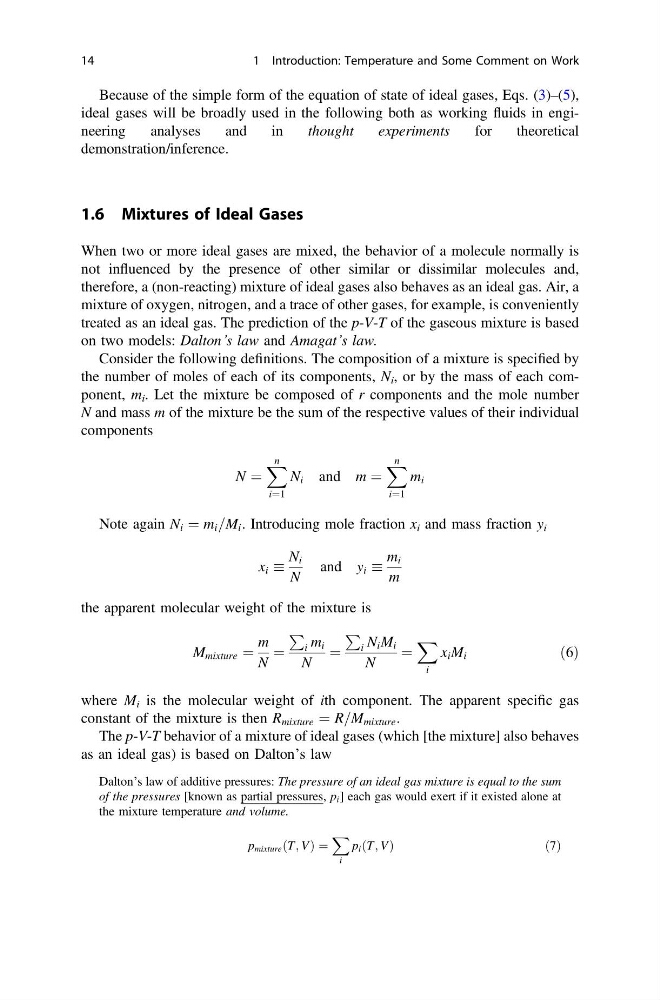
Because of the simple form of the equation of state of ideal gases, Eqs. (3)–(5),
ideal gases will be broadly used in the following both as working fluids in engineering
analyses
and
in
thought
experiments
for
theoretical
demonstration/inference.
1.6 Mixtures of Ideal Gases
When two or more ideal gases are mixed, the behavior of a molecule normally is
not influenced by the presence of other similar or dissimilar molecules and,
therefore, a (non-reacting) mixture of ideal gases also behaves as an ideal gas. Air, a
mixture of oxygen, nitrogen, and a trace of other gases, for example, is conveniently
treated as an ideal gas. The prediction of the p-V-T of the gaseous mixture is based
on two models: Dalton’s law and Amagat’s law.
Consider the following definitions. The composition of a mixture is specified by
the number of moles of each of its components, N i , or by the mass of each component, m i . Let the mixture be composed of r components and the mole number
N and mass m of the mixture be the sum of the respective values of their individual
components
N ¼
X n
i¼1
N i and m ¼
X n
i¼1
m i
Note again N i ¼ m i =M i . Introducing mole fraction x i and mass fraction y i
x i
N i
N
and y i
m i
m
the apparent molecular weight of the mixture is
M mixture ¼
m
N
¼
P
i m i
N
¼
P
i N i M i
N
¼
X
i
x i M i
ð6Þ
where M i is the molecular weight of ith component. The apparent specific gas
constant of the mixture is then R mixture ¼ R=M mixture .
The p-V-T behavior of a mixture of ideal gases (which [the mixture] also behaves
as an ideal gas) is based on Dalton’s law
Dalton’s law of additive pressures: The pressure of an ideal gas mixture is equal to the sum
of the pressures [known as partial pressures, p i ] each gas would exert if it existed alone at
the mixture temperature and volume.
p mixture T; V
ð
Þ¼
X
i
p i T; V
ð
Þ
ð7Þ
14
1 Introduction: Temperature and Some Comment on Work
ideal gases will be broadly used in the following both as working fluids in engineering
analyses
and
in
thought
experiments
for
theoretical
demonstration/inference.
1.6 Mixtures of Ideal Gases
When two or more ideal gases are mixed, the behavior of a molecule normally is
not influenced by the presence of other similar or dissimilar molecules and,
therefore, a (non-reacting) mixture of ideal gases also behaves as an ideal gas. Air, a
mixture of oxygen, nitrogen, and a trace of other gases, for example, is conveniently
treated as an ideal gas. The prediction of the p-V-T of the gaseous mixture is based
on two models: Dalton’s law and Amagat’s law.
Consider the following definitions. The composition of a mixture is specified by
the number of moles of each of its components, N i , or by the mass of each component, m i . Let the mixture be composed of r components and the mole number
N and mass m of the mixture be the sum of the respective values of their individual
components
N ¼
X n
i¼1
N i and m ¼
X n
i¼1
m i
Note again N i ¼ m i =M i . Introducing mole fraction x i and mass fraction y i
x i
N i
N
and y i
m i
m
the apparent molecular weight of the mixture is
M mixture ¼
m
N
¼
P
i m i
N
¼
P
i N i M i
N
¼
X
i
x i M i
ð6Þ
where M i is the molecular weight of ith component. The apparent specific gas
constant of the mixture is then R mixture ¼ R=M mixture .
The p-V-T behavior of a mixture of ideal gases (which [the mixture] also behaves
as an ideal gas) is based on Dalton’s law
Dalton’s law of additive pressures: The pressure of an ideal gas mixture is equal to the sum
of the pressures [known as partial pressures, p i ] each gas would exert if it existed alone at
the mixture temperature and volume.
p mixture T; V
ð
Þ¼
X
i
p i T; V
ð
Þ
ð7Þ
14
1 Introduction: Temperature and Some Comment on Work