

realization that in natural heat transfer processes, man can avail himself of useful
work via the creation of reversible processes bringing about possibilities provided
by the “descriptive power” of laws. With this insight, Carnot discovered in
reversible cycles the causal necessity of efficacious causation.
Thus, Carnot gave philosophical meaning to engineering, especially to engineers
practicing engineering thermodynamics aiming for achieving efficiency. He defined
efficiency in terms of reversibility. Kelvin and Gibbs added the meaning of available
energy to reversibility; generation of engineers, Keenan, Rant, Bejan…, developed
the theory of exergy, and, thus, gave meaning to energy in terms of its exergy content
as the driver that is capable of making things happen. This disquisition identifies that
energy is proxy to entropy growth potential, which is the real driver, as well as
demonstrates that the essence of reversibility is the triadic framework under which
(including the generalized triadic framework) is how we manage the use of stock EGP
and natural EGP that will help us find pathways toward true efficiency. Efficiency is
not an energy problem alone; it depends on thinking in terms of natural EGP and
triadic framework, which can greatly increase the efficiency of stock EGP usage.
One necessary first step is to apply energy and exergy analyses to more problems,
as well as general efficiency assessment. One instance of applying energy and exergy
analyses can be found in an evaluation of how we used energy in the twentieth century,
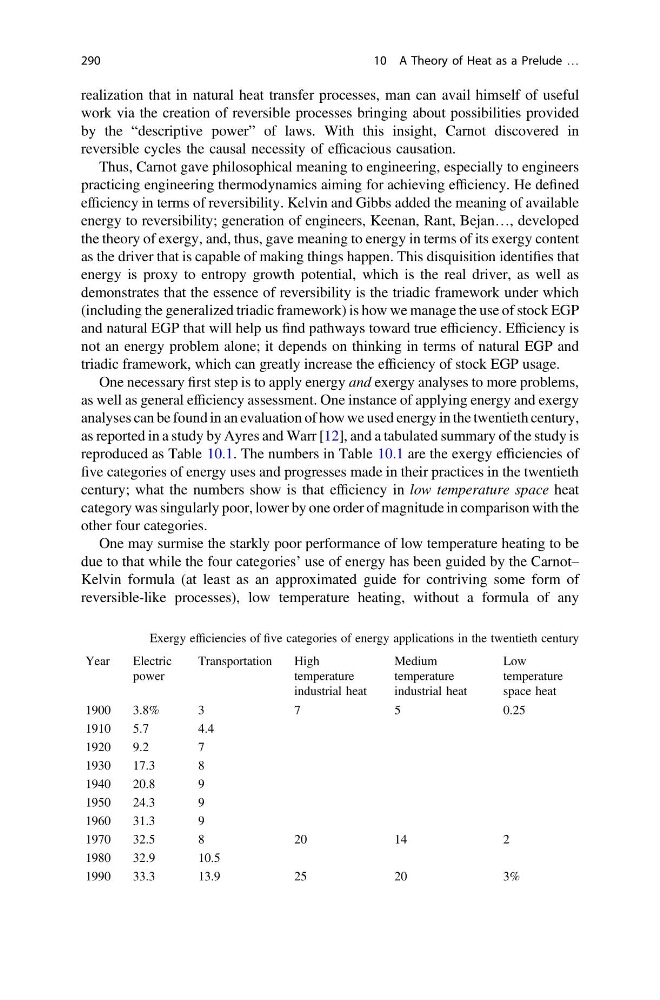
as reported in a study by Ayres and Warr [12], and a tabulated summary of the study is
reproduced as Table 10.1. The numbers in Table 10.1 are the exergy efficiencies of
five categories of energy uses and progresses made in their practices in the twentieth
century; what the numbers show is that efficiency in low temperature space heat
category was singularly poor, lower by one order of magnitude in comparison with the
other four categories.
One may surmise the starkly poor performance of low temperature heating to be
due to that while the four categories’ use of energy has been guided by the Carnot–
Kelvin formula (at least as an approximated guide for contriving some form of
reversible-like processes), low temperature heating, without a formula of any
Table 10.1 Exergy efficiencies of five categories of energy applications in the twentieth century
Year
Electric
power
Transportation
High
temperature
industrial heat
Medium
temperature
industrial heat
Low
temperature
space heat
1900
3.8%
3
7
5
0.25
1910
5.7
4.4
1920
9.2
7
1930
17.3
8
1940
20.8
9
1950
24.3
9
1960
31.3
9
1970
32.5
8
20
14
2
1980
32.9
10.5
1990
33.3
13.9
25
20
3%
290
10 A Theory of Heat as a Prelude …
work via the creation of reversible processes bringing about possibilities provided
by the “descriptive power” of laws. With this insight, Carnot discovered in
reversible cycles the causal necessity of efficacious causation.
Thus, Carnot gave philosophical meaning to engineering, especially to engineers
practicing engineering thermodynamics aiming for achieving efficiency. He defined
efficiency in terms of reversibility. Kelvin and Gibbs added the meaning of available
energy to reversibility; generation of engineers, Keenan, Rant, Bejan…, developed
the theory of exergy, and, thus, gave meaning to energy in terms of its exergy content
as the driver that is capable of making things happen. This disquisition identifies that
energy is proxy to entropy growth potential, which is the real driver, as well as
demonstrates that the essence of reversibility is the triadic framework under which
(including the generalized triadic framework) is how we manage the use of stock EGP
and natural EGP that will help us find pathways toward true efficiency. Efficiency is
not an energy problem alone; it depends on thinking in terms of natural EGP and
triadic framework, which can greatly increase the efficiency of stock EGP usage.
One necessary first step is to apply energy and exergy analyses to more problems,
as well as general efficiency assessment. One instance of applying energy and exergy
analyses can be found in an evaluation of how we used energy in the twentieth century,
as reported in a study by Ayres and Warr [12], and a tabulated summary of the study is
reproduced as Table 10.1. The numbers in Table 10.1 are the exergy efficiencies of
five categories of energy uses and progresses made in their practices in the twentieth
century; what the numbers show is that efficiency in low temperature space heat
category was singularly poor, lower by one order of magnitude in comparison with the
other four categories.
One may surmise the starkly poor performance of low temperature heating to be
due to that while the four categories’ use of energy has been guided by the Carnot–
Kelvin formula (at least as an approximated guide for contriving some form of
reversible-like processes), low temperature heating, without a formula of any
Table 10.1 Exergy efficiencies of five categories of energy applications in the twentieth century
Year
Electric
power
Transportation
High
temperature
industrial heat
Medium
temperature
industrial heat
Low
temperature
space heat
1900
3.8%
3
7
5
0.25
1910
5.7
4.4
1920
9.2
7
1930
17.3
8
1940
20.8
9
1950
24.3
9
1960
31.3
9
1970
32.5
8
20
14
2
1980
32.9
10.5
1990
33.3
13.9
25
20
3%
290
10 A Theory of Heat as a Prelude …