

So, in the conception of machines, we are dealing with a different kind of
knowledge from naturalistic observational knowledge, one at a higher level than
naturalistic science. We call this higher level knowledge contrivance, operational
principle, or the principle of the machine’s design, the defining characteristic of
which is the notion of “serving our purpose,” or the notion of “success” as well as
the notion of “breakdown”, or “failure”. All those notions are foreign to naturalistic
observational knowledge since it is of physical necessity.
Machines can achieve high performance, and they can fail. This is an entirely
new conception not found in the study of observational sciences of inanimate
systems. It would be nonsense to set up an enquiry into why thunderstorms go
wrong or how stones make mistakes. They cannot be judged in these terms; they are
necessary and they just are. This means that in judging machines we necessarily
have in mind the idea of achievement or fulfillment. That is a totally foreign notion
to physics and chemistry.
Lest we forget that every operational principle is subject to physical necessity.
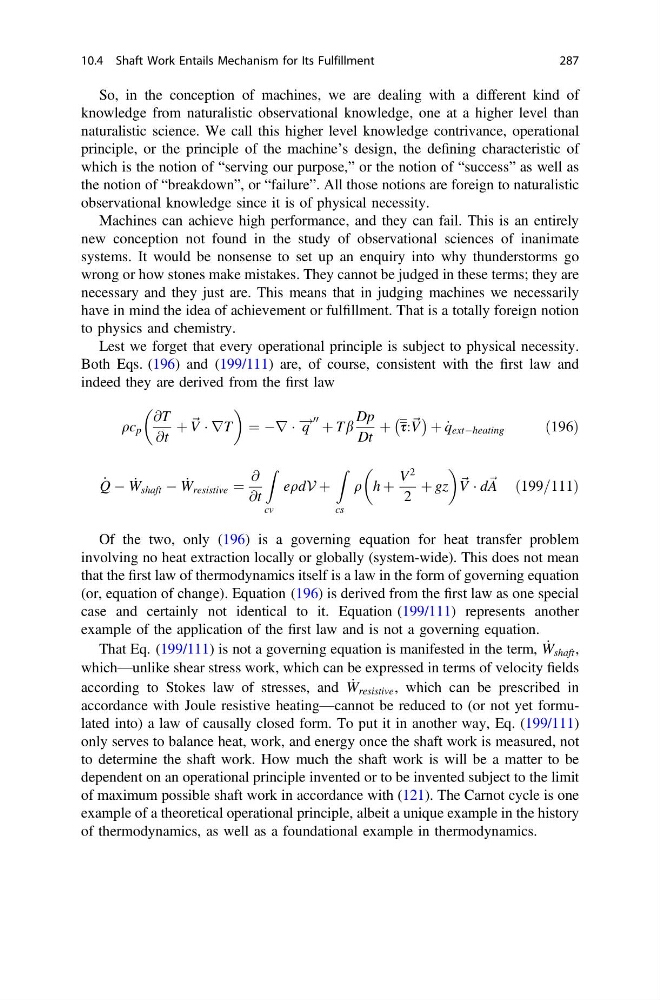
Both Eqs. (196) and (199/111) are, of course, consistent with the first law and
indeed they are derived from the first law
qc p
@T
@t
þ ~ V Á rT
¼ Àr Á q
! 00 þ Tb
Dp
Dt
þ s: ~ V
À Á þ _
q extÀheating
ð196Þ
_
Q À _
W shaft À _
W resistive ¼
@
@t
Z
cv
eqdV þ
Z
cs
q h þ
V
2
2
þ gz
~ V Á d ~ A ð199=111Þ
Of the two, only (196) is a governing equation for heat transfer problem
involving no heat extraction locally or globally (system-wide). This does not mean
that the first law of thermodynamics itself is a law in the form of governing equation
(or, equation of change). Equation (196) is derived from the first law as one special
case and certainly not identical to it. Equation (199/111) represents another
example of the application of the first law and is not a governing equation.
That Eq. (199/111) is not a governing equation is manifested in the term, _
W shaft ,
which—unlike shear stress work, which can be expressed in terms of velocity fields
according to Stokes law of stresses, and _
W resistive , which can be prescribed in
accordance with Joule resistive heating—cannot be reduced to (or not yet formulated into) a law of causally closed form. To put it in another way, Eq. (199/111)
only serves to balance heat, work, and energy once the shaft work is measured, not
to determine the shaft work. How much the shaft work is will be a matter to be
dependent on an operational principle invented or to be invented subject to the limit
of maximum possible shaft work in accordance with (121). The Carnot cycle is one
example of a theoretical operational principle, albeit a unique example in the history
of thermodynamics, as well as a foundational example in thermodynamics.
10.4 Shaft Work Entails Mechanism for Its Fulfillment
287
knowledge from naturalistic observational knowledge, one at a higher level than
naturalistic science. We call this higher level knowledge contrivance, operational
principle, or the principle of the machine’s design, the defining characteristic of
which is the notion of “serving our purpose,” or the notion of “success” as well as
the notion of “breakdown”, or “failure”. All those notions are foreign to naturalistic
observational knowledge since it is of physical necessity.
Machines can achieve high performance, and they can fail. This is an entirely
new conception not found in the study of observational sciences of inanimate
systems. It would be nonsense to set up an enquiry into why thunderstorms go
wrong or how stones make mistakes. They cannot be judged in these terms; they are
necessary and they just are. This means that in judging machines we necessarily
have in mind the idea of achievement or fulfillment. That is a totally foreign notion
to physics and chemistry.
Lest we forget that every operational principle is subject to physical necessity.
Both Eqs. (196) and (199/111) are, of course, consistent with the first law and
indeed they are derived from the first law
qc p
@T
@t
þ ~ V Á rT
¼ Àr Á q
! 00 þ Tb
Dp
Dt
þ s: ~ V
À Á þ _
q extÀheating
ð196Þ
_
Q À _
W shaft À _
W resistive ¼
@
@t
Z
cv
eqdV þ
Z
cs
q h þ
V
2
2
þ gz
~ V Á d ~ A ð199=111Þ
Of the two, only (196) is a governing equation for heat transfer problem
involving no heat extraction locally or globally (system-wide). This does not mean
that the first law of thermodynamics itself is a law in the form of governing equation
(or, equation of change). Equation (196) is derived from the first law as one special
case and certainly not identical to it. Equation (199/111) represents another
example of the application of the first law and is not a governing equation.
That Eq. (199/111) is not a governing equation is manifested in the term, _
W shaft ,
which—unlike shear stress work, which can be expressed in terms of velocity fields
according to Stokes law of stresses, and _
W resistive , which can be prescribed in
accordance with Joule resistive heating—cannot be reduced to (or not yet formulated into) a law of causally closed form. To put it in another way, Eq. (199/111)
only serves to balance heat, work, and energy once the shaft work is measured, not
to determine the shaft work. How much the shaft work is will be a matter to be
dependent on an operational principle invented or to be invented subject to the limit
of maximum possible shaft work in accordance with (121). The Carnot cycle is one
example of a theoretical operational principle, albeit a unique example in the history
of thermodynamics, as well as a foundational example in thermodynamics.
10.4 Shaft Work Entails Mechanism for Its Fulfillment
287