

we obtain
Q cv
: À _
W shaft À _
W resistive ¼
@
@t
Z
cv
eqdV þ
Z
cs
q u þ pv þ
V
2
2
þ gz
~ V Á d ~ A:
That is
Q cv
: À _
W shaft À _
W resistive ¼
@
@t
Z
cv
eqdV þ
Z
cs
q h þ
V
2
2
þ gz
~ V Á d ~ A ð199=111Þ
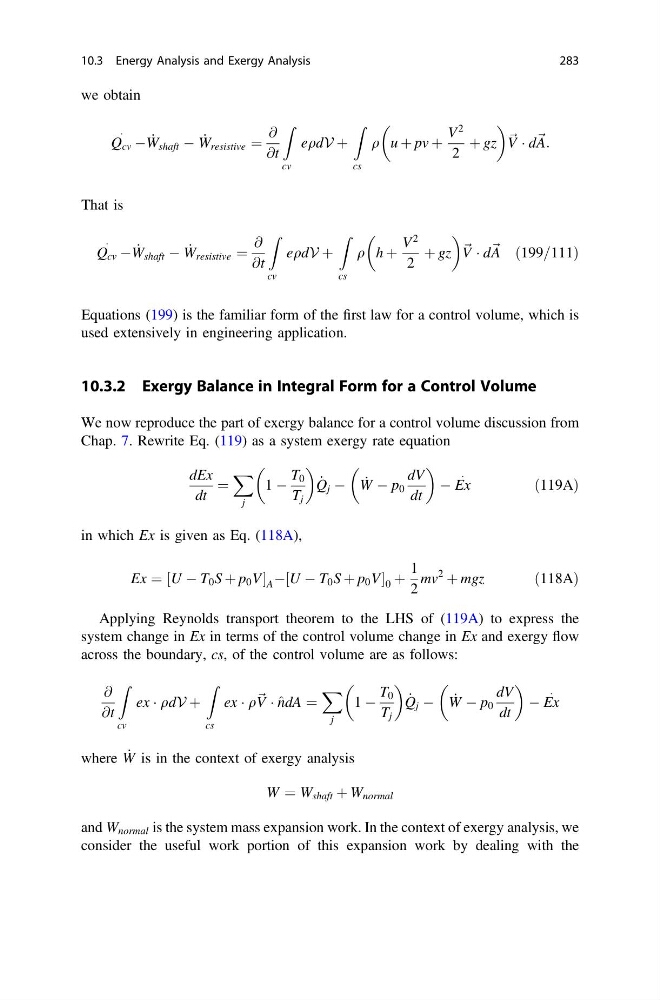
Equations (199) is the familiar form of the first law for a control volume, which is
used extensively in engineering application.
10.3.2 Exergy Balance in Integral Form for a Control Volume
We now reproduce the part of exergy balance for a control volume discussion from
Chap. 7. Rewrite Eq. (119) as a system exergy rate equation
dEx
dt
¼
X
j
1 À
T 0
T j
_
Q j À _
W À p 0
dV
dt
À Ex
:
ð119AÞ
in which Ex is given as Eq. (118A),
Ex ¼ U À T 0 S þ p 0 V
½
A À U À T 0 S þ p 0 V
½
0 þ
1
2
mv
2
þ mgz
ð118AÞ
Applying Reynolds transport theorem to the LHS of (119A) to express the
system change in Ex in terms of the control volume change in Ex and exergy flow
across the boundary, cs, of the control volume are as follows:
@
@t
Z
cv
ex Á qdV þ
Z
cs
ex Á q ~ V Á ^ ndA ¼
X
j
1 À
T 0
T j
_
Q j À _
W À p 0
dV
dt
À Ex
:
where _
W is in the context of exergy analysis
W ¼ W shaft þ W normal
and W normal is the system mass expansion work. In the context of exergy analysis, we
consider the useful work portion of this expansion work by dealing with the
10.3 Energy Analysis and Exergy Analysis
283
Q cv
: À _
W shaft À _
W resistive ¼
@
@t
Z
cv
eqdV þ
Z
cs
q u þ pv þ
V
2
2
þ gz
~ V Á d ~ A:
That is
Q cv
: À _
W shaft À _
W resistive ¼
@
@t
Z
cv
eqdV þ
Z
cs
q h þ
V
2
2
þ gz
~ V Á d ~ A ð199=111Þ
Equations (199) is the familiar form of the first law for a control volume, which is
used extensively in engineering application.
10.3.2 Exergy Balance in Integral Form for a Control Volume
We now reproduce the part of exergy balance for a control volume discussion from
Chap. 7. Rewrite Eq. (119) as a system exergy rate equation
dEx
dt
¼
X
j
1 À
T 0
T j
_
Q j À _
W À p 0
dV
dt
À Ex
:
ð119AÞ
in which Ex is given as Eq. (118A),
Ex ¼ U À T 0 S þ p 0 V
½
A À U À T 0 S þ p 0 V
½
0 þ
1
2
mv
2
þ mgz
ð118AÞ
Applying Reynolds transport theorem to the LHS of (119A) to express the
system change in Ex in terms of the control volume change in Ex and exergy flow
across the boundary, cs, of the control volume are as follows:
@
@t
Z
cv
ex Á qdV þ
Z
cs
ex Á q ~ V Á ^ ndA ¼
X
j
1 À
T 0
T j
_
Q j À _
W À p 0
dV
dt
À Ex
:
where _
W is in the context of exergy analysis
W ¼ W shaft þ W normal
and W normal is the system mass expansion work. In the context of exergy analysis, we
consider the useful work portion of this expansion work by dealing with the
10.3 Energy Analysis and Exergy Analysis
283