

Although the quantity of heat is determined by the same measure of that of
mechanical energy in Chap. 3, heat (more on that in Sect. 5.6) as a physical concept
remains distinctive from mechanical energy. Its full characterization requires a new
variable, temperature. Had the Boltzmann constant undergone the same transformation of g c and J, temperature too would have assumed the unit of energy (see
Footnote 2) and the distinction in the characterization of heat and thermal energy
versus work and mechanical energy would have disappeared completely––quantitatively as well as qualitatively. This emphatically is not the case, as we shall
discuss in detail in Chaps. 4–8. The Boltzmann constant and the universal gas
constant are considered to be dimensional universal constants. Thus, temperature is
a new fundamental dimension, H[K], which is added to the MKS system of length
L [m], mass M [kg], and time T [s] to form the SI system.
To recapitulate: We can identify universal constants into two groups: (1) dimensionless conversion factors (g c and J), and (2) dimensional universal constants
(k and R). The fundamental dimension set for the science of motion and heat is the
set of length L, mass M, time T, and temperature H (the corresponding SI units are
meter, kg, s, K). The complete SI system also includes the units of ampere and
candela.
The history of temperature both in terms of the formation of the concept (see
Sects. 4.3 and 4.4) and in terms of the evolution of its measurement and the
standardization of temperature scales (based on the proposal by W. F. Giauque
[6]:18,347]) is a rich one. The use of gas thermometer (see Sect. 1.5) and the
formulation of the second law (see Chaps. 4 and 5) played crucial roles in establishing our current state of the art.
1.5 Thermal Equation of State for Ideal Gases
The temperature scales in use before 1954 required for their specification two fixed
points, the ice point and the steam point. Hundreds of attempts were made to
measure temperature t with high precision without much success. In 1939, W.
F. Giauque proposed the use of a single fixed point, the triple point of water, set
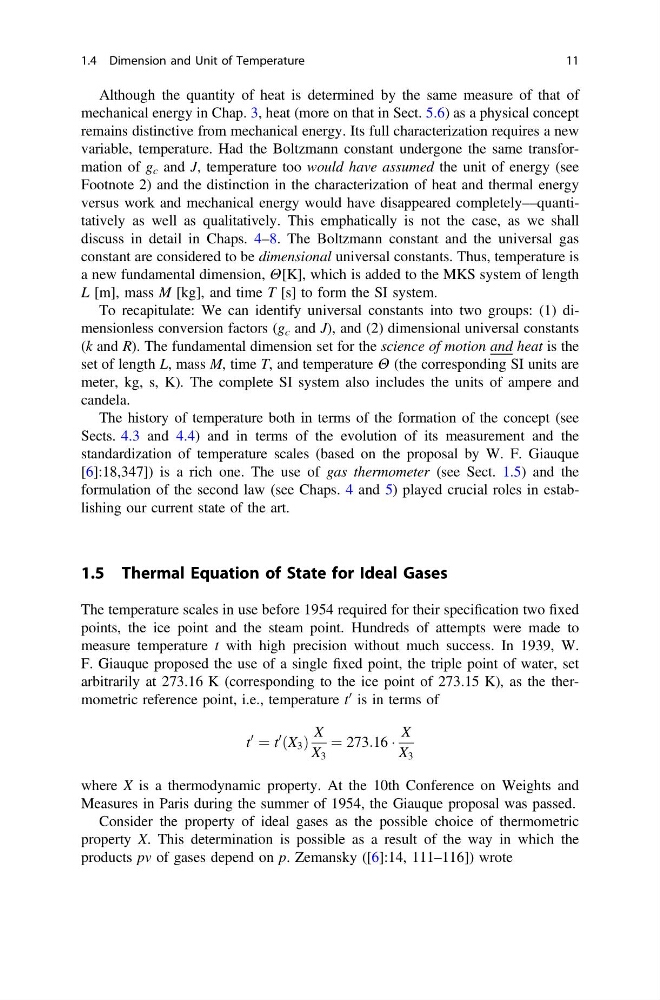
arbitrarily at 273.16 K (corresponding to the ice point of 273.15 K), as the thermometric reference point, i.e., temperature t
0 is in terms of
t
0
¼ t
0 X 3
ð Þ
X
X 3
¼ 273:16 Á
X
X 3
where X is a thermodynamic property. At the 10th Conference on Weights and
Measures in Paris during the summer of 1954, the Giauque proposal was passed.
Consider the property of ideal gases as the possible choice of thermometric
property X. This determination is possible as a result of the way in which the
products pv of gases depend on p. Zemansky ([6]:14, 111–116]) wrote
1.4 Dimension and Unit of Temperature
11
mechanical energy in Chap. 3, heat (more on that in Sect. 5.6) as a physical concept
remains distinctive from mechanical energy. Its full characterization requires a new
variable, temperature. Had the Boltzmann constant undergone the same transformation of g c and J, temperature too would have assumed the unit of energy (see
Footnote 2) and the distinction in the characterization of heat and thermal energy
versus work and mechanical energy would have disappeared completely––quantitatively as well as qualitatively. This emphatically is not the case, as we shall
discuss in detail in Chaps. 4–8. The Boltzmann constant and the universal gas
constant are considered to be dimensional universal constants. Thus, temperature is
a new fundamental dimension, H[K], which is added to the MKS system of length
L [m], mass M [kg], and time T [s] to form the SI system.
To recapitulate: We can identify universal constants into two groups: (1) dimensionless conversion factors (g c and J), and (2) dimensional universal constants
(k and R). The fundamental dimension set for the science of motion and heat is the
set of length L, mass M, time T, and temperature H (the corresponding SI units are
meter, kg, s, K). The complete SI system also includes the units of ampere and
candela.
The history of temperature both in terms of the formation of the concept (see
Sects. 4.3 and 4.4) and in terms of the evolution of its measurement and the
standardization of temperature scales (based on the proposal by W. F. Giauque
[6]:18,347]) is a rich one. The use of gas thermometer (see Sect. 1.5) and the
formulation of the second law (see Chaps. 4 and 5) played crucial roles in establishing our current state of the art.
1.5 Thermal Equation of State for Ideal Gases
The temperature scales in use before 1954 required for their specification two fixed
points, the ice point and the steam point. Hundreds of attempts were made to
measure temperature t with high precision without much success. In 1939, W.
F. Giauque proposed the use of a single fixed point, the triple point of water, set
arbitrarily at 273.16 K (corresponding to the ice point of 273.15 K), as the thermometric reference point, i.e., temperature t
0 is in terms of
t
0
¼ t
0 X 3
ð Þ
X
X 3
¼ 273:16 Á
X
X 3
where X is a thermodynamic property. At the 10th Conference on Weights and
Measures in Paris during the summer of 1954, the Giauque proposal was passed.
Consider the property of ideal gases as the possible choice of thermometric
property X. This determination is possible as a result of the way in which the
products pv of gases depend on p. Zemansky ([6]:14, 111–116]) wrote
1.4 Dimension and Unit of Temperature
11