

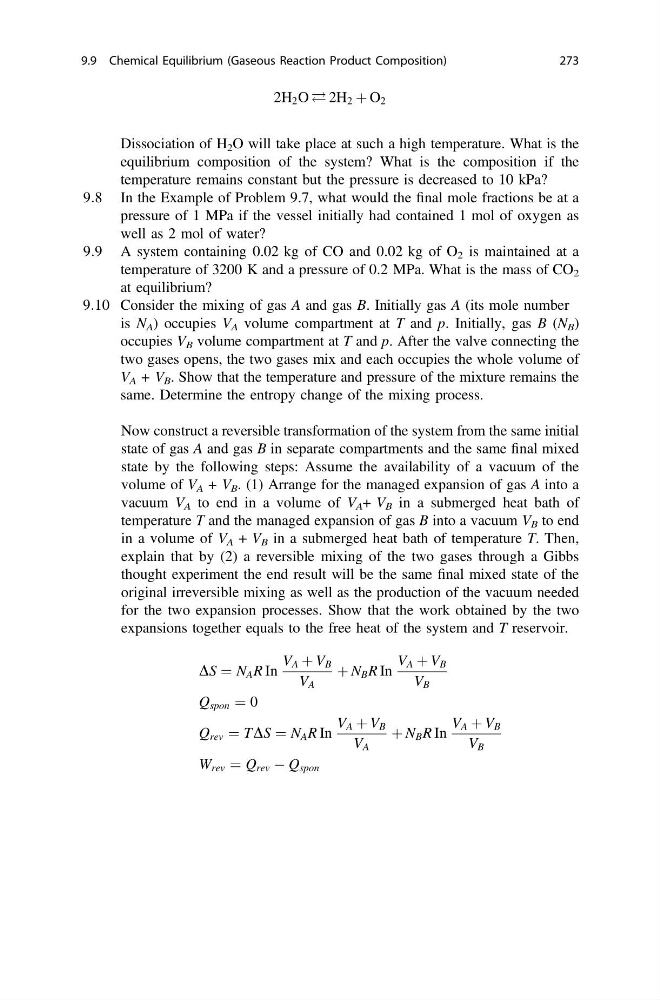
2H 2 O 2H 2 þ O 2
Dissociation of H 2 O will take place at such a high temperature. What is the
equilibrium composition of the system? What is the composition if the
temperature remains constant but the pressure is decreased to 10 kPa?
9:8 In the Example of Problem 9.7, what would the final mole fractions be at a
pressure of 1 MPa if the vessel initially had contained 1 mol of oxygen as
well as 2 mol of water?
9:9 A system containing 0.02 kg of CO and 0.02 kg of O 2 is maintained at a
temperature of 3200 K and a pressure of 0.2 MPa. What is the mass of CO 2
at equilibrium?
9:10 Consider the mixing of gas A and gas B. Initially gas A (its mole number
is N A ) occupies V A volume compartment at T and p. Initially, gas B (N B )
occupies V B volume compartment at T and p. After the valve connecting the
two gases opens, the two gases mix and each occupies the whole volume of
V A + V B . Show that the temperature and pressure of the mixture remains the
same. Determine the entropy change of the mixing process.
Now construct a reversible transformation of the system from the same initial
state of gas A and gas B in separate compartments and the same final mixed
state by the following steps: Assume the availability of a vacuum of the
volume of V A + V B . (1) Arrange for the managed expansion of gas A into a
vacuum V A to end in a volume of V A + V B in a submerged heat bath of
temperature T and the managed expansion of gas B into a vacuum V B to end
in a volume of V A + V B in a submerged heat bath of temperature T. Then,
explain that by (2) a reversible mixing of the two gases through a Gibbs
thought experiment the end result will be the same final mixed state of the
original irreversible mixing as well as the production of the vacuum needed
for the two expansion processes. Show that the work obtained by the two
expansions together equals to the free heat of the system and T reservoir.
DS ¼ N A R In
V A þ V B
V A
þ N B R In
V A þ V B
V B
Q spon ¼ 0
Q rev ¼ TDS ¼ N A R In
V A þ V B
V A
þ N B R In
V A þ V B
V B
W rev ¼ Q rev À Q spon
9.9 Chemical Equilibrium (Gaseous Reaction Product Composition)
273
Dissociation of H 2 O will take place at such a high temperature. What is the
equilibrium composition of the system? What is the composition if the
temperature remains constant but the pressure is decreased to 10 kPa?
9:8 In the Example of Problem 9.7, what would the final mole fractions be at a
pressure of 1 MPa if the vessel initially had contained 1 mol of oxygen as
well as 2 mol of water?
9:9 A system containing 0.02 kg of CO and 0.02 kg of O 2 is maintained at a
temperature of 3200 K and a pressure of 0.2 MPa. What is the mass of CO 2
at equilibrium?
9:10 Consider the mixing of gas A and gas B. Initially gas A (its mole number
is N A ) occupies V A volume compartment at T and p. Initially, gas B (N B )
occupies V B volume compartment at T and p. After the valve connecting the
two gases opens, the two gases mix and each occupies the whole volume of
V A + V B . Show that the temperature and pressure of the mixture remains the
same. Determine the entropy change of the mixing process.
Now construct a reversible transformation of the system from the same initial
state of gas A and gas B in separate compartments and the same final mixed
state by the following steps: Assume the availability of a vacuum of the
volume of V A + V B . (1) Arrange for the managed expansion of gas A into a
vacuum V A to end in a volume of V A + V B in a submerged heat bath of
temperature T and the managed expansion of gas B into a vacuum V B to end
in a volume of V A + V B in a submerged heat bath of temperature T. Then,
explain that by (2) a reversible mixing of the two gases through a Gibbs
thought experiment the end result will be the same final mixed state of the
original irreversible mixing as well as the production of the vacuum needed
for the two expansion processes. Show that the work obtained by the two
expansions together equals to the free heat of the system and T reservoir.
DS ¼ N A R In
V A þ V B
V A
þ N B R In
V A þ V B
V B
Q spon ¼ 0
Q rev ¼ TDS ¼ N A R In
V A þ V B
V A
þ N B R In
V A þ V B
V B
W rev ¼ Q rev À Q spon
9.9 Chemical Equilibrium (Gaseous Reaction Product Composition)
273