

9.9 Chemical Equilibrium (Gaseous Reaction Product
Composition)
The product mixtures considered in Sect. 9.8 exist at the standard temperature, at
which condition there is negligible dissociation in the product. The situation is
different when the product is maintained at high elevated temperatures in that
dissociation may not be negligible. In that case, the composition of the product
mixture is determined in accordance with chemical equilibrium criterion on the
basis of minimum Gibbs function under the constraint of constant T and p.
It is necessary to construct for a given reaction with a given composition of
reactant mixture the constant T and p quasi-static process in terms of G as a function
of extent of reaction, n. Take a simple reaction and assume the stoichiometric
(theoretical) fuel–air reactant mixture, the balancing equation (the state of microreversibility between reactant and product in an equilibrium mixture) of the reaction
is
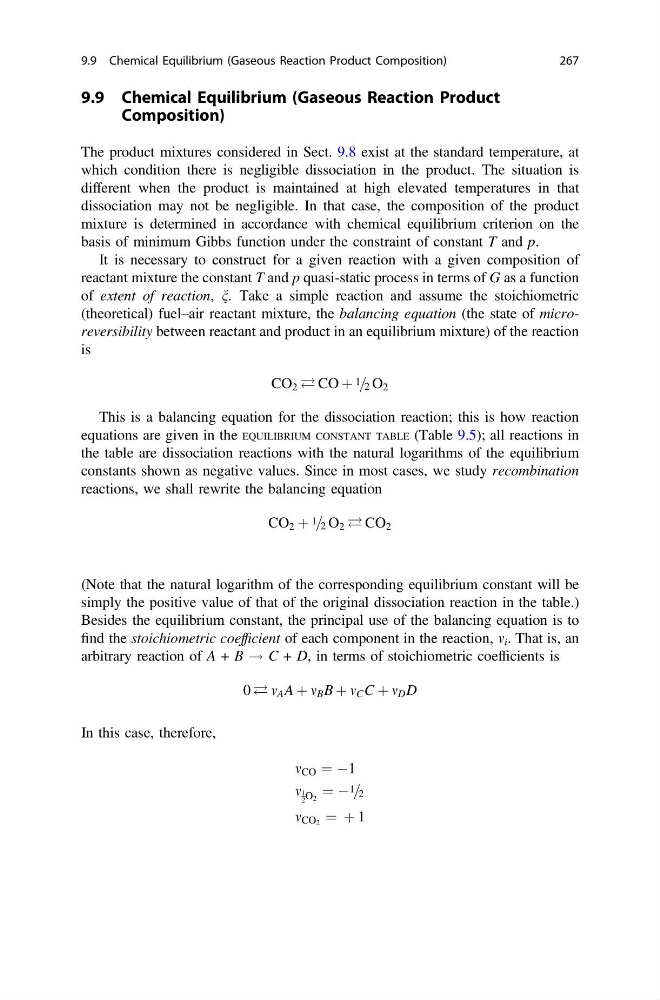
CO 2 CO þ 1 = 2 O 2
This is a balancing equation for the dissociation reaction; this is how reaction
equations are given in the EQUILIBRIUM CONSTANT TABLE (Table 9.5); all reactions in
the table are dissociation reactions with the natural logarithms of the equilibrium
constants shown as negative values. Since in most cases, we study recombination
reactions, we shall rewrite the balancing equation
CO 2 þ 1 = 2 O 2 CO 2
(Note that the natural logarithm of the corresponding equilibrium constant will be
simply the positive value of that of the original dissociation reaction in the table.)
Besides the equilibrium constant, the principal use of the balancing equation is to
find the stoichiometric coefficient of each component in the reaction, m i . That is, an
arbitrary reaction of A + B ! C + D, in terms of stoichiometric coefficients is
0 m A A þ m B B þ m C C þ m D D
In this case, therefore,
m CO ¼ À1
m1
2 O 2 ¼ À 1 = 2
m CO 2 ¼ þ 1
9.9 Chemical Equilibrium (Gaseous Reaction Product Composition)
267
Composition)
The product mixtures considered in Sect. 9.8 exist at the standard temperature, at
which condition there is negligible dissociation in the product. The situation is
different when the product is maintained at high elevated temperatures in that
dissociation may not be negligible. In that case, the composition of the product
mixture is determined in accordance with chemical equilibrium criterion on the
basis of minimum Gibbs function under the constraint of constant T and p.
It is necessary to construct for a given reaction with a given composition of
reactant mixture the constant T and p quasi-static process in terms of G as a function
of extent of reaction, n. Take a simple reaction and assume the stoichiometric
(theoretical) fuel–air reactant mixture, the balancing equation (the state of microreversibility between reactant and product in an equilibrium mixture) of the reaction
is
CO 2 CO þ 1 = 2 O 2
This is a balancing equation for the dissociation reaction; this is how reaction
equations are given in the EQUILIBRIUM CONSTANT TABLE (Table 9.5); all reactions in
the table are dissociation reactions with the natural logarithms of the equilibrium
constants shown as negative values. Since in most cases, we study recombination
reactions, we shall rewrite the balancing equation
CO 2 þ 1 = 2 O 2 CO 2
(Note that the natural logarithm of the corresponding equilibrium constant will be
simply the positive value of that of the original dissociation reaction in the table.)
Besides the equilibrium constant, the principal use of the balancing equation is to
find the stoichiometric coefficient of each component in the reaction, m i . That is, an
arbitrary reaction of A + B ! C + D, in terms of stoichiometric coefficients is
0 m A A þ m B B þ m C C þ m D D
In this case, therefore,
m CO ¼ À1
m1
2 O 2 ¼ À 1 = 2
m CO 2 ¼ þ 1
9.9 Chemical Equilibrium (Gaseous Reaction Product Composition)
267