

1
T 1
ð Þ
À
1
T 2
ð Þ
equili
¼ 0
p
1
ð Þ
T 1
ð Þ
À
p
2
ð Þ
T 2
ð Þ
equili
¼ 0
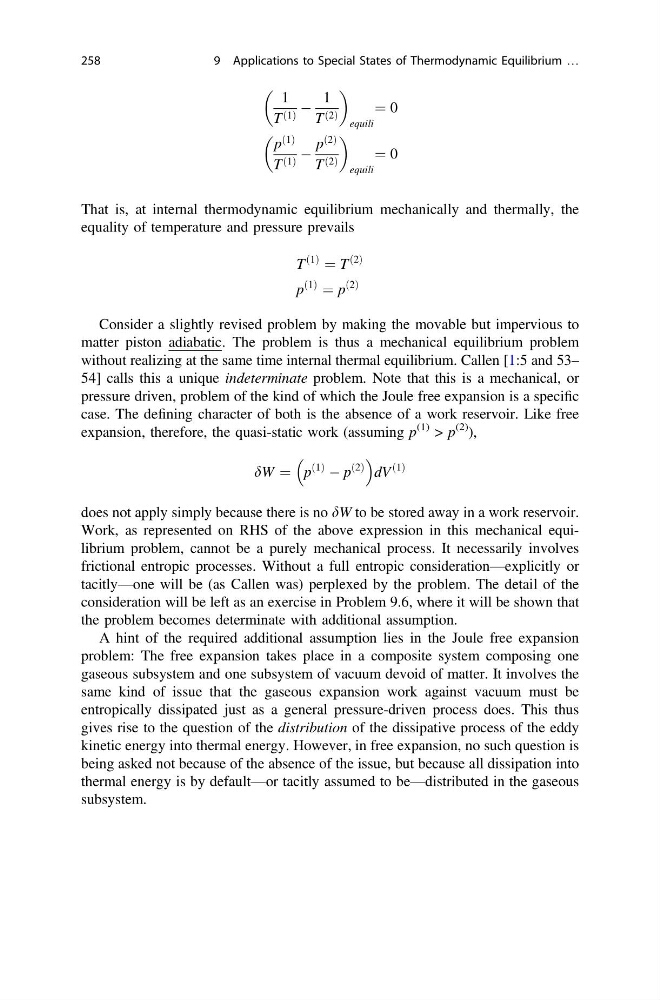
That is, at internal thermodynamic equilibrium mechanically and thermally, the
equality of temperature and pressure prevails
T
1
ð Þ
¼ T
2
ð Þ
p
1
ð Þ
¼ p
2
ð Þ
Consider a slightly revised problem by making the movable but impervious to
matter piston adiabatic. The problem is thus a mechanical equilibrium problem
without realizing at the same time internal thermal equilibrium. Callen [1:5 and 53–
54] calls this a unique indeterminate problem. Note that this is a mechanical, or
pressure driven, problem of the kind of which the Joule free expansion is a specific
case. The defining character of both is the absence of a work reservoir. Like free
expansion, therefore, the quasi-static work (assuming p
(1) > p
(2) ),
dW ¼ p
1
ð Þ
À p
2
ð Þ
dV
1
ð Þ
does not apply simply because there is no dW to be stored away in a work reservoir.
Work, as represented on RHS of the above expression in this mechanical equilibrium problem, cannot be a purely mechanical process. It necessarily involves
frictional entropic processes. Without a full entropic consideration—explicitly or
tacitly—one will be (as Callen was) perplexed by the problem. The detail of the
consideration will be left as an exercise in Problem 9.6, where it will be shown that
the problem becomes determinate with additional assumption.
A hint of the required additional assumption lies in the Joule free expansion
problem: The free expansion takes place in a composite system composing one
gaseous subsystem and one subsystem of vacuum devoid of matter. It involves the
same kind of issue that the gaseous expansion work against vacuum must be
entropically dissipated just as a general pressure-driven process does. This thus
gives rise to the question of the distribution of the dissipative process of the eddy
kinetic energy into thermal energy. However, in free expansion, no such question is
being asked not because of the absence of the issue, but because all dissipation into
thermal energy is by default—or tacitly assumed to be—distributed in the gaseous
subsystem.
258
9 Applications to Special States of Thermodynamic Equilibrium …
T 1
ð Þ
À
1
T 2
ð Þ
equili
¼ 0
p
1
ð Þ
T 1
ð Þ
À
p
2
ð Þ
T 2
ð Þ
equili
¼ 0
That is, at internal thermodynamic equilibrium mechanically and thermally, the
equality of temperature and pressure prevails
T
1
ð Þ
¼ T
2
ð Þ
p
1
ð Þ
¼ p
2
ð Þ
Consider a slightly revised problem by making the movable but impervious to
matter piston adiabatic. The problem is thus a mechanical equilibrium problem
without realizing at the same time internal thermal equilibrium. Callen [1:5 and 53–
54] calls this a unique indeterminate problem. Note that this is a mechanical, or
pressure driven, problem of the kind of which the Joule free expansion is a specific
case. The defining character of both is the absence of a work reservoir. Like free
expansion, therefore, the quasi-static work (assuming p
(1) > p
(2) ),
dW ¼ p
1
ð Þ
À p
2
ð Þ
dV
1
ð Þ
does not apply simply because there is no dW to be stored away in a work reservoir.
Work, as represented on RHS of the above expression in this mechanical equilibrium problem, cannot be a purely mechanical process. It necessarily involves
frictional entropic processes. Without a full entropic consideration—explicitly or
tacitly—one will be (as Callen was) perplexed by the problem. The detail of the
consideration will be left as an exercise in Problem 9.6, where it will be shown that
the problem becomes determinate with additional assumption.
A hint of the required additional assumption lies in the Joule free expansion
problem: The free expansion takes place in a composite system composing one
gaseous subsystem and one subsystem of vacuum devoid of matter. It involves the
same kind of issue that the gaseous expansion work against vacuum must be
entropically dissipated just as a general pressure-driven process does. This thus
gives rise to the question of the distribution of the dissipative process of the eddy
kinetic energy into thermal energy. However, in free expansion, no such question is
being asked not because of the absence of the issue, but because all dissipation into
thermal energy is by default—or tacitly assumed to be—distributed in the gaseous
subsystem.
258
9 Applications to Special States of Thermodynamic Equilibrium …