

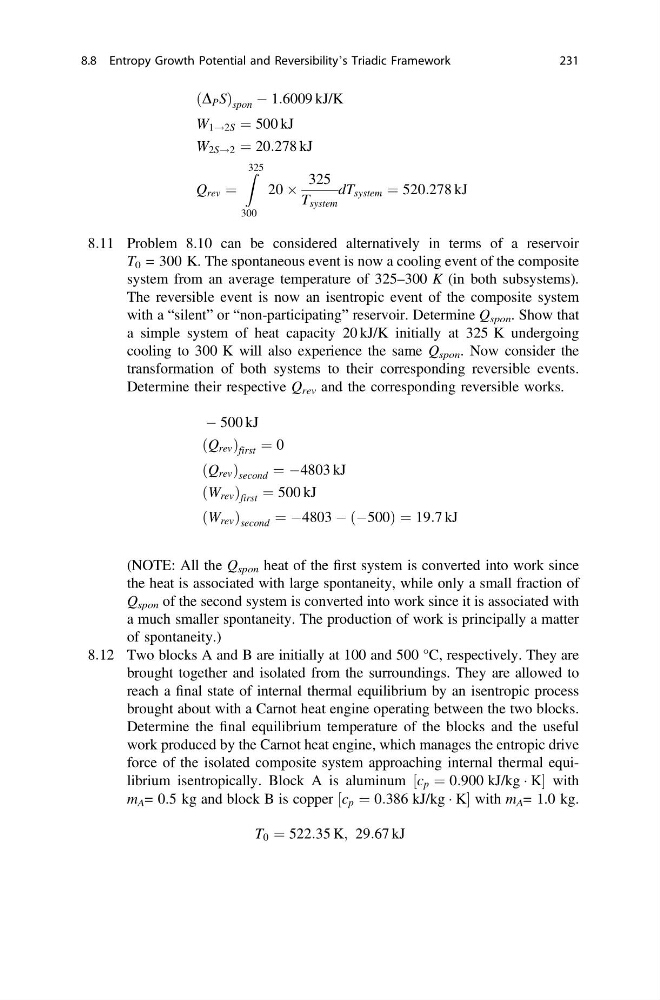
ðD P SÞ spon À 1:6009 kJ/K
W 1!2S ¼ 500 kJ
W 2S!2 ¼ 20:278 kJ
Q rev ¼
Z 325
300
20 Â
325
T system
dT system ¼ 520:278 kJ
8:11 Problem 8.10 can be considered alternatively in terms of a reservoir
T 0 = 300 K. The spontaneous event is now a cooling event of the composite
system from an average temperature of 325–300 K (in both subsystems).
The reversible event is now an isentropic event of the composite system
with a “silent” or “non-participating” reservoir. Determine Q spon . Show that
a simple system of heat capacity 20 kJ/K initially at 325 K undergoing
cooling to 300 K will also experience the same Q spon . Now consider the
transformation of both systems to their corresponding reversible events.
Determine their respective Q rev and the corresponding reversible works.
À 500 kJ
ðQ rev Þ first ¼ 0
ðQ rev Þ second ¼ À4803 kJ
ðW rev Þ first ¼ 500 kJ
ðW rev Þ second ¼ À4803 À ðÀ500Þ ¼ 19:7 kJ
(NOTE: All the Q spon heat of the first system is converted into work since
the heat is associated with large spontaneity, while only a small fraction of
Q spon of the second system is converted into work since it is associated with
a much smaller spontaneity. The production of work is principally a matter
of spontaneity.)
8:12 Two blocks A and B are initially at 100 and 500 °C, respectively. They are
brought together and isolated from the surroundings. They are allowed to
reach a final state of internal thermal equilibrium by an isentropic process
brought about with a Carnot heat engine operating between the two blocks.
Determine the final equilibrium temperature of the blocks and the useful
work produced by the Carnot heat engine, which manages the entropic drive
force of the isolated composite system approaching internal thermal equilibrium isentropically. Block A is aluminum ½c p ¼ 0:900 kJ/kg Á K with
m A = 0.5 kg and block B is copper ½c p ¼ 0:386 kJ/kg Á K with m A = 1.0 kg.
T 0 ¼ 522:35 K; 29:67 kJ
8.8 Entropy Growth Potential and Reversibility’s Triadic Framework
231
W 1!2S ¼ 500 kJ
W 2S!2 ¼ 20:278 kJ
Q rev ¼
Z 325
300
20 Â
325
T system
dT system ¼ 520:278 kJ
8:11 Problem 8.10 can be considered alternatively in terms of a reservoir
T 0 = 300 K. The spontaneous event is now a cooling event of the composite
system from an average temperature of 325–300 K (in both subsystems).
The reversible event is now an isentropic event of the composite system
with a “silent” or “non-participating” reservoir. Determine Q spon . Show that
a simple system of heat capacity 20 kJ/K initially at 325 K undergoing
cooling to 300 K will also experience the same Q spon . Now consider the
transformation of both systems to their corresponding reversible events.
Determine their respective Q rev and the corresponding reversible works.
À 500 kJ
ðQ rev Þ first ¼ 0
ðQ rev Þ second ¼ À4803 kJ
ðW rev Þ first ¼ 500 kJ
ðW rev Þ second ¼ À4803 À ðÀ500Þ ¼ 19:7 kJ
(NOTE: All the Q spon heat of the first system is converted into work since
the heat is associated with large spontaneity, while only a small fraction of
Q spon of the second system is converted into work since it is associated with
a much smaller spontaneity. The production of work is principally a matter
of spontaneity.)
8:12 Two blocks A and B are initially at 100 and 500 °C, respectively. They are
brought together and isolated from the surroundings. They are allowed to
reach a final state of internal thermal equilibrium by an isentropic process
brought about with a Carnot heat engine operating between the two blocks.
Determine the final equilibrium temperature of the blocks and the useful
work produced by the Carnot heat engine, which manages the entropic drive
force of the isolated composite system approaching internal thermal equilibrium isentropically. Block A is aluminum ½c p ¼ 0:900 kJ/kg Á K with
m A = 0.5 kg and block B is copper ½c p ¼ 0:386 kJ/kg Á K with m A = 1.0 kg.
T 0 ¼ 522:35 K; 29:67 kJ
8.8 Entropy Growth Potential and Reversibility’s Triadic Framework
231