

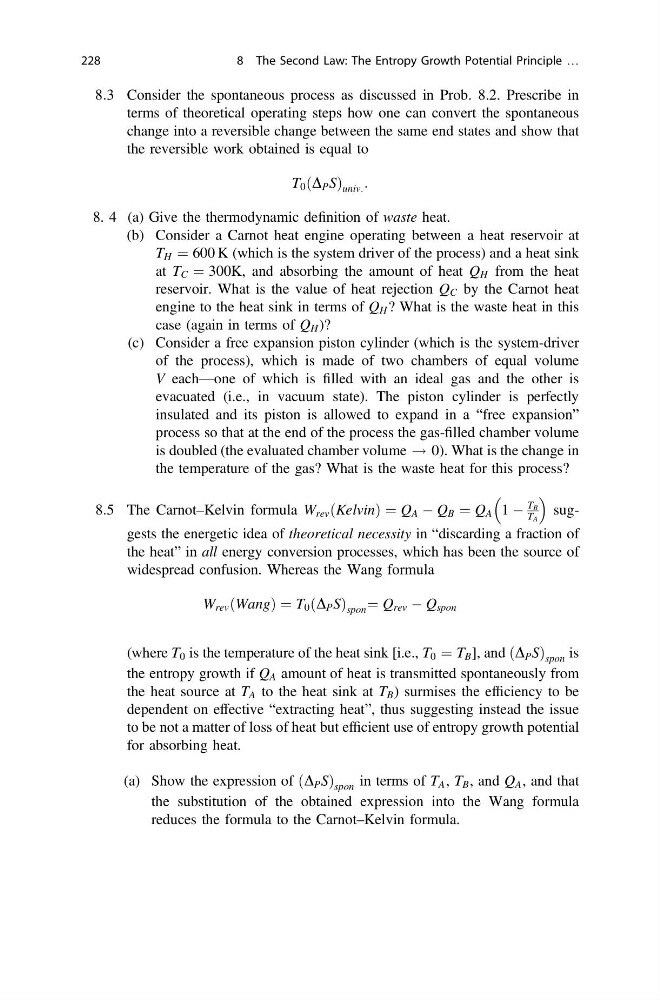
8:3 Consider the spontaneous process as discussed in Prob. 8.2. Prescribe in
terms of theoretical operating steps how one can convert the spontaneous
change into a reversible change between the same end states and show that
the reversible work obtained is equal to
T 0 D P S
ð
Þ univ: :
8. 4 (a) Give the thermodynamic definition of waste heat.
(b) Consider a Carnot heat engine operating between a heat reservoir at
T H ¼ 600 K (which is the system driver of the process) and a heat sink
at T C ¼ 300K, and absorbing the amount of heat Q H from the heat
reservoir. What is the value of heat rejection Q C by the Carnot heat
engine to the heat sink in terms of Q H ? What is the waste heat in this
case (again in terms of Q H )?
(c) Consider a free expansion piston cylinder (which is the system-driver
of the process), which is made of two chambers of equal volume
V each—one of which is filled with an ideal gas and the other is
evacuated (i.e., in vacuum state). The piston cylinder is perfectly
insulated and its piston is allowed to expand in a “free expansion”
process so that at the end of the process the gas-filled chamber volume
is doubled (the evaluated chamber volume ! 0). What is the change in
the temperature of the gas? What is the waste heat for this process?
8:5 The Carnot–Kelvin formula W rev Kelvin
ð
Þ¼Q A À Q B ¼ Q A 1 À
T B
T A
suggests the energetic idea of theoretical necessity in “discarding a fraction of
the heat” in all energy conversion processes, which has been the source of
widespread confusion. Whereas the Wang formula
W rev Wang
ð
Þ¼T 0 D P S
ð
Þ spon ¼ Q rev À Q spon
(where T 0 is the temperature of the heat sink [i.e., T 0 ¼ T B ], and D P S
ð
Þ spon is
the entropy growth if Q A amount of heat is transmitted spontaneously from
the heat source at T A to the heat sink at T B ) surmises the efficiency to be
dependent on effective “extracting heat”, thus suggesting instead the issue
to be not a matter of loss of heat but efficient use of entropy growth potential
for absorbing heat.
(a) Show the expression of D P S
ð
Þ spon in terms of T A , T B , and Q A , and that
the substitution of the obtained expression into the Wang formula
reduces the formula to the Carnot–Kelvin formula.
228
8 The Second Law: The Entropy Growth Potential Principle …
terms of theoretical operating steps how one can convert the spontaneous
change into a reversible change between the same end states and show that
the reversible work obtained is equal to
T 0 D P S
ð
Þ univ: :
8. 4 (a) Give the thermodynamic definition of waste heat.
(b) Consider a Carnot heat engine operating between a heat reservoir at
T H ¼ 600 K (which is the system driver of the process) and a heat sink
at T C ¼ 300K, and absorbing the amount of heat Q H from the heat
reservoir. What is the value of heat rejection Q C by the Carnot heat
engine to the heat sink in terms of Q H ? What is the waste heat in this
case (again in terms of Q H )?
(c) Consider a free expansion piston cylinder (which is the system-driver
of the process), which is made of two chambers of equal volume
V each—one of which is filled with an ideal gas and the other is
evacuated (i.e., in vacuum state). The piston cylinder is perfectly
insulated and its piston is allowed to expand in a “free expansion”
process so that at the end of the process the gas-filled chamber volume
is doubled (the evaluated chamber volume ! 0). What is the change in
the temperature of the gas? What is the waste heat for this process?
8:5 The Carnot–Kelvin formula W rev Kelvin
ð
Þ¼Q A À Q B ¼ Q A 1 À
T B
T A
suggests the energetic idea of theoretical necessity in “discarding a fraction of
the heat” in all energy conversion processes, which has been the source of
widespread confusion. Whereas the Wang formula
W rev Wang
ð
Þ¼T 0 D P S
ð
Þ spon ¼ Q rev À Q spon
(where T 0 is the temperature of the heat sink [i.e., T 0 ¼ T B ], and D P S
ð
Þ spon is
the entropy growth if Q A amount of heat is transmitted spontaneously from
the heat source at T A to the heat sink at T B ) surmises the efficiency to be
dependent on effective “extracting heat”, thus suggesting instead the issue
to be not a matter of loss of heat but efficient use of entropy growth potential
for absorbing heat.
(a) Show the expression of D P S
ð
Þ spon in terms of T A , T B , and Q A , and that
the substitution of the obtained expression into the Wang formula
reduces the formula to the Carnot–Kelvin formula.
228
8 The Second Law: The Entropy Growth Potential Principle …