

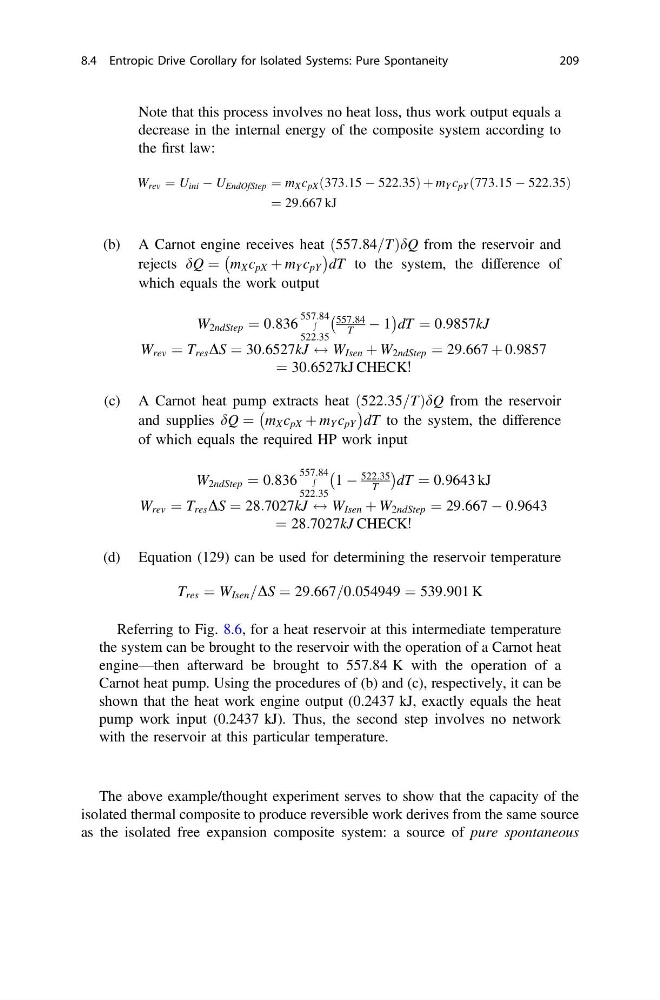
Note that this process involves no heat loss, thus work output equals a
decrease in the internal energy of the composite system according to
the first law:
W rev ¼ U ini À U EndOfStep ¼ m X c pX 373:15 À 522:35
ð
Þ þ m Y c pY 773:15 À 522:35
ð
Þ
¼ 29:667 kJ
(b) A Carnot engine receives heat 557:84=T
ð
Þ dQ from the reservoir and
rejects dQ ¼ m X c pX þ m Y c pY
À
Á
dT to the system, the difference of
which equals the work output
W 2ndStep ¼ 0:836
R
557:84
522:35
557:84
T À 1
À
Á
dT ¼ 0:9857kJ
W rev ¼ T res DS ¼ 30:6527kJ $ W Isen þ W 2ndStep ¼ 29:667 þ 0:9857
¼ 30:6527kJ CHECK!
(c) A Carnot heat pump extracts heat 522:35=T
ð
Þ dQ from the reservoir
and supplies dQ ¼ m X c pX þ m Y c pY
À
Á
dT to the system, the difference
of which equals the required HP work input
W 2ndStep ¼ 0:836
R
557:84
522:35
1 À
522:35
T
À
Á
dT ¼ 0:9643 kJ
W rev ¼ T res DS ¼ 28:7027kJ $ W Isen þ W 2ndStep ¼ 29:667 À 0:9643
¼ 28:7027kJ CHECK!
(d) Equation (129) can be used for determining the reservoir temperature
T res ¼ W Isen =DS ¼ 29:667=0:054949 ¼ 539:901 K
Referring to Fig. 8.6, for a heat reservoir at this intermediate temperature
the system can be brought to the reservoir with the operation of a Carnot heat
engine—then afterward be brought to 557.84 K with the operation of a
Carnot heat pump. Using the procedures of (b) and (c), respectively, it can be
shown that the heat work engine output (0.2437 kJ, exactly equals the heat
pump work input (0.2437 kJ). Thus, the second step involves no network
with the reservoir at this particular temperature.
The above example/thought experiment serves to show that the capacity of the
isolated thermal composite to produce reversible work derives from the same source
as the isolated free expansion composite system: a source of pure spontaneous
8.4 Entropic Drive Corollary for Isolated Systems: Pure Spontaneity
209
decrease in the internal energy of the composite system according to
the first law:
W rev ¼ U ini À U EndOfStep ¼ m X c pX 373:15 À 522:35
ð
Þ þ m Y c pY 773:15 À 522:35
ð
Þ
¼ 29:667 kJ
(b) A Carnot engine receives heat 557:84=T
ð
Þ dQ from the reservoir and
rejects dQ ¼ m X c pX þ m Y c pY
À
Á
dT to the system, the difference of
which equals the work output
W 2ndStep ¼ 0:836
R
557:84
522:35
557:84
T À 1
À
Á
dT ¼ 0:9857kJ
W rev ¼ T res DS ¼ 30:6527kJ $ W Isen þ W 2ndStep ¼ 29:667 þ 0:9857
¼ 30:6527kJ CHECK!
(c) A Carnot heat pump extracts heat 522:35=T
ð
Þ dQ from the reservoir
and supplies dQ ¼ m X c pX þ m Y c pY
À
Á
dT to the system, the difference
of which equals the required HP work input
W 2ndStep ¼ 0:836
R
557:84
522:35
1 À
522:35
T
À
Á
dT ¼ 0:9643 kJ
W rev ¼ T res DS ¼ 28:7027kJ $ W Isen þ W 2ndStep ¼ 29:667 À 0:9643
¼ 28:7027kJ CHECK!
(d) Equation (129) can be used for determining the reservoir temperature
T res ¼ W Isen =DS ¼ 29:667=0:054949 ¼ 539:901 K
Referring to Fig. 8.6, for a heat reservoir at this intermediate temperature
the system can be brought to the reservoir with the operation of a Carnot heat
engine—then afterward be brought to 557.84 K with the operation of a
Carnot heat pump. Using the procedures of (b) and (c), respectively, it can be
shown that the heat work engine output (0.2437 kJ, exactly equals the heat
pump work input (0.2437 kJ). Thus, the second step involves no network
with the reservoir at this particular temperature.
The above example/thought experiment serves to show that the capacity of the
isolated thermal composite to produce reversible work derives from the same source
as the isolated free expansion composite system: a source of pure spontaneous
8.4 Entropic Drive Corollary for Isolated Systems: Pure Spontaneity
209