

But, this outcome was not Carnot’s take on his principle (see Sects. 4.2, p. 64
and 4.5), which he viewed to be the cornerstone of understanding transformation of
heat into work rather than being merely a necessary restriction on possible types of
heat!work transformations. In other words, the second law as it was formulated in
MTH is incomplete and, as a result, the law does not enjoy equal status with the first
law and the understanding of heat is correspondingly incoherent.
Ultimately, the goal of this essay is to accord equal status to the first law and the
second law in its complete form.
1.2 Thermal Equilibrium and Temperature
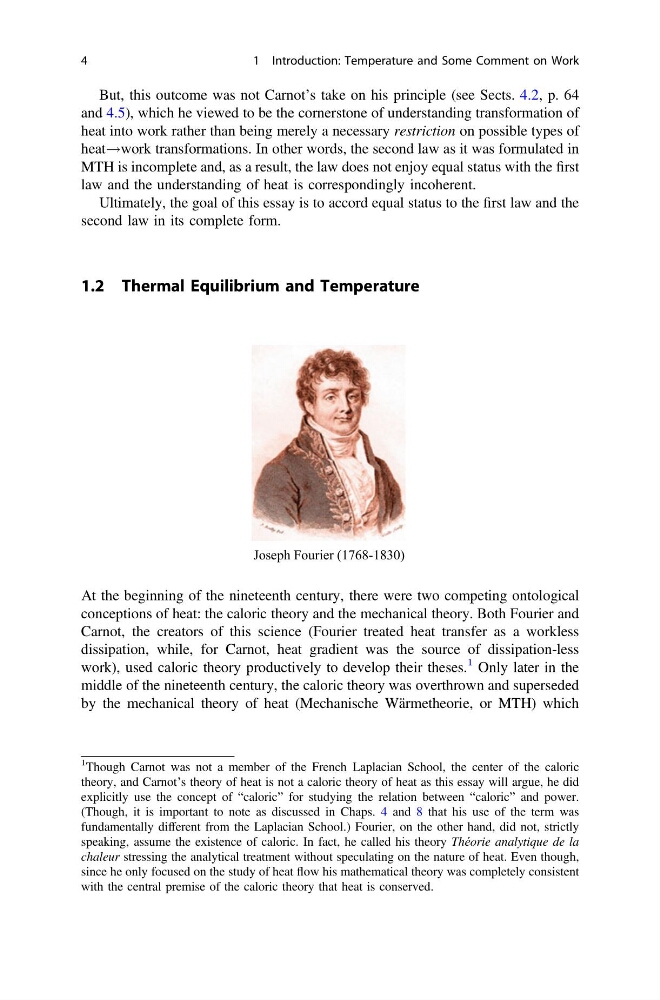
Joseph Fourier (1768-1830)
At the beginning of the nineteenth century, there were two competing ontological
conceptions of heat: the caloric theory and the mechanical theory. Both Fourier and
Carnot, the creators of this science (Fourier treated heat transfer as a workless
dissipation, while, for Carnot, heat gradient was the source of dissipation-less
work), used caloric theory productively to develop their theses.
1 Only later in the
middle of the nineteenth century, the caloric theory was overthrown and superseded
by the mechanical theory of heat (Mechanische Wärmetheorie, or MTH) which
1
Though Carnot was not a member of the French Laplacian School, the center of the caloric
theory, and Carnot’s theory of heat is not a caloric theory of heat as this essay will argue, he did
explicitly use the concept of “caloric” for studying the relation between “caloric” and power.
(Though, it is important to note as discussed in Chaps. 4 and 8 that his use of the term was
fundamentally different from the Laplacian School.) Fourier, on the other hand, did not, strictly
speaking, assume the existence of caloric. In fact, he called his theory Théorie analytique de la
chaleur stressing the analytical treatment without speculating on the nature of heat. Even though,
since he only focused on the study of heat flow his mathematical theory was completely consistent
with the central premise of the caloric theory that heat is conserved.
4
1 Introduction: Temperature and Some Comment on Work
and 4.5), which he viewed to be the cornerstone of understanding transformation of
heat into work rather than being merely a necessary restriction on possible types of
heat!work transformations. In other words, the second law as it was formulated in
MTH is incomplete and, as a result, the law does not enjoy equal status with the first
law and the understanding of heat is correspondingly incoherent.
Ultimately, the goal of this essay is to accord equal status to the first law and the
second law in its complete form.
1.2 Thermal Equilibrium and Temperature
Joseph Fourier (1768-1830)
At the beginning of the nineteenth century, there were two competing ontological
conceptions of heat: the caloric theory and the mechanical theory. Both Fourier and
Carnot, the creators of this science (Fourier treated heat transfer as a workless
dissipation, while, for Carnot, heat gradient was the source of dissipation-less
work), used caloric theory productively to develop their theses.
1 Only later in the
middle of the nineteenth century, the caloric theory was overthrown and superseded
by the mechanical theory of heat (Mechanische Wärmetheorie, or MTH) which
1
Though Carnot was not a member of the French Laplacian School, the center of the caloric
theory, and Carnot’s theory of heat is not a caloric theory of heat as this essay will argue, he did
explicitly use the concept of “caloric” for studying the relation between “caloric” and power.
(Though, it is important to note as discussed in Chaps. 4 and 8 that his use of the term was
fundamentally different from the Laplacian School.) Fourier, on the other hand, did not, strictly
speaking, assume the existence of caloric. In fact, he called his theory Théorie analytique de la
chaleur stressing the analytical treatment without speculating on the nature of heat. Even though,
since he only focused on the study of heat flow his mathematical theory was completely consistent
with the central premise of the caloric theory that heat is conserved.
4
1 Introduction: Temperature and Some Comment on Work