

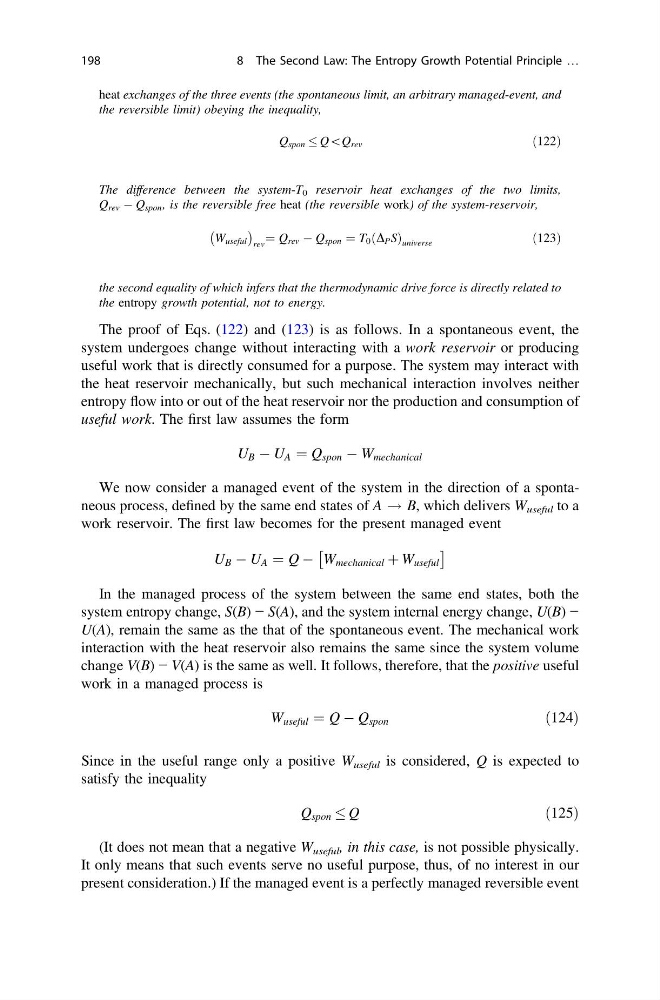
heat exchanges of the three events (the spontaneous limit, an arbitrary managed-event, and
the reversible limit) obeying the inequality,
Q spon Q\Q rev
ð122Þ
The difference between the system-T 0 reservoir heat exchanges of the two limits,
Q rev À Q spon , is the reversible free heat (the reversible work) of the system-reservoir,
W useful
À
Á
rev
¼ Q rev À Q spon ¼ T 0 D P S
ð
Þ universe
ð123Þ
the second equality of which infers that the thermodynamic drive force is directly related to
the entropy growth potential, not to energy.
The proof of Eqs. (122) and (123) is as follows. In a spontaneous event, the
system undergoes change without interacting with a work reservoir or producing
useful work that is directly consumed for a purpose. The system may interact with
the heat reservoir mechanically, but such mechanical interaction involves neither
entropy flow into or out of the heat reservoir nor the production and consumption of
useful work. The first law assumes the form
U B À U A ¼ Q spon À W mechanical
We now consider a managed event of the system in the direction of a spontaneous process, defined by the same end states of A ! B, which delivers W useful to a
work reservoir. The first law becomes for the present managed event
U B À U A ¼ Q À W mechanical þ W useful
Â
Ã
In the managed process of the system between the same end states, both the
system entropy change, S(B) − S(A), and the system internal energy change, U(B) −
U(A), remain the same as the that of the spontaneous event. The mechanical work
interaction with the heat reservoir also remains the same since the system volume
change V(B) − V(A) is the same as well. It follows, therefore, that the positive useful
work in a managed process is
W useful ¼ Q À Q spon
ð124Þ
Since in the useful range only a positive W useful is considered, Q is expected to
satisfy the inequality
Q spon Q
ð125Þ
(It does not mean that a negative W useful , in this case, is not possible physically.
It only means that such events serve no useful purpose, thus, of no interest in our
present consideration.) If the managed event is a perfectly managed reversible event
198
8 The Second Law: The Entropy Growth Potential Principle …
the reversible limit) obeying the inequality,
Q spon Q\Q rev
ð122Þ
The difference between the system-T 0 reservoir heat exchanges of the two limits,
Q rev À Q spon , is the reversible free heat (the reversible work) of the system-reservoir,
W useful
À
Á
rev
¼ Q rev À Q spon ¼ T 0 D P S
ð
Þ universe
ð123Þ
the second equality of which infers that the thermodynamic drive force is directly related to
the entropy growth potential, not to energy.
The proof of Eqs. (122) and (123) is as follows. In a spontaneous event, the
system undergoes change without interacting with a work reservoir or producing
useful work that is directly consumed for a purpose. The system may interact with
the heat reservoir mechanically, but such mechanical interaction involves neither
entropy flow into or out of the heat reservoir nor the production and consumption of
useful work. The first law assumes the form
U B À U A ¼ Q spon À W mechanical
We now consider a managed event of the system in the direction of a spontaneous process, defined by the same end states of A ! B, which delivers W useful to a
work reservoir. The first law becomes for the present managed event
U B À U A ¼ Q À W mechanical þ W useful
Â
Ã
In the managed process of the system between the same end states, both the
system entropy change, S(B) − S(A), and the system internal energy change, U(B) −
U(A), remain the same as the that of the spontaneous event. The mechanical work
interaction with the heat reservoir also remains the same since the system volume
change V(B) − V(A) is the same as well. It follows, therefore, that the positive useful
work in a managed process is
W useful ¼ Q À Q spon
ð124Þ
Since in the useful range only a positive W useful is considered, Q is expected to
satisfy the inequality
Q spon Q
ð125Þ
(It does not mean that a negative W useful , in this case, is not possible physically.
It only means that such events serve no useful purpose, thus, of no interest in our
present consideration.) If the managed event is a perfectly managed reversible event
198
8 The Second Law: The Entropy Growth Potential Principle …