

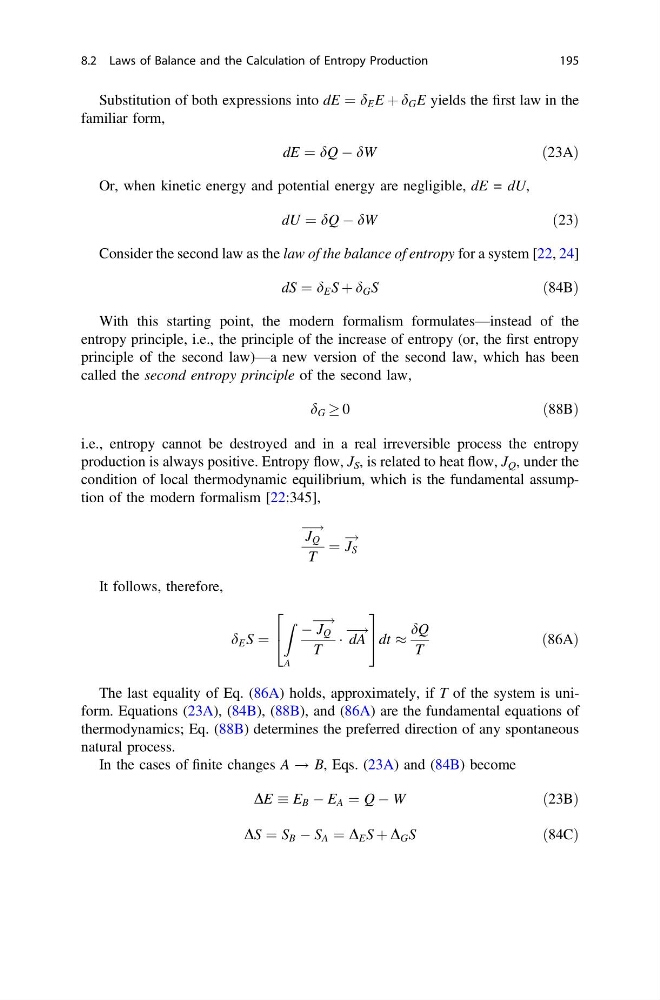
Substitution of both expressions into dE ¼ d E E þ d G E yields the first law in the
familiar form,
dE ¼ dQ À dW
ð23AÞ
Or, when kinetic energy and potential energy are negligible, dE = dU,
dU ¼ dQ À dW
ð23Þ
Consider the second law as the law of the balance of entropy for a system [22, 24]
dS ¼ d E S þ d G S
ð84BÞ
With this starting point, the modern formalism formulates—instead of the
entropy principle, i.e., the principle of the increase of entropy (or, the first entropy
principle of the second law)—a new version of the second law, which has been
called the second entropy principle of the second law,
d G ! 0
ð88BÞ
i.e., entropy cannot be destroyed and in a real irreversible process the entropy
production is always positive. Entropy flow, J S , is related to heat flow, J Q , under the
condition of local thermodynamic equilibrium, which is the fundamental assumption of the modern formalism [22:345],
J Q
!
T
¼ J S
!
It follows, therefore,
d E S ¼
Z
A
À J Q
!
T
Á dA
!
2
4
3
5 dt %
dQ
T
ð86AÞ
The last equality of Eq. (86A) holds, approximately, if T of the system is uniform. Equations (23A), (84B), (88B), and (86A) are the fundamental equations of
thermodynamics; Eq. (88B) determines the preferred direction of any spontaneous
natural process.
In the cases of finite changes A ! B, Eqs. (23A) and (84B) become
DE E B À E A ¼ Q À W
ð23BÞ
DS ¼ S B À S A ¼ D E S þ D G S
ð84CÞ
8.2 Laws of Balance and the Calculation of Entropy Production
195
familiar form,
dE ¼ dQ À dW
ð23AÞ
Or, when kinetic energy and potential energy are negligible, dE = dU,
dU ¼ dQ À dW
ð23Þ
Consider the second law as the law of the balance of entropy for a system [22, 24]
dS ¼ d E S þ d G S
ð84BÞ
With this starting point, the modern formalism formulates—instead of the
entropy principle, i.e., the principle of the increase of entropy (or, the first entropy
principle of the second law)—a new version of the second law, which has been
called the second entropy principle of the second law,
d G ! 0
ð88BÞ
i.e., entropy cannot be destroyed and in a real irreversible process the entropy
production is always positive. Entropy flow, J S , is related to heat flow, J Q , under the
condition of local thermodynamic equilibrium, which is the fundamental assumption of the modern formalism [22:345],
J Q
!
T
¼ J S
!
It follows, therefore,
d E S ¼
Z
A
À J Q
!
T
Á dA
!
2
4
3
5 dt %
dQ
T
ð86AÞ
The last equality of Eq. (86A) holds, approximately, if T of the system is uniform. Equations (23A), (84B), (88B), and (86A) are the fundamental equations of
thermodynamics; Eq. (88B) determines the preferred direction of any spontaneous
natural process.
In the cases of finite changes A ! B, Eqs. (23A) and (84B) become
DE E B À E A ¼ Q À W
ð23BÞ
DS ¼ S B À S A ¼ D E S þ D G S
ð84CÞ
8.2 Laws of Balance and the Calculation of Entropy Production
195